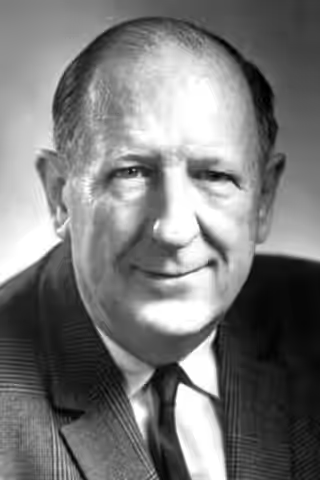
Paul Ford spent his screen career as the man in charge who has lost control of the situation, and he did it with more conviction than almost anyone. The joke is a good one. The trouble is that he was rarely given a second act to it.
Fi1m perspective
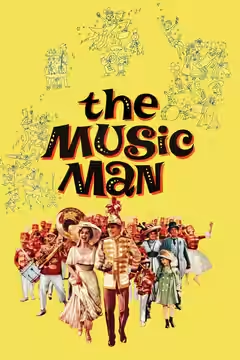
Mayor George Shinn stands up to make an announcement and the sentence leaves him partway through. The face knows before the mouth does. He pushes on anyway, because a mayor cannot stop talking simply because he has nothing left to say, and the town waits for him to finish with the patience of people who have heard this before. That is Paul Ford's whole act in The Music Man (1962), and for the first hour it is one of the best things in the film.
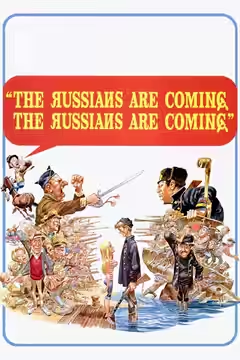
He came to it late. Ford was a salesman, and then a writer and performer of puppet shows for the WPA in the Depression, and he did not act professionally until his late thirties; Broadway came in the mid-1940s, with Another Part of the Forest and Command Decision. The part that made him was Colonel John T. Hall on The Phil Silvers Show (1955–1959), the flustered commanding officer opposite Silvers, and he was fifty-four when it started. The 1960s films followed the same line: Shinn, Colonel Wilberforce in It's a Mad, Mad, Mad, Mad World (1963), Fendall Hawkins raising a militia out of the bar in The Russians Are Coming, the Russians Are Coming (1966). Advise & Consent (1962) gave him a senator to play straight. He retired in the early 1970s.
What he did was pomposity from the inside. Most actors play a blowhard by shouting; Ford played him by believing every word, so the comedy came from watching a man's dignity fail him while he stood perfectly still. The trick was in the voice, a low, aggrieved rumble, and in the body, which stayed planted while everything above the collar went into a mild panic. On the Silvers show he was known to lose his lines and bluster through the gap, which for a man playing Colonel Hall hardly counts as a fault.
The limit is that it is one trick. We laughed hard at Shinn in the first hour, and by the third act of The Music Man we were waiting for the sentences to stop collapsing, which is not something we expected to feel about a joke that good; Morton DaCosta and Marion Hargrove repeat him rather than develop him. In The Russians Are Coming he and Jonathan Winters make most of the noise in a film that already has too much, and once Norman Jewison has sent the islanders up and down the same street for the twentieth time, Ford's sword is one more thing in the frame.
Start with the first hour of The Music Man, where he is given room and Hermione Gingold to work against, and see The Russians Are Coming for the scene in the bar. He spent his best years playing men who should never have been put in charge, and nobody did it with more certainty.
Biography
Paul Ford, born Paul Ford Weaver, was an American character actor. He was born in Baltimore, Maryland, on 2 November 1901 and died in Mineola, New York, on 12 April 1976.
He specialised in comic portrayals of authority figures. He played Colonel John T. Hall opposite Phil Silvers in the television series The Phil Silvers Show (1955–1959) and appeared on Broadway in The Teahouse of the August Moon (1953) before replacing David Burns as Mayor George Shinn in the musical The Music Man (1957). He reprised the role in the 1962 film adaptation.
Ford's other screen credits include It's a Mad, Mad, Mad, Mad World (1963), Advise & Consent (1962), The Russians Are Coming, the Russians Are Coming (1966) and The Comedians (1967). He received a Tony Award nomination for Never Too Late (1962).