Paul W. S. Anderson builds a room, puts people in it and lets the walls try to kill them. When the space is small and the people are few, it works. Add a squad and a franchise and it becomes a level to be cleared.
Fi1m perspective
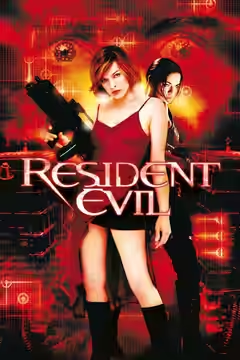
The best thing Paul W. S. Anderson has put on screen is a corridor. It is in Resident Evil (2002), deep in an underground laboratory called the Hive, and for a couple of minutes the film stops being about soldiers and zombies and becomes about a space that wants the people in it dead. That is his gift. He thinks in rooms: sealed ships, tunnels, arenas, places with rules and traps. Bodies move through them and the camera always knows where everything is. When he is good, you could draw the floor plan afterwards.
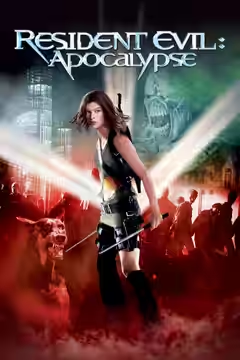
The career has been steady rather than various. He started with Shopping (1994), had a hit with Mortal Kombat (1995), which was a video game, and he has kept adapting games ever since. Event Horizon (1997) and Soldier (1998) came and went. Then Resident Evil in 2002, and a series he directed four times, the first, fourth, fifth and sixth films between 2002 and 2016, writing and producing the rest. Around it: Alien vs. Predator (2004), Death Race (2008), The Three Musketeers (2011), Pompeii (2014), Monster Hunter (2020). Milla Jovovich has been in seven of his films; Jeremy Bolt has produced ten. He knows what he does and who he does it with.
What works is the geometry. What does not is everyone standing in it. Our complaint about Resident Evil was that it had one superb corridor and a hundred minutes of soldiers walking down the others, and that the zombies were the least frightening thing in the building. We were bored through the middle forty minutes, and the reason was plain: nobody in the film is ever alone. The game's fear was a locked door with only you on the wrong side. Anderson replaced that with a squad and rifles, and a rifle turns a monster into a target. The set is designed with care, the people inside it are written in a glance, and when they die we check our watches rather than our pulses.
He has said he approaches these games "first and foremost as a fan", and it shows in both directions: he knows what a player wants to see, and he mistakes seeing it for caring about it. Jovovich is his best argument. She was better than her lines in Resident Evil, and he keeps giving her lines to be better than. What she brings to his films is a woman who can walk through one of his rooms and look as if she knows where she is going.
If you want the case for him, Event Horizon is where we would send you: a small crew inside a place that has gone wrong, and the place doing the work. It is the film in which the room is frightening and the people are few. He has made bigger sets since and had less patience in them. The next one will be handsome and quick and will have a room in it we remember. We would settle for one person in that room we minded losing.
Biography
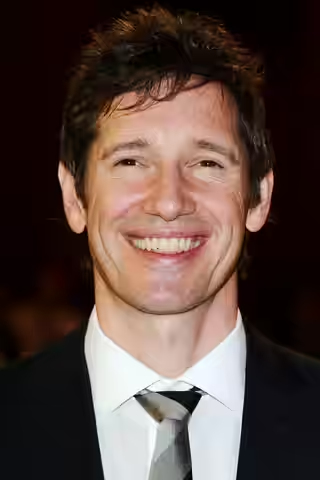
Paul W. S. Anderson is an English film director, screenwriter and producer. Born on 4 March 1965 in Wallsend, England, he graduated from the University of Warwick with a degree in film and literature. He co-founded Impact Pictures with producer Jeremy Bolt in 1992.
Anderson made his feature directorial debut with Shopping (1994), which he also wrote. He achieved commercial success with the video game adaptation Mortal Kombat (1995) and directed the science fiction film Event Horizon (1997). He is best known for his contributions to the Resident Evil series, serving as director, writer and producer on Resident Evil (2002) and Resident Evil: The Final Chapter (2016). He has also directed Alien vs. Predator (2004), Death Race (2008) and Monster Hunter (2020).
Anderson is married to actress Milla Jovovich.