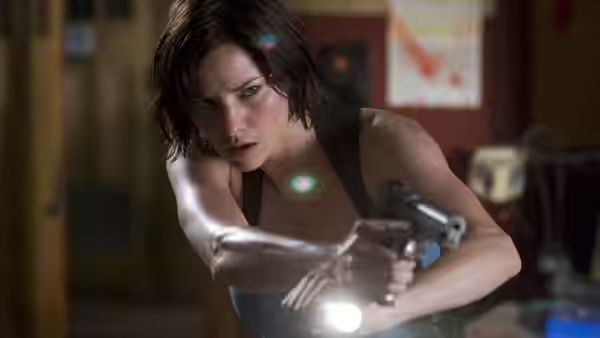
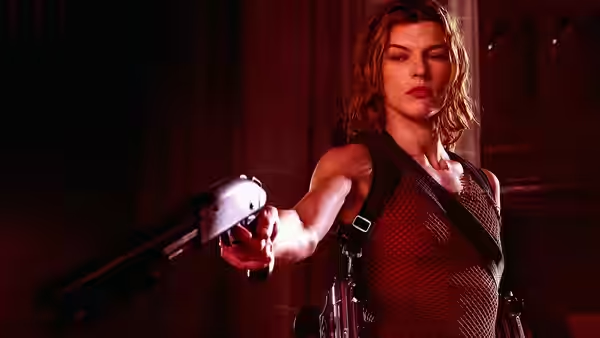
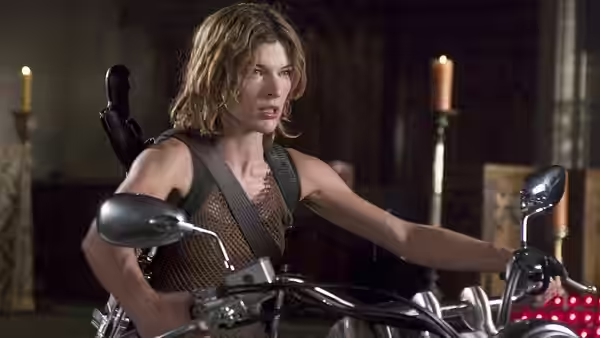
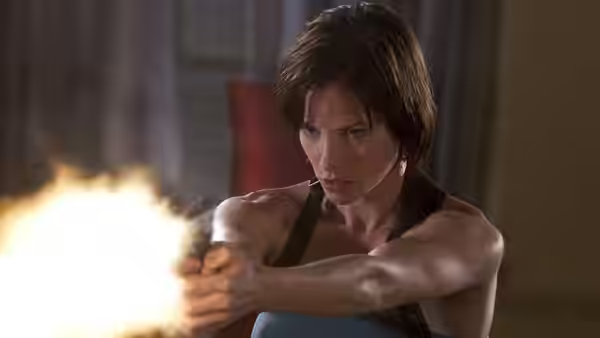
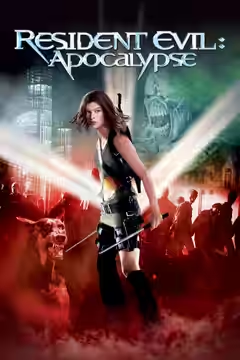
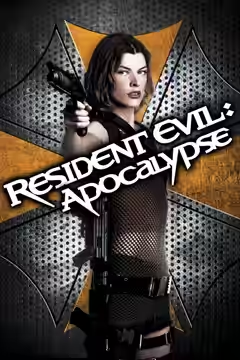
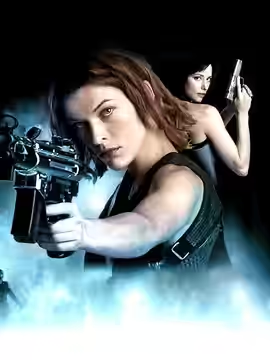
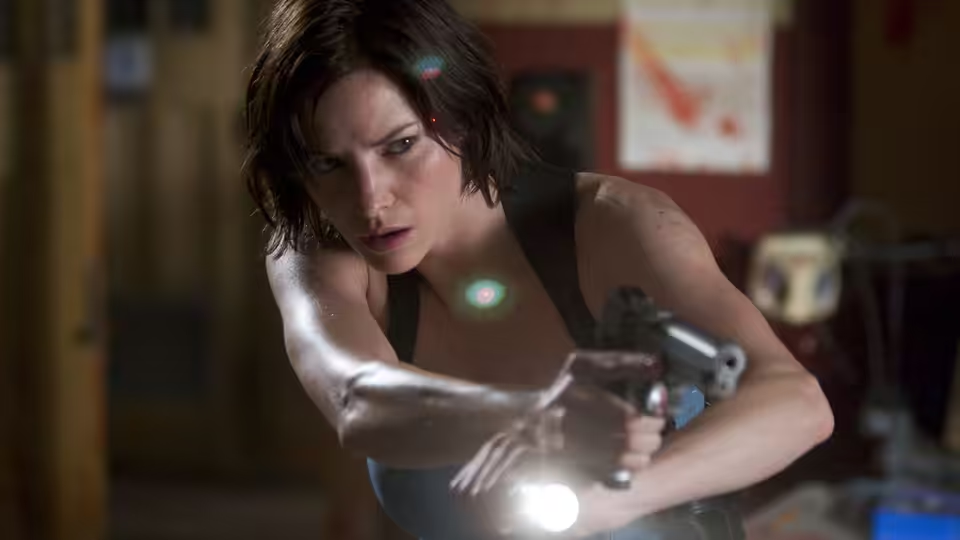
Alice (Milla Jovovich) aiming a pistol with attached flashlight
Film review

Resident Evil: Apocalypse

2004 · Directed by Alexander Witt · 1h 34m · MPA R

In a sentenceNinety-four minutes of gunfire in the rain, about half of it visible

Raccoon City, a company town built over the Umbrella Corporation’s underground laboratory, the Hive. When the corporation reopens the sealed facility, the T-virus escapes and the dead begin walking the streets. Umbrella closes the bridges and puts armed men on the gates. Left inside are Jill Valentine (Sienna Guillory), a suspended police officer who knows what the shambling figures are before her colleagues do; Carlos Olivera (Oded Fehr), an Umbrella soldier abandoned by his employer; L.J. (Mike Epps), a civilian keeping his head down; and Terri Morales (Sandrine Holt), a television reporter with a camera. At the bridge, Major Cain (Thomas Kretschmann) orders the crowds turned back. In a hospital, Alice (Milla Jovovich) wakes, dresses, and goes out to find the city already lost.

Fi1m review

Alexander Witt lets the virus out of the laboratory and into Raccoon City, then shoots the city at night in the rain. Milla Jovovich is game, the church set piece is daft fun, and the rest is noise in the dark.

The first Resident Evil, in 2002, kept its zombies in a laboratory under the ground, and whatever else you thought of it the walls gave it a shape. Paul W. S. Anderson directed that one; here he writes and produces and hands the chair to Alexander Witt, directing a feature for the first time. The virus is out of the Hive and into Raccoon City above, which is the obvious sequel, and the obvious problem comes with it. A city is bigger than a corridor and needs more filling. Witt fills it with rain, gunfire and a great deal of darkness, and at 94 minutes the film still feels padded.

The set-up is sound. The Umbrella Corporation seals the bridges, leaves its own soldiers inside with the civilians, and we watch what comes out. Jill Valentine (Sienna Guillory) gets a good entrance, walking into a police station and shooting a man her colleagues are still trying to reason with. Carlos Olivera (Oded Fehr) is the decent soldier whose employer has stopped answering the radio. Alice (Milla Jovovich) arrives late, wakes in a hospital, and plays the rest of the film as someone who has read the script and is waiting for everyone else to catch up. That is not a complaint. She is the only performer who seems to know what kind of film she is in.

The church is the reason to stay. Jill, Terri Morales (Sandrine Holt) and Sgt. Peyton Wells (Razaaq Adoti) take shelter among the pews and find that something faster than a zombie has got into the rafters first; then Alice comes through the stained glass on a motorbike. We laughed out loud, and then laughed again when Witt held the pause long enough to tell us he wanted us to. Jeff Danna’s score, guitars and drum machines, is right for once, the one stretch where the noise and the picture agree. Paul Denham Austerberry’s production design gives the police station, the graveyard and the school the exact look of the game with the detail turned up, and for ten minutes the film is the cheerful rubbish it wants to be.

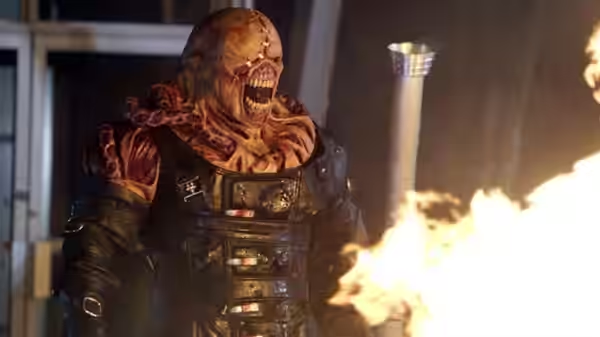
Then the lights go down and stay down. Derek Rogers and Christian Sebaldt shoot nearly everything at night, in rain, with the lamps behind the actors, so the dead are silhouettes and the fights are flashes. Eddie Hamilton cuts those fights into pieces a second or two long. Put the two together and a woman fighting a monster becomes a sequence of sounds with the occasional face. There is a long fall down the side of a building that should be the best stunt in the film and is instead a dark shape passing dark windows. We were bored, and then we were cross about being bored, because the film keeps promising to show us something and then turning the lights down.

The people do not help. Thomas Kretschmann’s Major Cain says the word Umbrella as if it were a rank and is given nothing else. Jared Harris, as Dr. Ashford, a father in a wheelchair watching his daughter Angie (Sophie Vavasseur) on a bank of monitors, brings more worry to the part than Anderson wrote into it. Mike Epps’s L.J. gets a laugh about one time in three, which is a better rate than the dialogue manages elsewhere. Nobody here has a relationship with anybody. They meet, they shoot, they run to the next building.

As a zombie film it is not frightening once, which is a strange thing to say of a 15 certificate with this body count. The violence happens in the dark or just off the edge of the frame, and the infected are extras in grey paint who wait politely to be shot. George Romero’s Dawn of the Dead, in 1978, used a shopping centre to say something about shoppers. Anderson’s Raccoon City is a map with levels on it, and the film moves through them in order. Mary E. McLeod’s costumes, the tactical black and the short blue skirt, are the game’s, and they are worn by people the film never asks us to mind about.

Most critics have been unkind and we are only a little kinder. If you liked the first film, this is the same meal with larger portions and the lights turned off. Watch it at home with the curtains drawn and the brightness up, which is the only way to see what the money went on.

Critical consensus AI synthesised

40
Positive
1
Mixed
1
Negative
9
Slant Magazine
11 September 2004
75*

Witt’s rambunctious sequel is equally excessive, idiotic, and enjoyable as the first film, with a superficial broads-and-bullets extravaganza that proudly wears its stupidity on its sleeve. The critic singles out the adrenalized techno-metal score, Jovovich’s sultry intensity, and Witt’s muscular action choreography as elements that keep the brain-dead film heartily alive.

Read the full review →
The AV Club
14 September 2004 · Nathan Rabin
65*

The sequel benefits from low expectations as a follow-up to a mediocre video-game adaptation and ultimately delivers enough B-movie thrills to be worthwhile. It takes too long to ignite but peaks with strong action sequences featuring Jovovich battling the monster Nemesis and a clever cynical twist at the end.

Read the full review →
Empire
· Chris Hewitt
44*

The sequel does nothing to improve on the original and is undone by its first-time director's poor handling of action and plot. Alice remains kick-ass but the film lacks any emotional connection to its characters.

Read the full review →
Los Angeles Times
10 September 2004 · Kevin Crust
40*

The film plays so much like a videogame that viewers will reach for a joystick, but without an interactive element it offers only a few glimmers of undead fun and the ever-watchable Milla Jovovich. The director provides visual razzle-dazzle but the pace deadens when zombies are offscreen.

Read the full review →
Total Film
8 October 2004
38*

The film is tedious and inept in marginally different ways to the original, with a worse script despite slightly better direction. It is a soulless, scare-free zombie drone that exploits its fanbase.

Read the full review →
The Times
7 October 2004 · James Christopher
30*

The critic calls this the deeply inferior sequel to the first film. A corrupt biotech corporation unleashes zombies in Raccoon City, forcing Milla Jovovich and Sienna Guillory to fight their way out amid exploding skyscrapers.

Read the full review →

Straight answers AI written, from our review

Is Resident Evil: Apocalypse worth watching?
Resident Evil: Apocalypse is not worth an evening unless you liked the first film and want more of the same with the lights turned off, and we scored it 43. The church set piece is daft fun and Milla Jovovich knows what kind of film she is in, but most of the fighting is shot so dark and cut so fast that it becomes noise. Watch it at home with the brightness up.
How long is Resident Evil: Apocalypse, and what is it rated?
Resident Evil: Apocalypse runs 1h 34m and is rated R by the MPA in the US. It is a horror and action film.
Where can I watch Resident Evil: Apocalypse in the US?
Resident Evil: Apocalypse is streaming on AMC+, The Roku Channel and Amazon Prime Video in the US, and it is also available to rent from Amazon Prime Video from $3.99. It leaves The Roku Channel on 1 October. Availability is checked daily; the links above go straight to each service.
How violent or frightening is Resident Evil: Apocalypse, and is it suitable for children?
Resident Evil: Apocalypse is a 15 in the UK and an R in the US, with a large body count, sustained gunfire and zombies, so it is not for children. Much of the violence happens in the dark or off the edge of the frame, and we did not find it frightening once. Teenagers used to video-game action will cope; the squeamish will mostly be watching silhouettes.
How does Resident Evil: Apocalypse compare to Resident Evil?
Resident Evil: Apocalypse is louder and larger than Resident Evil and the weaker film, because the first kept its zombies in corridors under the ground and the walls gave it a shape. Taking the virus into Raccoon City leaves more space to fill, and Alexander Witt fills it with rain and darkness. Newcomers should start with the first; only its admirers need the sequel.
What should I watch after Resident Evil: Apocalypse?
After Resident Evil: Apocalypse, try Resident Evil (2002, Fi1m 56): The corridor version: same corporation, same Alice, and walls that give it a shape. Then Train to Busan (2016, Fi1m 84): The outbreak film with people you mind about, on a train, in daylight.

Cast

If you liked this, try…

  1. Resident Evil (2002, Fi1m 56)The corridor version: same corporation, same Alice, and walls that give it a shape.

  2. Dawn of the Dead (2004) · not on Fi1m yetZack Snyder’s remake runs its zombies fast and lets you see them.

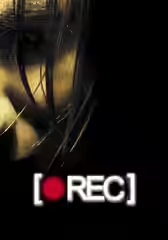
  3. [REC] (2007) · not on Fi1m yetOne Barcelona flat, one camera, and more fear than this whole city musters.

  4. Train to Busan (2016, Fi1m 84)The outbreak film with people you mind about, on a train, in daylight.

  5. Escape from New York (1981) · not on Fi1m yetA sealed city, a deadline and a reluctant hero, done on a fraction of the noise.