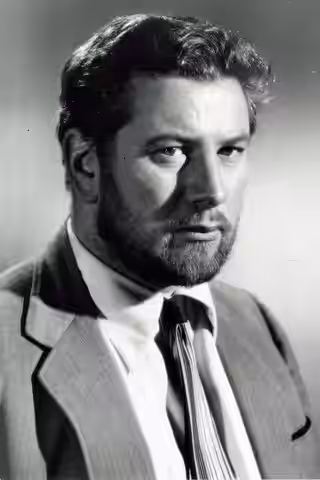
A large man who played men who wanted an audience and were afraid of losing it. Ustinov is funniest when the fear shows, in a Nero forever composing and in a drover who was once a sailor; ask him for plain sincerity and he can look foolish.
Fi1m perspective
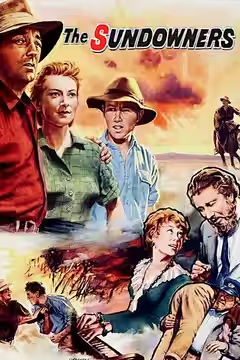
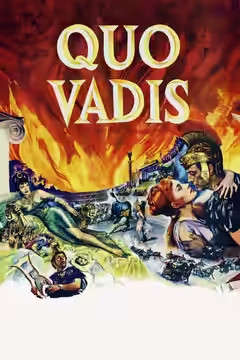
Nero in Quo Vadis (1951) finishes a verse of majestic badness, wet-eyed, and looks about the court for the applause. It comes, because the alternative is death, and Ustinov accepts it as though he had earned it. That look is the thing he did that other actors did not. His men perform for whoever happens to be watching, and somewhere behind the performance they are frightened of what happens when it stops. Nero fears the silence. Rupert Venneker in The Sundowners (1960), an ex-ship's officer who has decided not to be anything since, fears that being fond of people might commit him to staying with them.
He came up in British theatre and revue in the late 1930s, and the revue never left him: he had an ear for accents and dialects in several languages and used them. Nero made him a Hollywood character actor at thirty, and the 1960s were the run: the slave dealer Lentulus Batiatus in Kubrick's Spartacus (1960), Venneker the same year, Billy Budd (1962), which he adapted, directed and played Captain Vere in, and the thief Arthur Simon Simpson in Topkapi (1964). From Death on the Nile (1978) he was Hercule Poirot, six times, and for a generation that is who he was.
What works is the comedy, and it works best when someone else in the shot is not laughing. Leo Genn's Petronius flatters Nero in a voice so dry the flattery curdles, and Ustinov takes every insult as a compliment; Glynis Johns's Mrs Firth sets about Venneker with the directness of a woman who has run a bar for years, and Ustinov spends a beat working out whether he has just been insulted. He needs a straight face across the table. When Rome burns we laughed out loud, and not at him: he and Mervyn LeRoy put the ridiculousness and the danger of the man in the same shot, and the laugh has fright in it.
The old complaint is that he could not do intense feeling without looking foolish, and Quo Vadis is usually the exhibit. We half agree. The wet eyes over the poem are funny because they are sincere, and we are not sure Ustinov could have switched the joke off had a director asked. Few did. He was cast, for the rest of his career, as the eccentric in the corner of somebody else's epic, and he was too good at it to be offered much else.
He said drama was "an escape road from the dismal rat race of school", and he treated it like one. Start with Quo Vadis, at home, and walk through the middle hour; stay for every scene he is in. Then The Sundowners, where for once the film around him is as good-natured as he is. He was better in small doses in large films, which is roughly how he arranged things.
Biography
Peter Ustinov was an English actor, writer and director. He was born Peter Alexander Freiherr von Ustinow on 16 April 1921 in Camden, London, and died on 28 March 2004.
Ustinov made his screen debut in the 1940s and appeared in numerous films and television productions. He played the Roman emperor Nero in Quo Vadis (1951), a performance that earned him a Golden Globe Award for Best Supporting Actor and an Academy Award nomination. He later won Academy Awards for Best Supporting Actor for his roles in Spartacus (1960) and Topkapi (1964).
He was also known for playing Hercule Poirot in several films, including Death on the Nile (1978) and Evil Under the Sun (1982), and for voice work such as Prince John in the animated Robin Hood (1973).