Robert Preston spent his best years playing men who were selling something and letting you know they knew it. Hollywood kept him in B-picture leads and villains in the epics for the best part of twenty years; the stage worked out what he was for.
Fi1m perspective
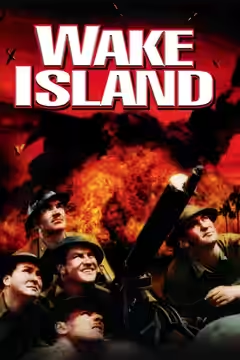
In Wake Island (1942) Robert Preston is Private Joe Doyle, one of two Marines who cannot be in the same room without hitting each other. William Bendix is the other, counting the days to the end of his hitch, and the routine runs a scene or two longer than it needs to. We laughed at the pair of them, more at Bendix than at Preston if we are honest, and then the raids began and John Farrow turned the laughter against us. Preston's job in that film is to be the quick one, the man with the answer, and he does it without asking for the frame. It is a fair sample of what Hollywood thought he was for.
Which was not a great deal. Paramount signed him in 1938 out of the Pasadena Community Playhouse and put him into Westerns and adventures, Union Pacific and Beau Geste in 1939 among them, and into three films for Cecil B. DeMille. He was away for the war, came back to freelance work that led nowhere in particular, and gave the best account of the period himself: "I played the lead in all the 'B' pictures and the villain in all the epics." After a while, he said, it was clear to him he had reached what he was going to be in films. In 1951 he went to Broadway instead.
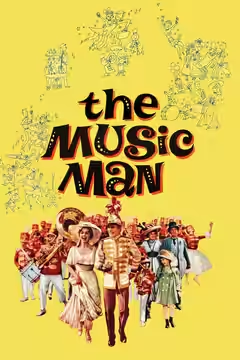
That is where he found the part he had been playing all along. Harold Hill in The Music Man, on stage in 1957 and on film in 1962, is a salesman with nothing behind the sample case, and Preston took him on with almost no singing experience to speak of. What he had instead is the thing critics have noticed ever since: the con man who lets you see he knows he is one, and is forgiven for it. He had a Western hero's build and a comedian's timing, and until Hill nobody had thought to use both at once.
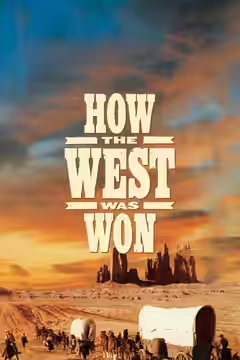
Films took him back after that, in supporting parts built on the same footing: Roger Morgan in How the West Was Won (1962), Ace Bonner for Sam Peckinpah in Junior Bonner (1972), and Carroll "Toddy" Todd in Victor/Victoria (1982), one of two films he made with Blake Edwards. The Edwards part is the one people mean now when they say his name, and the reason is the one that was already there in 1942: a man putting on an act and telling you so. His last film was The Last Starfighter (1984), in which he plays Centauri, a recruiter from another planet talking a boy into a job. He finished as a salesman.
Start with Hill if you want him at full stretch. Start with Doyle hitting Bendix if you want to see what the studio had on the payroll for twenty years and did not notice.
Biography
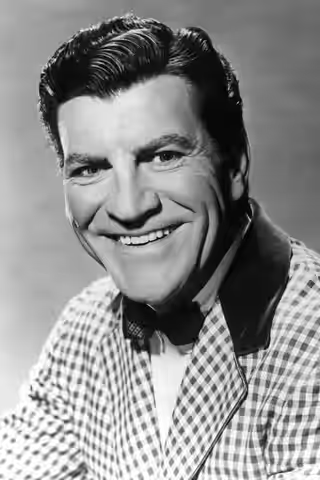
Robert Preston (born Robert Preston Meservey) was an American stage and film actor and singer. He was born on 8 June 1918 in Newton Highlands, Massachusetts, and died on 21 March 1987 in Montecito, California.
He began his career in the late 1930s with Paramount, appearing in films such as Beau Geste (1939), Union Pacific (1939) and Wake Island (1942) as Pvt. Joe Doyle. After military service in the US Army Air Forces during the Second World War, he focused more on stage work.
Preston originated the role of Professor Harold Hill in the 1957 Broadway musical The Music Man, winning a Tony Award for Best Actor in a Musical; he reprised it in the 1962 film adaptation. He received a second Tony for I Do! I Do! (1966) and an Academy Award nomination for Best Supporting Actor for his performance in Victor/Victoria (1982).