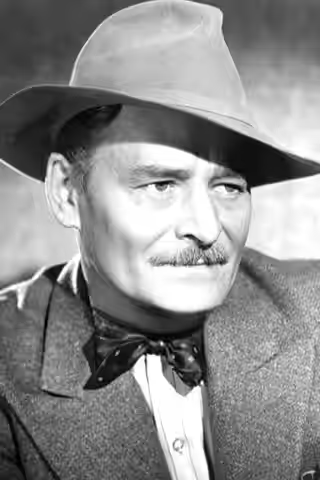
Roman Bohnen spent his career playing men older than he was, sitting at the edge of other people's scenes and thinking where the script gave him no words. Watch Of Mice and Men to see how much an actor can do by keeping still.
Fi1m perspective
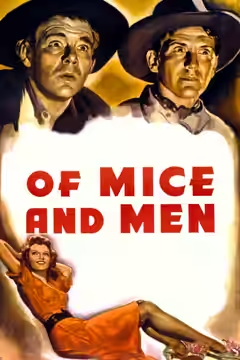
An old man with one hand sits on a bunk while two strangers describe a farm they will never own. He is not part of the conversation. Lewis Milestone keeps him in the shot anyway, and Roman Bohnen's face works out, without a line, whether there might be room in that future for him. Nobody underlines it, and the men go to bed. That is the Bohnen performance in small: a man at the edge of the frame doing the thinking the writers left out.
He came to pictures from the Group Theatre in New York, where he spent the second half of the 1930s in Clifford Odets plays and others, and the habit of playing as one of a company rather than as a lead never left him. Of Mice and Men (1939) was the film that made him a screen character actor, and by 1941 he was almost entirely in films. He was not yet forty when he played Candy and looked twenty years more. His face had aged early and the studios cast it accordingly: fathers, ranch hands, men who had been working for a long time. He made four films with Milestone, who knew what to do with him.
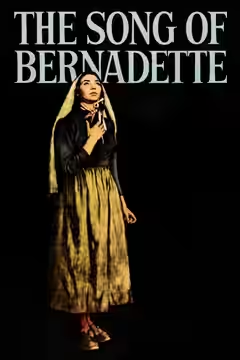
The Song of Bernadette (1943) gives him less and he does it the same way. His François Soubirous goes out each morning to look for a day's work and comes back without one, and Henry King's film is at its best in that opening half hour, before the visions, when it is simply about a family living in a disused jail and being cold. Bohnen plays poverty as routine rather than as tragedy, which is why it registers. Then the film runs a good hour too long and he mostly disappears from it, which is a fair picture of how the studios used him. The part most often cited for the same trick is Pat Derry in The Best Years of Our Lives (1946), a father with a few minutes of screen time; we have not reviewed it, but the reputation is for a whole man built in almost no time, and that squares with what we have seen. After the war the parts ran to authority, Warden Barnes in Brute Force (1947), Durand Laxart in Joan of Arc (1948).
We have seen the farm scene acted before and read it more often than that, and it still moved us more than we expected, and the reason was not Meredith or Chaney but the third man, listening from his bunk. The reservation, if there is one, is that the films rarely asked him for anything else. A face that old that early gets cast for its age, and he was seldom given the middle of a scene rather than its edge. Start with Of Mice and Men, and watch the man who is not talking.
Biography
Roman Bohnen was an American actor who worked in both theatre and film. Born in Saint Paul, Minnesota, he graduated from the University of Minnesota and began his career on the stage, becoming a member of the Group Theatre in New York from 1934 to 1940. He appeared in productions including Golden Boy, Awake and Sing! and The Gentle People.
Bohnen moved to Hollywood in the late 1930s. His film roles include Candy in Of Mice and Men (1939), François Soubirous in The Song of Bernadette (1943) and Pat Derry in The Best Years of Our Lives (1946). He was also active with the Actors' Laboratory Theatre. He died of a heart attack in Hollywood in 1949, aged 47.