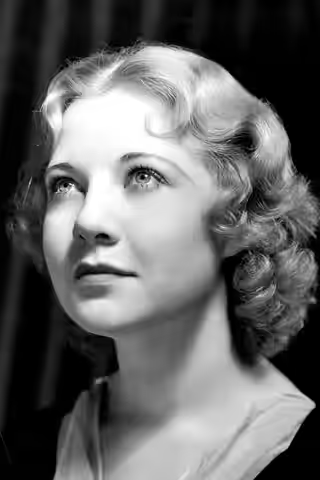
Una Merkel stood beside the star, in a Kentucky drawl, and said the second line. She did it in around a hundred films and almost never got the first one, which is the job, and the reason she is so easy to overlook.
Fi1m perspective
Look for Una Merkel in a 1930s musical and you will find her a step to the side of the leading lady, waiting for the drawl to land. She played the friend, the roommate, the chorus girl who had been in too many shows to be impressed by this one. The voice came from Covington, Kentucky, and she kept it, and directors cast her for it: a dry Southern sound that made a wisecrack seem to arrive a beat late and hit harder for the wait.
She began in silent films in the early 1920s, for a time as a stand-in for Lillian Gish, went to Broadway, where she appeared in Coquette (1927), and came back to Hollywood for D.W. Griffith's Abraham Lincoln (1930), playing Ann Rutledge. Then she became a busy MGM contract player, almost always in support. She made four films with Jean Harlow and two with Ginger Rogers, and turned up in the backstage musicals built around Eleanor Powell. The work thinned in the 1940s, though The Bank Dick (1940), with W.C. Fields, is in there. From the mid-1950s she came back, first on stage and then in films such as The Parent Trap (1961) and Summer and Smoke (1961), and took her last role in 1966. Around a hundred films in all, and she is the lead in very few of them.
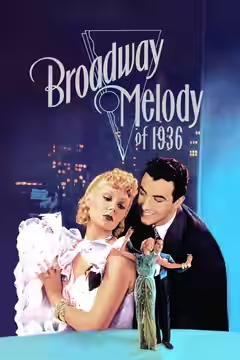
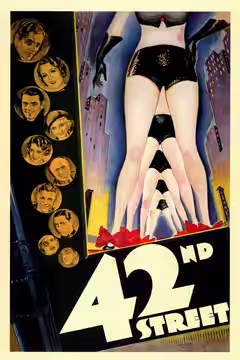
The two we have reviewed show the shape of the career. In 42nd Street (1933) she and Rogers are the chorus veterans who do the talking, and it is Rogers, in a monocle and a borrowed accent, who gets the sharpest lines. In Broadway Melody of 1936 (1935) she is half of a fast-talking comic couple with Sid Silvers, and Silvers, who co-wrote the script, gave himself most of the good ones. Twice, then, she is setting up the joke rather than telling it. We do not count that against her. Watching 42nd Street again, we caught ourselves looking at Merkel while Rogers talked, because her face was telling us how much of the accent to believe, and we laughed at the right moment because she had shown us where it was. That is a skill, and it is rarely noticed, which is the point of it.
The one scene of hers people remember is a fight. In Destry Rides Again (1939), playing Lily Belle, she takes on Marlene Dietrich, and the two of them did it without doubles. “All through the fight she’d whisper to me, ‘Are you all right?’” Merkel said in 1978. “We went at it tooth and nail.” For once she is the one the scene is about.
Start with 42nd Street, and this time watch the woman who is not talking. Then find Destry. The other ninety-odd are for the interested, and there are a great many of them.
Biography
Una Merkel (10 December 1903 – 2 January 1986) was an American stage, film, radio and television actress. Born in Covington, Kentucky, she began acting on Broadway in the 1920s and appeared in the long-running play Coquette (1927) with Helen Hayes.
She made her screen debut as Ann Rutledge in D.W. Griffith's Abraham Lincoln (1930) and became a Metro-Goldwyn-Mayer contract player, appearing in numerous supporting roles. Among her best-known performances are those in 42nd Street (1933), Destry Rides Again (1939), The Bank Dick (1940) and The Parent Trap (1961). Merkel won a Tony Award in 1956 for The Ponder Heart and received an Academy Award nomination for best supporting actress for Summer and Smoke (1961).