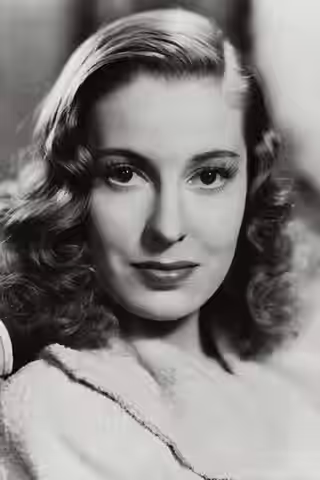
Valerie Hobson is at her best when she takes an absurd situation seriously. Her coolness suits high comedy, though we find her less persuasive when a film needs us to feel the hurt beneath good manners.
Fi1m perspective
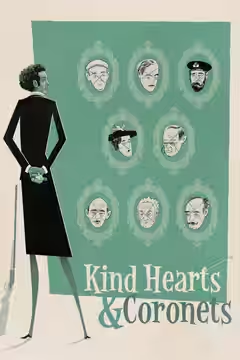
In Kind Hearts and Coronets (1949), Valerie Hobson's Edith D'Ascoyne gives Dennis Price a cooler presence to play against than Joan Greenwood's Sibella. Greenwood makes her dialogue sound considered in advance; Hobson is more reserved. We enjoyed the contrast, because it gives the scenes around Price a welcome change of pace. She plays the comedy straight, which is just what Robert Hamer's film needs. The film gives neither woman enough time to account for herself, though Louis has plenty.
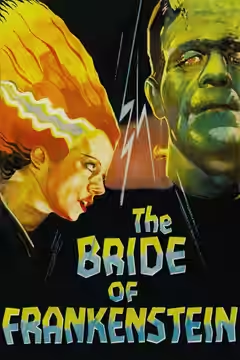
That seriousness was put to several uses before her postwar roles. After modest British films, she went to Hollywood in 1935, playing Elizabeth in Bride of Frankenstein (1935). Back in Britain, Michael Powell's The Spy in Black (1939) cast her as the School Mistress, one of her spirited thriller heroines. But frequent casting as upper-class women also made primness a familiar requirement, and left her with limited opportunities to show what else she could do.
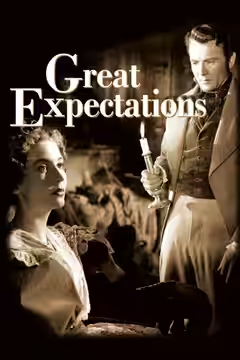
In David Lean's Great Expectations (1946), that reserve becomes a problem, and we find Hobson's Estella difficult to understand. Jean Simmons gives the younger Estella an assurance that makes Pip's uncertainty painful; when Hobson and John Mills take over, the romance cannot recover the awkwardness of those childhood scenes. Mills remains engaging, but the adult pairing asks us to supply feelings the performances have not made convincing. Walter Goehr's music provides warmth that the playing does not always earn. The settings and supporting performances are strong enough for us to recommend the film, but we would not send anyone to it chiefly for Hobson.
Later roles included the Countess of Chell opposite Alec Guinness in The Card (1952), while Knave of Hearts (1954) gave her further scope for subtle comedy. That is the part of her work we would follow first. Hamer makes better use of her severity than Lean does, allowing it to vary the company rather than carry a romance. Start with Kind Hearts and Coronets, and watch the woman who is not trying to be the most amusing person present.
Biography
Valerie Hobson (14 April 1917 – 13 November 1998) was a British actress whose film career ran from the 1930s to the early 1950s. Born Babette Louisa Valerie Hobson in Larne, County Antrim, Northern Ireland, she trained at the Royal Academy of Dramatic Art and began in dance before moving into acting. She appeared in Hollywood productions including Bride of Frankenstein (1935) and Werewolf of London (1935) before returning to Britain, where she took leading roles in films such as Great Expectations (1946) as Estella and Kind Hearts and Coronets (1949) as Edith D'Ascoyne.
Hobson was married first to film producer Sir Anthony Havelock-Allan from 1939 until their divorce in 1952, and then to MP John Profumo from 1954. She gave up screen acting after her final film role in 1954, though she appeared on stage as Anna Leonowens in the original London production of The King and I (1953). She later supported charitable work with her husband.