Vittorio De Sica’s patient attention to people with little to spare gives his neorealist films their force. We recommend Bicycle Thieves above all, for performances that make its account of poverty hard to shake.
Fi1m perspective
In Bicycle Thieves (1948), Antonio searches post-war Rome with his son Bruno for a stolen bicycle. Vittorio De Sica lets the search be interrupted by other people, by bureaucracy and by the time it takes to ask for help. We found it deeply upsetting because Antonio’s desperation makes clear how little he can afford to lose. De Sica gives a workman’s practical problem enough attention to make it matter to us, without inventing a larger crime to justify the film.
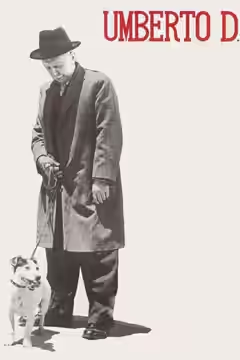
His directing began with comedies in 1940, before his collaboration with screenwriter Cesare Zavattini helped turn him towards neorealism. Their attention settled on small stories of poverty and dignity in post-war Italy. The sequence from Shoeshine (1946) through Miracle in Milan (1951) to Umberto D. (1952) includes street children, the dispossessed and an isolated elderly man. The fantasy of Miracle in Milan also makes clear that recording everyday life was not the only way he could approach such people.
The practical skill is clearest in Bicycle Thieves. Editor Eraldo Da Roma keeps the search easy to follow while allowing its encounters to delay it, so we register the wasted time without losing patience with the film. The non-professional cast and location work give Antonio and Bruno a convincing everyday presence, and De Sica allows humour into their difficulties without making light of them. There is room for ordinary foolishness alongside the desperation. The music is the weakness: it presses for an emotion that the performances have already made difficult to resist.
After Umberto D., De Sica returned to lighter, more commercial work. His later films include Two Women (1960), Yesterday, Today and Tomorrow (1963) and The Garden of the Finzi-Continis (1970). That change matters when choosing what to watch: his name does not always promise another account of post-war hardship made with non-professional actors. Start with Bicycle Thieves, preferably with someone who will not want to change the subject straight afterwards.
Biography
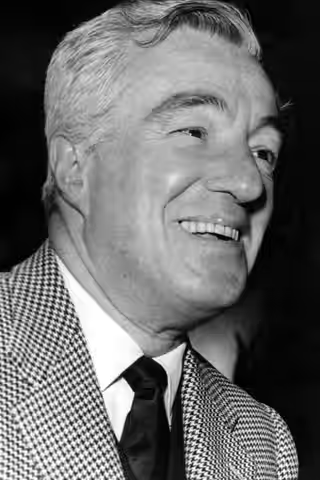
Vittorio De Sica (7 July 1901 – 13 November 1974) was an Italian film director and actor. Born in Sora, Lazio, he grew up in Naples and began his career as a stage actor in 1923, later becoming a leading man in Italian cinema during the 1930s. He made his directorial debut in 1940 with comedies and turned to more serious subjects with The Children Are Watching Us (1943).
De Sica is best known for his postwar neorealist films made in collaboration with screenwriter Cesare Zavattini, including Shoeshine (1946), Bicycle Thieves (1948), Miracle in Milan (1951) and Umberto D. (1952). He also directed Two Women (1960), Yesterday, Today and Tomorrow (1963), Marriage Italian Style (1964) and The Garden of the Finzi-Continis (1970). Four of his films received Academy Awards: honorary awards for Shoeshine and Bicycle Thieves, and Best Foreign Language Film for Yesterday, Today and Tomorrow and The Garden of the Finzi-Continis. He continued to act throughout his career and received an Oscar nomination for Best Supporting Actor for A Farewell to Arms (1957).