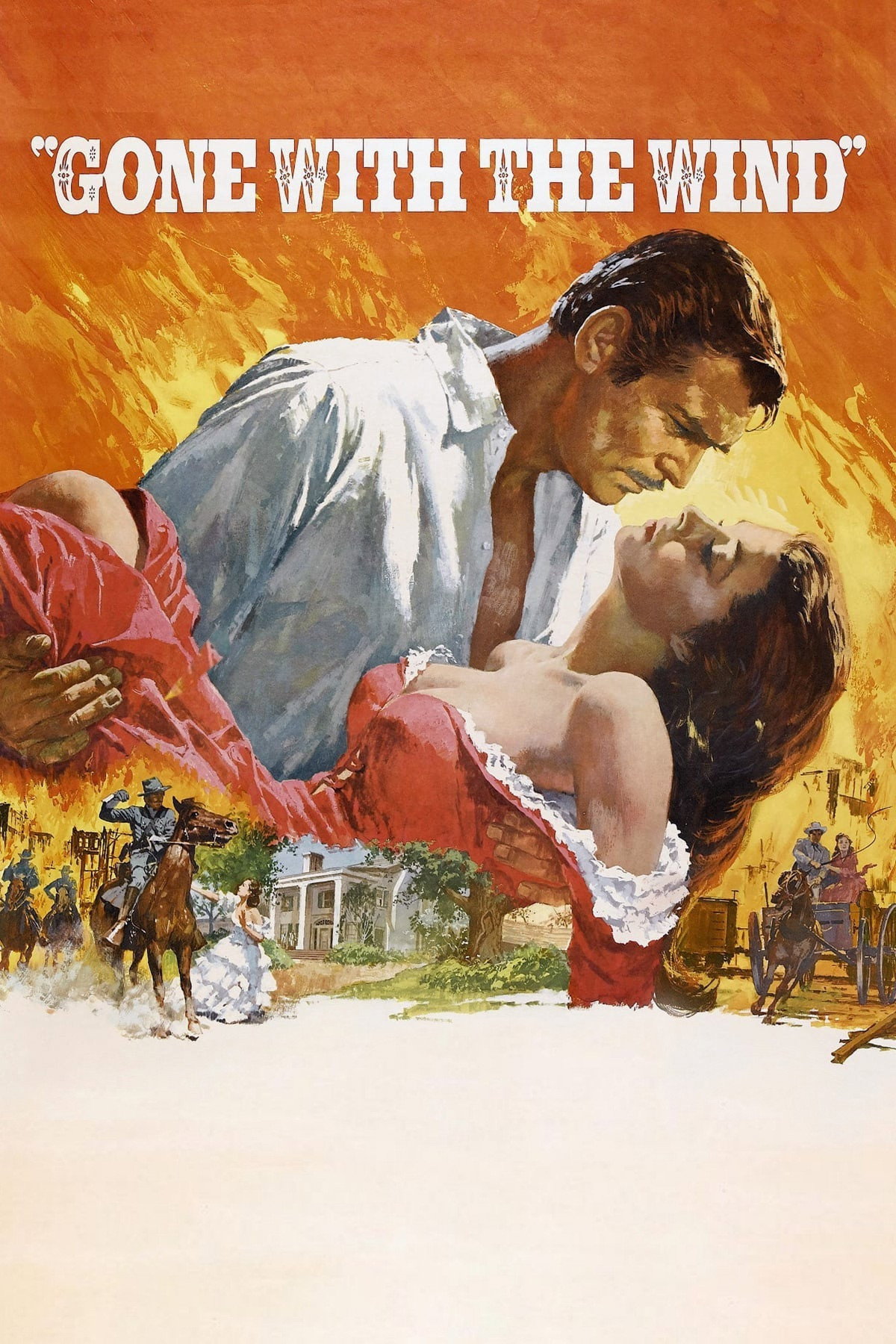
We value Vivien Leigh for the precision with which she makes selfishness absorbing. Her Scarlett O'Hara never needs to become nicer to hold our attention, though the film asks for more patience than even she can supply.
Fi1m perspective
Scarlett O'Hara wants attention, and Vivien Leigh lets us see how much work she puts into getting it. In Gone with the Wind (1939), the character's artificiality is part of the pleasure: Leigh does not smooth it away to make her a more agreeable romantic heroine. We enjoyed Scarlett's bad behaviour because Leigh commits to her selfishness without asking us to forgive it. Even when our sympathy has run out, she keeps us interested in what this woman will demand next.
Before Scarlett, she had gained notice in British films such as Fire Over England (1937), and stage work remained her main commitment even after international film stardom. Waterloo Bridge (1940), opposite Robert Taylor, and That Hamilton Woman (1941), with Laurence Olivier, kept her in romantic and historical drama. Blanche DuBois in A Streetcar Named Desire (1951) brought a different Southern belle, far more fragile than Scarlett. Later screen appearances were fewer and tended towards character parts.
The stage background matters to how she works on screen: an expressive face, quick changes of mood and an evident care over how a character presents herself. That care can be conspicuous, and some early and stage notices found her preparation more apparent than spontaneity or depth. In Scarlett, the calculation is appropriate, because making an impression is so much of what she wants. Victor Fleming's direction gives this selfish woman's romantic troubles the weight of a war drama, and Leigh is strong enough to justify much of that attention. She does not have to make Scarlett deserving.
At 238 minutes, Gone with the Wind gives even this performance too much room. Its second half lets Scarlett's troubles drag, and Leigh cannot make every extension of them necessary. The woman who keeps us curious can also be exhausting company over such a stretch. Start there for Leigh, but leave a long evening free.
Biography
Vivien Leigh was a British actress. Born Vivian Mary Hartley on 5 November 1913 in Darjeeling, India, she trained at the Royal Academy of Dramatic Art in London.
She made her film debut in 1934 and appeared in British productions including Fire Over England (1937). Her breakthrough came with the role of Scarlett O'Hara in Gone with the Wind (1939), for which she received the Academy Award for Best Actress. She won a second Academy Award for her performance as Blanche DuBois in A Streetcar Named Desire (1951).
Leigh frequently collaborated with Laurence Olivier, to whom she was married from 1940 to 1960. Other notable films include Waterloo Bridge (1940), That Hamilton Woman (1941), Anna Karenina (1948) and Ship of Fools (1965). She died in London in 1967.