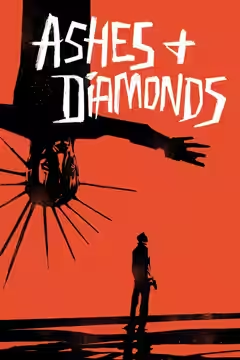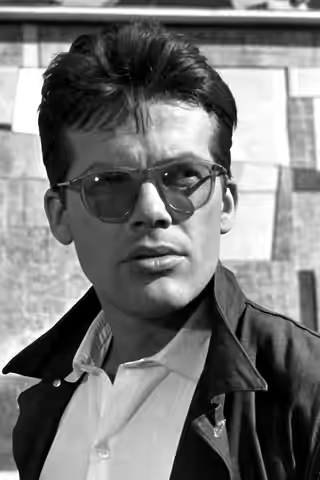
Zbigniew Cybulski makes defiance feel awkward, vulnerable and recognisably human. We value the warmth beneath his restless gestures, though the rebel image established by Ashes and Diamonds could leave later performances repeating familiar habits.
Fi1m perspective
The dark glasses in Ashes and Diamonds (1958) make Maciek Chełmicki harder to read, but Zbigniew Cybulski keeps us looking for the uncertainty behind them. He is particularly good at the discomfort of being around other people. Maciek has the appearance of a rebel without the easy assurance that might make him tiresome company. We rate Cybulski for making that awkwardness worth watching, and for the warmth that survives his characters’ sharper edges.
Andrzej Wajda gives that performance room, especially in the romance, where Maciek is allowed wants of his own. We were moved by the vulnerability behind those dark lenses, because Cybulski makes them seem like something this man needs rather than an accessory chosen to impress us. The film is less persuasive when its heavy symbolism explains what he has already conveyed. Wajda gets a fine performance from him, then occasionally seems unwilling to let it speak for itself.
He had already played a small part in Wajda’s A Generation (1955), but Ashes and Diamonds made him a star. It also gave him an image that later work struggled to escape, with attempts at different parts meeting resistance from audiences and critics. He co-wrote Goodbye, See You Tomorrow (1960), drawing on his student theatre years for something lighter and more personal. How to Be Loved (1963) cast him as the selfish Wiktor Rawicz. Wojciech Has’s The Saragossa Manuscript (1965) gave him the lead in a costume fantasy, another reason not to treat Maciek as the limit of his work.
The nervous, unfinished gestures and sudden shifts from calm to intensity could make his acting feel spontaneous. They could also become habits: some later performances were criticised for mannerism and repetition. He was also being asked to embody youthful rebellion as he grew older. Start with Ashes and Diamonds, but follow it with How to Be Loved before deciding that defiance was all he could do.
Biography
Zbigniew Cybulski was a Polish actor. He was born on 3 November 1927 in Kniaże, Poland (now in Ukraine), and died on 8 January 1967 in Wrocław, Poland.
After the Second World War he trained at the Theatre Academy in Kraków, graduating in 1953. He made his stage debut at the Wybrzeże Theatre in Gdańsk and, with Bogumił Kobiela, founded the student theatre Bim-Bom. In the early 1960s he moved to Warsaw and worked at the Ateneum Theatre and Kabaret Wagabunda.
Cybulski appeared in more than thirty films. He is best known for his role as Maciek Chełmicki in Andrzej Wajda's Ashes and Diamonds (1958). Other notable screen roles include Kostek in A Generation (1955), Staszek in Night Train (1959), Edmund in Innocent Sorcerers (1960), Zbyszek in the Warsaw segment of Love at Twenty (1962), and Alfonse Van Worden in The Saragossa Manuscript (1965).