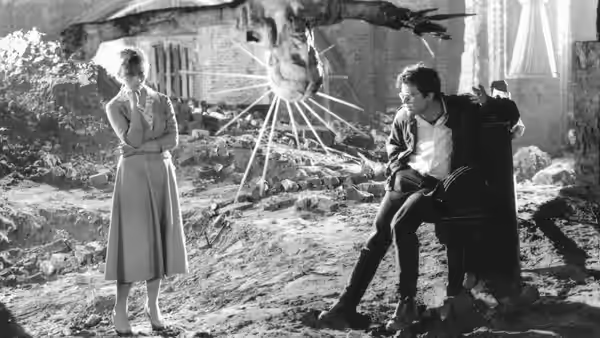
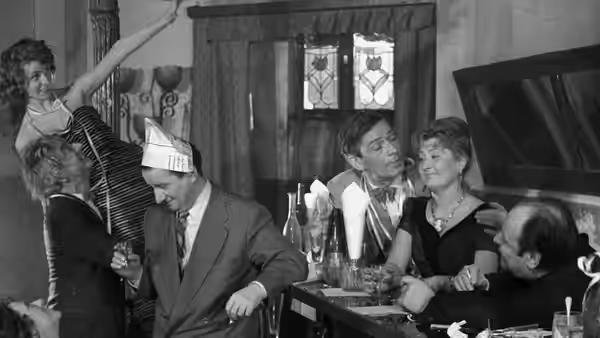
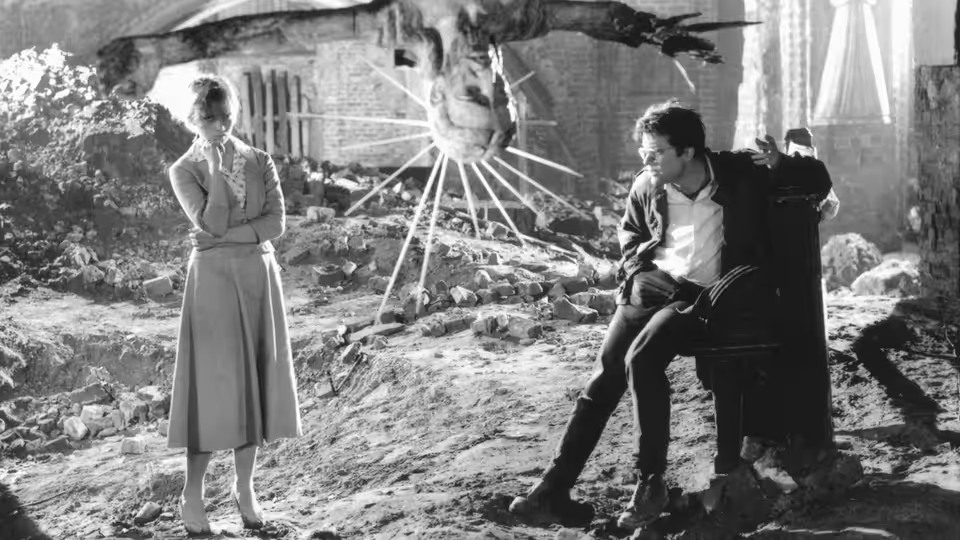
A woman stands among rubble while a young man sits in a chair nearby
Film review

Ashes and Diamonds

1958 · Directed by Andrzej Wajda · 1h 43m

In a sentenceWe would follow Zbigniew Cybulski through considerably more symbolism than this

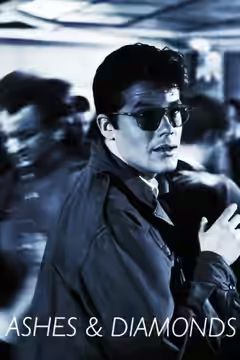
In Poland after the war, Maciek Chełmicki (Zbigniew Cybulski) faces a peace that brings little certainty. Around him are Krystyna Rozbicka (Ewa Krzyżewska), Szczuka (Wacław Zastrzeżynski) and Andrzej Kossecki (Adam Pawlikowski). Hotel interiors, smoke and alcohol form the surroundings as personal relationships become entangled with the country’s unsettled future. Maciek’s dark glasses conceal his eyes in a society where people’s loyalties matter. Romance shares space with political unease, while the drinking and awkward company bring moments of farce into lives still marked by war.

Fi1m review

Andrzej Wajda’s postwar drama is moving and occasionally overemphatic. Zbigniew Cybulski gives it the vulnerable human centre it needs, though the heavy symbolism sometimes insists on explaining what his performance has already made clear.

Andrzej Wajda’s Ashes and Diamonds is a moving war drama whose symbols sometimes get in the way of its people. We recommend it for Zbigniew Cybulski, who gives Maciek Chełmicki enough awkward humanity to resist being reduced to an illustration of Poland’s troubles. The country is emerging from war, but the film finds little reassurance in that fact. It approaches the uncertainty through drink, uneasy company and a performance that makes the political tensions feel painfully personal.

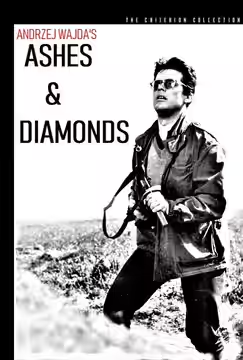
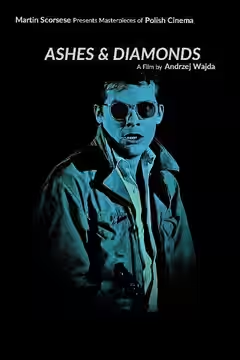
The dark glasses are the most obvious example of the film finding something tangible for its anxieties. They give us a face we cannot quite read, and the performance makes that difficulty matter: we keep trying to decide how much Maciek is concealing, even from himself. We were moved by the vulnerability Zbigniew Cybulski conveys behind those dark lenses. The glasses could have been an easy statement about youth and estrangement. He makes them feel like something this particular man needs to wear.

Jerzy Wójcik’s photography gives the hotel interiors a density that repays looking, even when the drama is asking us to concentrate on a face. Roman Mann’s production design helps make the hotel feel like a place where other people’s business is difficult to escape. The smoke and alcohol offer little sense of comfort; even company can feel oppressive here. These surroundings work better than some of the more insistent symbolism, because they let us feel the strain without having to identify an emblem for it.

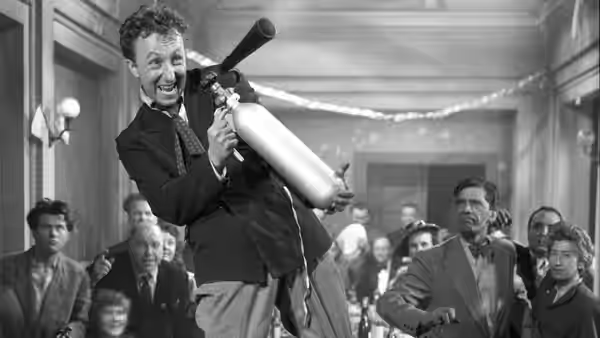
There is also room for farce, which is a relief in a film so conscious of the seriousness of its subject. The screenplay by Jerzy Andrzejewski and Andrzej Wajda allows human foolishness to interrupt the solemnity without making the uncertainty in Poland seem trivial. The drink helps: it stops this company looking like people assembled solely to explain a political position. We can recognise their weakness even when their circumstances seem remote. The humour makes the seriousness easier to bear.

Halina Nawrocka’s editing has to hold those changes of mood together, and the movement between farce and unease is generally persuasive. The difficulty comes when the expressionistic style insists that we pause to consider the significance of an image. Some of that emphasis is useful, but the accumulation can feel overbearing, particularly when the acting has already made the point. Andrzej Wajda occasionally seems reluctant to leave an image alone. A little less insistence would have helped us stay with the people.

For a war drama, this is unusually interested in the awkwardness of being around other people, rather than simply the positions they hold. The romance matters for the same reason: it makes room for wants that cannot be settled by a political allegiance. At 103 minutes, the film gives these competing pressures enough space without turning into a historical survey. Its occasional overstatement is worth tolerating for the attention paid to human frailty. See it for Zbigniew Cybulski, and be prepared to forgive a few heavily underlined images.

Critical consensus AI synthesised

73
Positive
7
Mixed
2
Negative
0

Most critics respond warmly to Ashes and Diamonds, with praise clustering around Zbigniew Cybulski’s performance as Maciek and Wajda’s portrayal of Poland’s postwar uncertainty. The reviews repeatedly value its bleak, disillusioned atmosphere and its attention to political and personal unease. Cybulski gives the historical crisis an intimate focus, while the film’s imagery and smoke-filled social world draw appreciation for making that uncertainty palpable. The emphasis varies between political nuance, emotional force and visual expression.

The reservations concern how insistently the film makes its points. Variety finds the expressionistic style somewhat overdone, while Empire admires the film despite its heavy symbolism. The AV Club finds it compelling but less immediate than Kanal. These are qualifications within favourable assessments rather than outright dissent. The available verdicts range from measured approval to strong enthusiasm; two entries have no readable review text, so their specific reservations cannot be established.

The Guardian
3 February 2026 · Peter Bradshaw
85*

Bradshaw presents the film as a masterful, bleak portrait of Poland’s postwar crisis of identity. He particularly praises its disillusioned atmosphere and the symbolic power of Maciek’s dark glasses.

Read the full review →
Slant Magazine
23 August 2021 · ★★★★ · Jake Cole
80

Cole regards the film as a powerful, bleak portrait of Poland’s postwar uncertainty, and praises Criterion’s substantial upgrade. He singles out the restoration’s sharp, detailed cinematography and improved hotel scenes.

Read the full review →
Empire
24 March 2006 · David Parkinson
70*

Parkinson regards the film as an intimate, affecting work despite its heavy symbolism. He singles out Zbigniew Cybulski’s remarkable performance as Maciek.

Read the full review →
The AV Club
9 December 2003 · Scott Tobias
70*

Tobias finds Ashes and Diamonds politically nuanced and compelling, despite judging it less immediate than Kanal. He singles out Zbigniew Cybulski’s performance and the ironic fireworks-set climax for praise.

Read the full review →
The New Yorker
11 March 2013 · Anthony Lane
70*

Lane presents the film as an appreciative, wistful blend of farce and historical unease. He singles out Wajda’s distinctive mood and the company’s smoke-filled, booze-soaked world.

Read the full review →
Variety
31 December 1957 · Variety Staff
70*

Variety finds the film an above-average drama, praising its direction, performances and insight into a changing Poland. It particularly singles out Zbigniew Cybulski’s performance, while faulting the expressionistic style as somewhat overdone.

Read the full review →

Straight answers AI written, from our review

Is Ashes and Diamonds worth watching?
Ashes and Diamonds is worth watching for its moving portrait of postwar uncertainty, especially Zbigniew Cybulski’s vulnerable performance, and we score it 82 out of 100. We recommend it to viewers drawn to politically troubled character dramas, with the caveat that Wajda’s heavy symbolism sometimes explains what the acting has already made clear.
How long is Ashes and Diamonds, and what is it rated?
Ashes and Diamonds runs 1h 43m. It is a drama and war film.
Where can I watch Ashes and Diamonds in the US?
Ashes and Diamonds is streaming on HBO Max, The Roku Channel, Amazon Prime Video and Hulu in the US, and it is also available to rent from Apple TV and Amazon Prime Video from $3.99. Availability is checked daily; the links above go straight to each service.
How violent or frightening is Ashes and Diamonds, and is it suitable for children?
Ashes and Diamonds has no listed UK or US certificate, so we cannot give an age-rating-based recommendation for children. Its drinking, oppressive atmosphere and political unease make it a more natural choice for adults interested in postwar drama; we cannot establish the intensity of violence or frightening material from those elements alone.
How does Ashes and Diamonds compare to The Third Man?
Ashes and Diamonds is the more suitable choice for a performance-led postwar drama, while we recommend The Third Man more readily for a gripping mystery. Both make private loyalty difficult amid public uncertainty, and both find room for humour. Wajda’s symbolism can overstate the emotion; Reed’s intrigue leaves some relationships needing more space.
Is Ashes and Diamonds based on a true story or a book?
Ashes and Diamonds is adapted from a novel by Jerzy Andrzejewski, rather than presented as a true-story account. Andrzejewski also shares the screenplay credit with Andrzej Wajda, though that alone does not establish fidelity to the book. We find Cybulski’s performance makes the political tensions personal enough to approach without knowing the novel.
What should I watch after Ashes and Diamonds?
After Ashes and Diamonds, try The Third Man (1949, Fi1m 92): Another damaged postwar city, with private loyalty making public duty harder. Then The Cranes Are Flying (1957, Fi1m 87): War and romance meet in faces that make the history hurt; and The Conformist (1970, Fi1m 87): Political obedience becomes personal tragedy, with striking images that sometimes overwhelm.

Cast

If you liked this, try…

  1. The Third Man (1949, Fi1m 92)Another damaged postwar city, with private loyalty making public duty harder.

  2. The Cranes Are Flying (1957, Fi1m 87)War and romance meet in faces that make the history hurt.

  3. Army of Shadows (1969) · not on Fi1m yetA sterner treatment of resistance, where loyalty offers little protection from doubt.

  4. The Conformist (1970, Fi1m 87)Political obedience becomes personal tragedy, with striking images that sometimes overwhelm.

  5. Phoenix (2014, Fi1m 68)Postwar identity and intimate betrayal, handled with restraint that makes the hurt sharper.