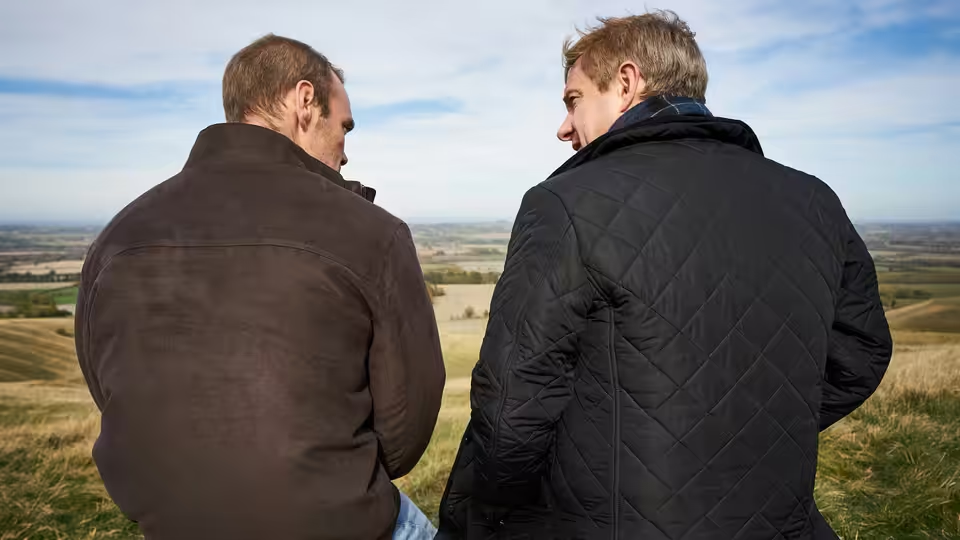
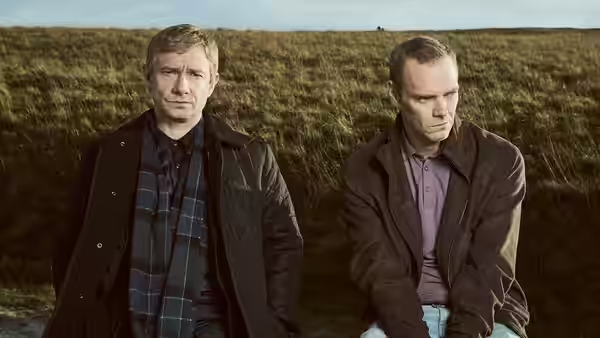
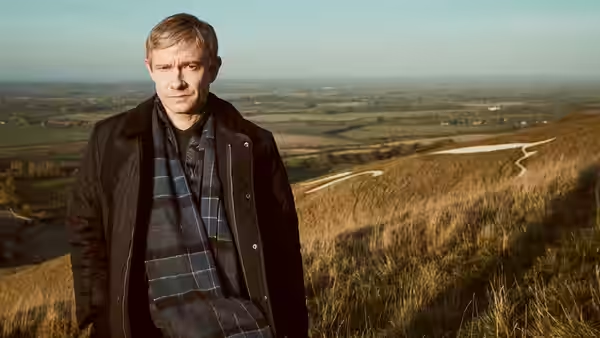
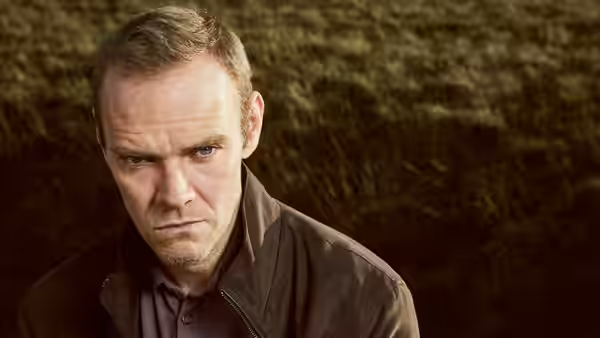
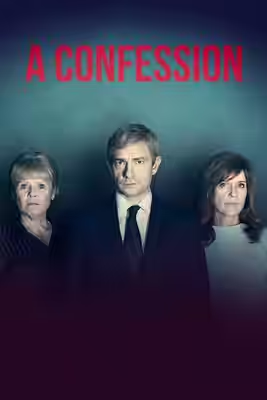
An affecting, patient crime drama led by Martin Freeman, Siobhan Finneran and Imelda Staunton. Its care for the families makes it worth the time, though the music too often insists on feelings the actors have already supplied.
Written by Jeff Pope, A Confession is an affecting crime drama, distinguished by its care for the families and weakened by music that presses too hard. Across six episodes, director Paul Andrew Williams keeps the pursuit of justice serious without treating distress as a spectacle. There is enough here to hold our attention without dressing the case up as entertainment at every opportunity. The patience is largely repaid by the actors.
Siobhan Finneran, as Elaine Pickford, gives the programme its most immediate pull. Her worry feels unsettled and awkward, free of the tidy emotional cues that make some television distress so easy to sit through. We found her restraint upsetting, because it leaves the anxiety unresolved rather than giving us the relief of a big display. She makes the wait for news feel exhausting, and gives us no comfortable distance from it.
Imelda Staunton gives Karen Edwards a stubbornness that prevents the character becoming simply an object of pity. Her resilience feels difficult to sustain, which makes it affecting rather than merely admirable. Martin Freeman, playing Steve Fulcher, supplies a firm centre, although the mothers’ performances stayed with us longer than his did. Together, these actors make the programme’s concern for the families convincing; their presence keeps our attention on the people affected by the investigation.
Vanessa Whyte’s cinematography suits that emphasis, letting the performances hold our interest without competing for attention. Max Gottlieb’s production design is similarly unobtrusive, giving the actors surroundings that feel fit for ordinary lives. We would not ask for a crime drama to be drab on principle. Here, though, the lack of visual fuss helps the director keep attention on behaviour, and stops the subject becoming an excuse for decorative gloom.
James Taylor’s editing is patient with those performances, and the steadiness is mostly welcome. The cost is a rhythm that can become too uniform: some stretches carry the same measured weight when a change of pace would help. The writing is strongest when the families’ need for answers remains close to the police work. That emphasis gives the programme a reason to exist beyond the familiar appeal of following clues and waiting for an explanation.
Niall Byrne’s music is less willing to leave us alone. It underlines distress already communicated by the actors, and the insistence becomes especially noticeable in a drama otherwise so careful about how much it asks of us. We wanted it to quieten down and let the acting do its work. The extra prompting makes those passages less affecting, because it becomes harder to concentrate on the people speaking when the accompaniment is so determined to be heard.
The patient approach will be a drawback if the main attraction of crime television is the next revelation. Here, the attention paid to people living with uncertainty is the reason to stay. The performances make that uncertainty sufficiently painful without much assistance. Choose it for the actors, and do not expect a restful evening.