Neil McKay’s two-part account of Fred West and the woman who sat beside him in the interview room is exact, restrained and hard to shake. Dominic West and Emily Watson are both superb; only the scenes at Janet’s home feel written.
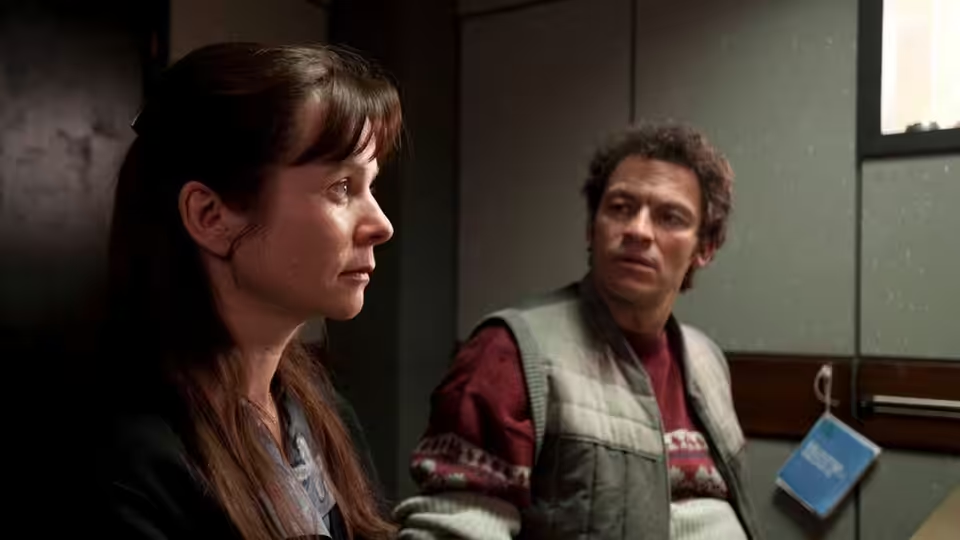
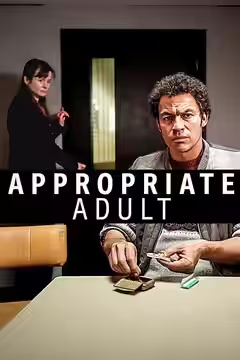
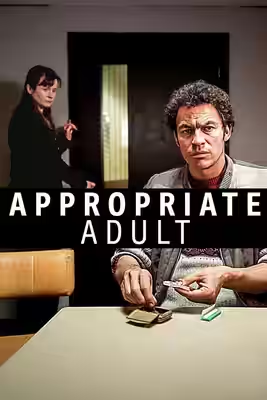
In February 1994 Gloucester police began digging up the garden at 25 Cromwell Street. Appropriate Adult starts there, but it is not about the digging and it shows almost none of it. Neil McKay’s two-part drama stays in the interview room and in the car park outside it, with Janet Leach (Emily Watson), a trainee social worker required by law to sit beside Fred West (Dominic West) while he is questioned. It is a drama about listening, and about what happens to the person who does the listening. It is also, over two 90-minute parts, one of the most careful things British television has made about a murderer, and we recommend it without much hesitation.
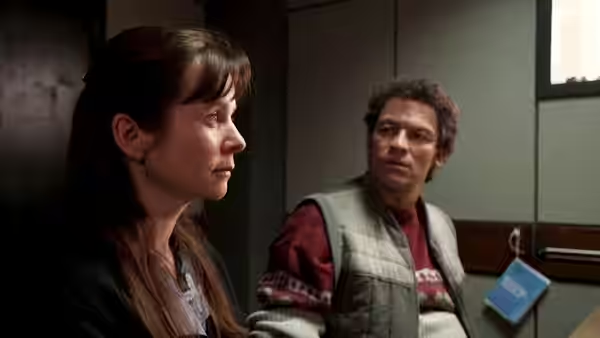
Dominic West is the reason it works. His Fred is a small, cheerful man in a jumper and anorak who calls everyone love, tells the police how helpful he intends to be and then helps them towards something slightly to one side of the truth. He never raises his voice. He confesses to killing his daughter Heather in the tone of a man explaining a plumbing fault. We were frightened of him, and more frightened of how easy he was to sit with: there is a scene early on in which he asks Janet about her children, and West plays the interest as entirely real, and that is the moment the drama gets its hooks in. He is good company. That is the whole horror of it, and McKay and director Julian Jarrold never once underline it.
Emily Watson has the quieter part and does the harder work. Janet is kind, under-confident and out of her depth, and Watson plays the slide from duty to something closer to need almost without dialogue: a glance at the clock, a lie to Mike about where she has been, the way she starts to lean in when Fred lowers his voice. She is not a fool and the script does not make her one. She simply becomes the one person he will talk to, and the police, through Robert Glenister’s patient, tired Bennett, work out that this is useful before she does.
Tony Slater Ling shoots the station in flat overhead light, grey walls and greenish tiles, and keeps the camera at table height so that we are at the table rather than looking in. Pat Campbell’s Cromwell Street, when we go there, is a warren of cheap panelling and home improvements, every surface something Fred built, and the camera does not linger. Stephen Noble puts Janet in soft cardigans and Fred in the kind of knitwear you would not look at twice, which is the point. Dan Jones’s score is sparse, a low drone that comes in under the interviews and goes out again, and Andrew Hulme cuts between the station and Janet’s kitchen so that the two begin to feel like the same room.
The supporting cast is strong across the board. Sylvestra Le Touzel’s Hazel Savage is the detective who refuses to be charmed and is right not to be. Gerard Horan, as the solicitor Howard Ogden, is a man slowly realising what he has agreed to represent. Monica Dolan is on screen as Rose West for a fraction of the running time and is the most unsettling thing in it, flat and watchful, with a way of answering a question that makes the question sound stupid. Selin Hizli and James McArdle, as Mae and Stephen, get a handful of scenes as children trying to work out what their parents were and they are not wasted.
What does not work is home. Anthony Flanagan’s Mike and Rupert Simonian’s Josh are there to show us what Janet is neglecting, and the scenes feel built to that purpose: a row about dinner, a row about the phone, a row about the newspapers. Flanagan does what he can, but the strand is the one place where the writing shows its joins. The second part also circles. Fred changes his story, Janet goes back, Fred changes it again, and after the fourth variation we understood the pattern and wanted the drama to move on slightly before it did.
McKay had already written See No Evil: The Moors Murders, and Jarrold had made Red Riding 1974, and both of those were interested in the people around a crime rather than the crime itself. This is better than either. The 18 certificate is honest but perhaps misleading: there is no violence on screen at all, only description, and the descriptions are worse. Watch it in two sittings, as it was made, and do not expect to sleep straight afterwards.