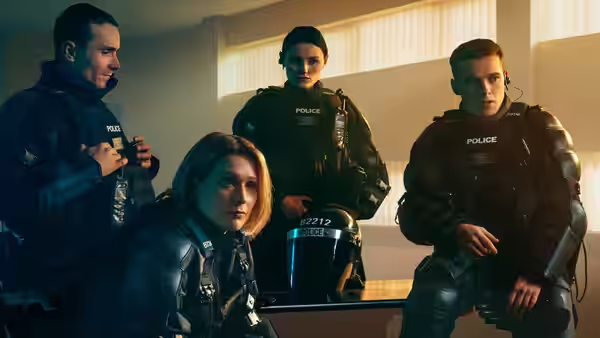
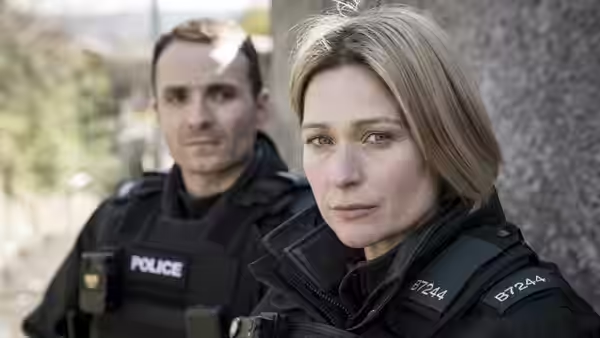
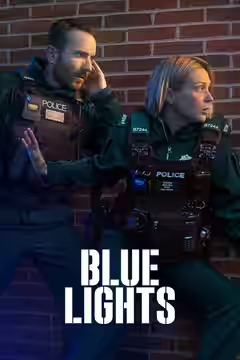
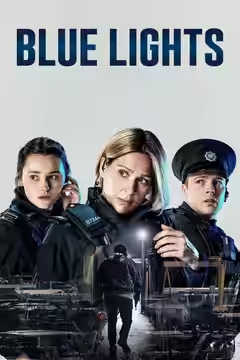
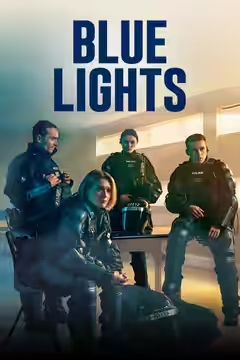
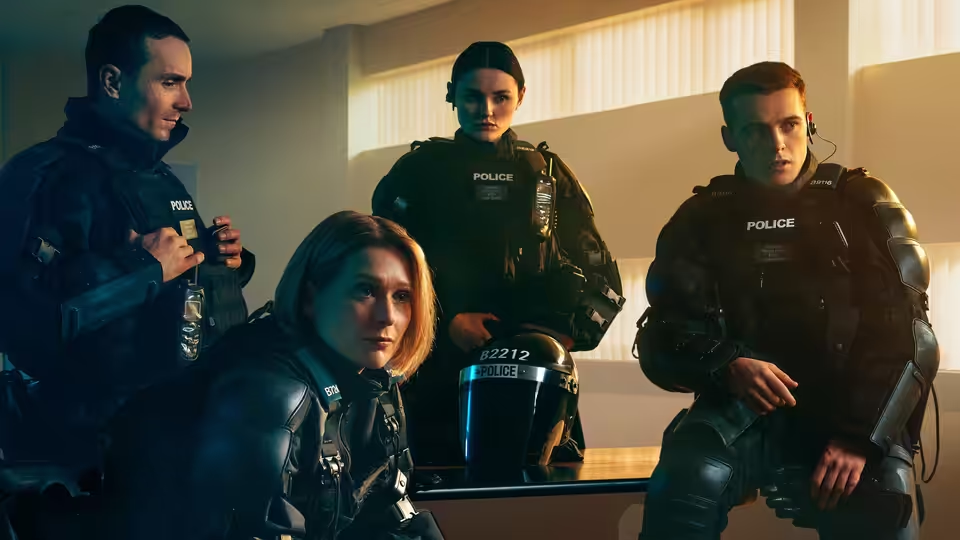
Four police officers in black tactical gear posing together indoors near a window
Series review

Blue Lights

2023 · Created by Declan Lawn, Adam Patterson · Series

In a sentenceWe would last about ten minutes as Belfast police recruits, and spend nine of them apologising

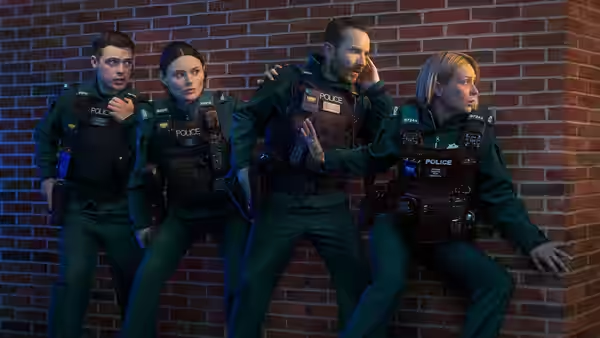
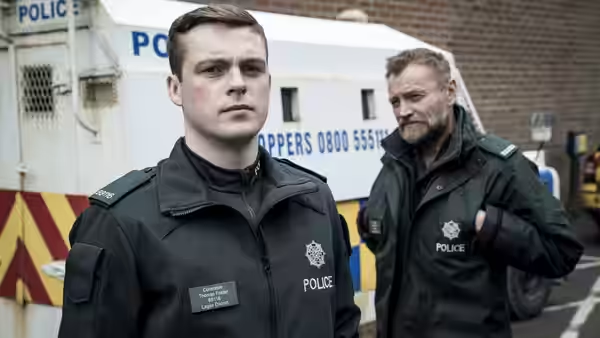
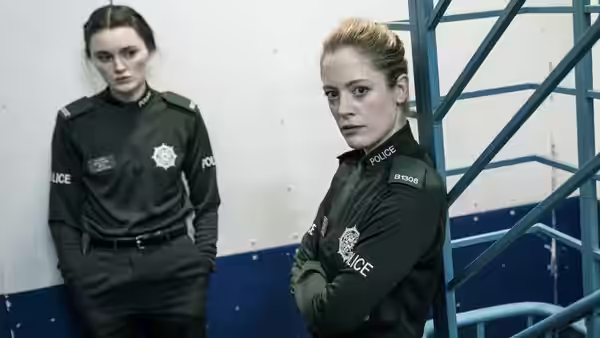
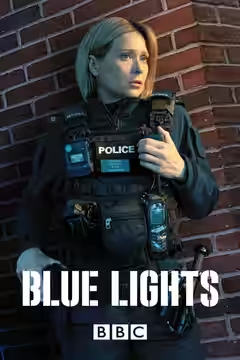
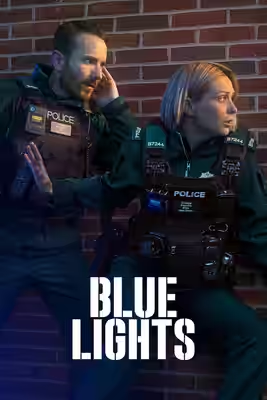
Sian Brooke plays Grace Ellis alongside Katherine Devlin as Annie Conlon and Nathan Braniff as Tommy Foster in Blue Lights, a Belfast-set crime drama. The series follows rookie recruits as they enter everyday police work in a city where the legacy of sectarian violence shapes relations between officers and the people they serve. Learning the job means working out what authority permits and what the community will accept. Martin McCann plays Stevie Neil, with Richard Dormer as Gerry Cliff and Joanne Crawford as Helen McNally.

Plays from YouTube when you press play; nothing loads from them until then.

Fi1m review

Blue Lights is a tense, humane police drama that makes its inexperienced Belfast officers worth worrying about. The rookie viewpoint can make the explanations conspicuous, but the performances give familiar situations enough weight to keep us involved.

Blue Lights is a tense, humane police drama, and we recommend it with one reservation: its rookie viewpoint sometimes makes the explanations too noticeable. Following inexperienced officers gives the programme a straightforward way into Belfast policing, without requiring anyone to arrive knowing the job. It also puts people who are liable to get things wrong at the centre of the story. Their lack of confidence has consequences beyond an uncomfortable meeting with the boss.

The Belfast setting matters because an officer’s authority cannot simply be assumed. The legacy of sectarian violence affects how the police are received, and the question of consent sits underneath the ordinary business of doing the job. We are asked to consider what happens when a uniform does not settle the question of whom to trust. That makes familiar police-drama situations more difficult, even before anybody makes a mistake.

Sian Brooke’s Grace Ellis, Katherine Devlin’s Annie Conlon and Nathan Braniff’s Tommy Foster give that approach people we can care about. The performances make inexperience feel like a continuing problem, with little of the easy assurance that can make fictional beginners hard to believe. Devlin and Braniff are particularly good at keeping their characters’ vulnerability present without asking for sympathy. The ensemble’s appeal comes from the sense that competence still has to be learnt.

Gilles Bannier’s direction gets useful suspense from the recruits’ vulnerability. We were anxious for them. Their uncertainty remains visible as the work becomes dangerous, and we can follow the reasons for that anxiety without waiting for some hidden threat to be revealed. It helps that the programme is willing to build interest around ordinary officers, giving us time to worry about their judgement and their capacity to cope.

The weakness comes when the recruits also have to help explain the programme’s social and professional background. Writers Declan Lawn, Adam Patterson and Fran Harris work with an accessible route into complicated material, but we occasionally become too aware of the instruction being provided. Being new gives a character a reason to need things explained; it does not automatically make those explanations interesting. These passages are less persuasive than the doubts the actors communicate without having to spell them out.

As a police procedural, this is not attempting to replace every familiar part of the machinery. The inexperienced recruits and the gradually connected stories are recognisable enough. What distinguishes the programme is how seriously it takes the ordinary officer’s position in this particular city. We have reason to be interested in the people doing the work before we start wondering how the stories will fit together. The opening series has six episodes in which to develop those connections.

We would begin for the ensemble and allow the plotting to earn our attention at its own pace. Anyone looking principally for ingenious twists may find the emphasis on character too patient. The occasional lesson in how things work is a fair price for officers who seem capable of being frightened and making mistakes. Give it an evening when there is enough quiet to pay attention.

Critical consensus AI synthesised

80
Positive
8
Mixed
0
Negative
0

All eight reviews are positive, and most say the same thing: this is a police procedural that feels fresh because it looks at the job from the bottom. Critics like the decision to follow probationary officers rather than seasoned detectives, and they like Belfast as a setting, with the legacy of the Troubles and the question of policing by consent giving routine calls a weight most precinct dramas lack. The characters are called credible and vulnerable, and several reviews praise the newer cast members in particular.

The spread is narrow. No review is lukewarm, and the only full-marks verdict comes from Den of Geek. Where reservations appear they concern scale rather than quality: Radio Times finds it less intense than Happy Valley, and The i Paper notes that it favours ordinary officers over high-stakes twists, which some viewers will take as a limitation. The Times enjoys it mostly for being funny.

The Guardian
27 March 2023
85*

The critic finds Blue Lights well-crafted, fantastically tense and thrilling, following naive rookie recruits plunged into dangerous policing work in Belfast. They single out the layers of social and political complexity from the post-Troubles setting and the notion of policing by consent for particular praise.

Read the full review →
Radio Times
27 March 2023 · ★★★★ · James Hibbs
80

The critic praises the Belfast setting and focus on rookie officers as refreshing takes on the police procedural genre, highlighting strong performances especially from newcomers. They note it doesn't match Happy Valley's intensity but is thoughtful and authentic.

Read the full review →
The i Paper
27 March 2023 · Ed Power
80*

The critic praises Blue Lights for standing out from typical police dramas by focusing on ordinary officers in Belfast's unique context, highlighting its authenticity and character-driven approach rather than high-stakes twists.

Read the full review →
The Telegraph
28 March 2023
80*

The critic calls it a rare gem among police procedurals that deserves as much hype as Line of Duty, praising its realistic characters and storylines that knit together satisfyingly. They single out the smart choice to view policing through rookie eyes for praise.

Read the full review →
Vulture
27 November 2025
80*

The critic presents Blue Lights as an absorbing, propulsive precinct drama that balances routine comfort with emotional stakes and the unique Belfast context. It singles out the strong ensemble performances, the show's humanity amid endless crime, and its ability to deliver punches without cynicism.

Read the full review →
The Times
27 March 2023 · ★★★★☆ · Carol Midgley
70*

The critic finds the series a complicated, cleverly observed and funny drama that is a cut above the average police procedural. She singles out the fresh, irreverent quality and credible characters of the probationary officers.

Read the full review →

Straight answers AI written, from our review

Is Blue Lights worth watching?
Blue Lights is worth watching for anyone who wants a tense, humane police drama built around inexperienced officers, and we scored it 82. Sian Brooke, Katherine Devlin and Nathan Braniff make the Belfast recruits worth worrying about, though the rookie viewpoint sometimes turns the background into a lesson. Viewers after ingenious twists may find its patience frustrating.
Where can I watch Blue Lights in Croatia?
Blue Lights is not on any streaming or rental service in Croatia at the moment. It is available in 7 other countries; change your country at the top of the page to see where. Availability is checked daily.
How violent or frightening is Blue Lights, and is it suitable for children?
Blue Lights carries a UK 15 certificate and is not suitable for children. It is a crime drama about police in a city shaped by sectarian violence, and the tension comes from watching vulnerable recruits do dangerous work rather than from graphic shocks. We were anxious for them throughout, so the squeamish should expect sustained unease rather than gore.
How does Blue Lights compare to Memories of Murder?
Blue Lights and Memories of Murder both follow police who are not yet, or not ever, equal to the job, but they are different in kind. The Korean film is a single murder investigation that moves from comedy to something much darker, and it is the better work. The Belfast series is gentler, warmer and more patient, better suited to anyone who wants time with an ensemble across six episodes.

Cast

Awards

BAFTA Television Awards, 2025

Won
Best Drama Series

If you liked this, try…

  1. The Cops (1998) · not reviewed yetAnother British police series that gives ordinary working officers room to be complicated.

  2. Southland (2009) · not reviewed yetPatrol work, strained partnerships and danger that does not wait for experience.

  3. Spiral (2005) · not reviewed yetParisian police work with institutional pressures and compromises that accumulate across cases.

  4. Memories of Murder (2003, Fi1m 91)A murder investigation where police fallibility becomes increasingly difficult to laugh off.

  5. The Blue Lamp (1950) · not reviewed yetAn earlier British view of patrol work, with experience measured against youthful confidence.

Free account

Know what to watch tonight

Two lists that know where things are streaming, collections you can share, your own score beside ours, and Discover that remembers what you have seen.

  • Want to see, sorted by what is streaming now
  • Seen, with your score out of ten
  • No adverts, ever