Brian Jordan Alvarez’s school comedy is quick, well cast and funny about arguments most sitcoms would not go near. It is also slight: eight episodes of good staffroom talk with no story to hold them together.
Brian Jordan Alvarez has created, written for, directed episodes of and starred in a comedy about an American high school, and about the arguments that now gather around any American classroom: what can be said, what can be taught, who can kiss whom in a corridor. That is a hard thing to joke about without picking a side or losing your nerve, and English Teacher mostly manages it. It is quick, well cast and funny. It is also slight, and eight episodes go by without much happening to anyone.
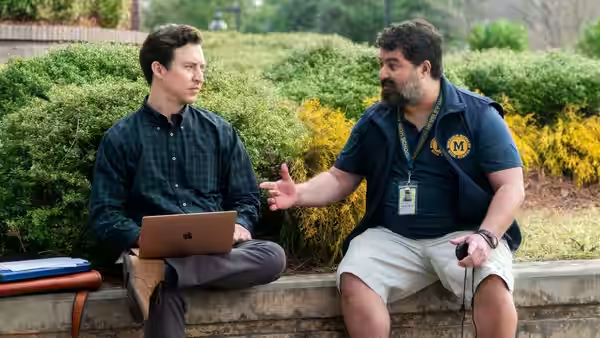
Alvarez plays Evan Marquez, who teaches English and would like to get through the term without being the subject of a staffroom row. He is not so lucky. His principal, Grant Moretti (Enrico Colantoni), would like every problem to go away quietly. His friend Gwen Sanders (Stephanie Koenig) would like to talk about each one at length. Markie Hillridge (Sean Patton) has opinions about everything and keeps none of them for longer than a scene. The best of the programme is in the staffroom, where these four talk across one another at a speed most sitcoms gave up on decades ago.
Koenig is the find. She is among the writers as well, and it shows: she plays Gwen as a woman who says the wrong thing with complete confidence and is usually half right, and she and Alvarez have the rhythm of people who have been finishing each other’s sentences for years. We laughed out loud, several times an episode, at lines that went past before we had quite caught them. Then, an hour after each episode, we found we could not say what had happened in it. Both of those things are true of the whole series.
Colantoni gives Moretti the tired patience of a man who has read every memo and believed none of them, and he gets the best quiet reactions in the show. Patton’s Markie is the one who should not work, the loud dissenter in a comedy made by a gay man, and the scripts treat him as a friend rather than a target, which is braver than it sounds. Carmen Christopher’s Rick Santana, a fellow teacher with a scheme in every scene, and Trixie Mattel, who turns up as a drag performer called Keith, fill out a staff that is more interesting than any of the pupils. That is a problem for a programme named after a teacher. The teenagers are mostly furniture, there to say something alarming and leave.
Jeffrey Waldron and Brian Burgoyne shoot it bright and flat, in the hard light of a school corridor, and they resist the hand-held wobble most American workplace comedies now use. Kate Bunch’s production design gets the laminated posters, the blocky lockers and a staffroom where nothing has been replaced since the nineties. Erinn Knight and Cristina Spiridakis dress Evan a little too well for his salary and Markie in shorts in all weathers. Jonathan Krisel is among the directors, and the episodes keep a straight face no matter how odd the premise. The editing, shared between five people, keeps the scenes short. Nothing is allowed to settle.
The slightness is the real complaint. Each episode picks up a live argument, deals with it and puts it down, and the next one starts clean. Nothing is the spine of the series. Nobody changes, nobody loses anything, and by the eighth episode we had stopped expecting them to. Alvarez the actor is also less sure than Alvarez the writer. He plays Evan with a bright, slightly performed patter that can look like a man doing bits in his own show, and the people around him are easier to believe in. A second season of ten episodes followed.
Set against the school comedies it will be compared with, it is sharper than Abbott Elementary and a good deal less kind, and it has none of the cruelty of Vice Principals. It wants to be liked, and it is. Watch it two episodes at a time, with somebody who will argue back. On your own, late at night, it goes past pleasantly and you will not remember it in the morning.