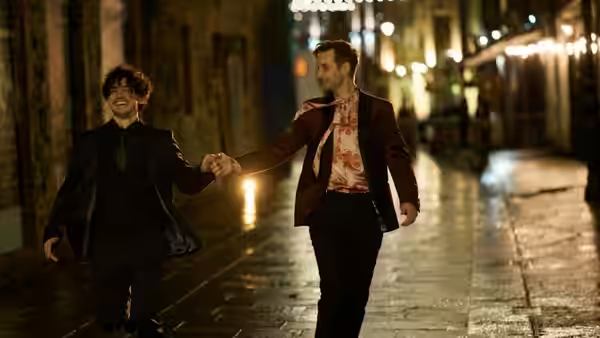
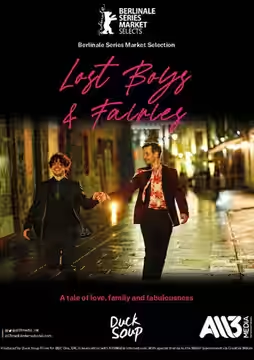
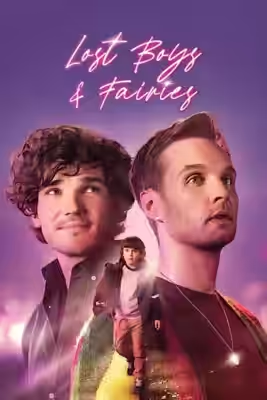
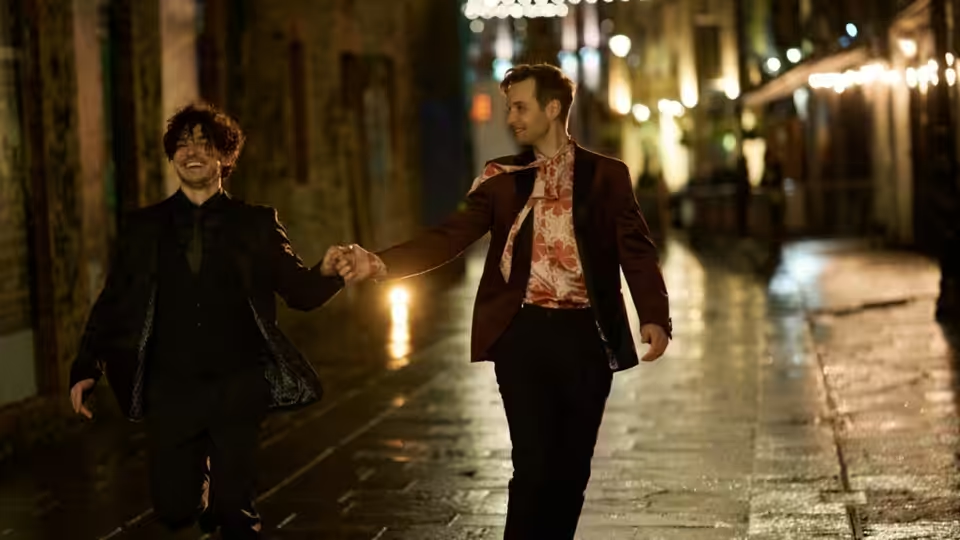
Two men walk hand in hand along a wet, lantern-lit street
Series review

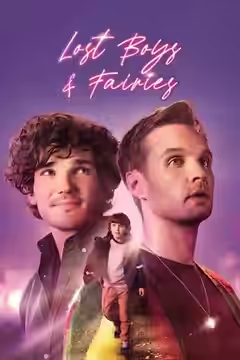
Lost Boys and Fairies

2024 · Created by Daf James · Series · 57m

In a sentenceDrag numbers, a social worker with a clipboard, and more grief than three episodes should be asked to hold

Cardiff, the present day. Gabriel (Siôn Daniel Young) sings at Neverland, a gay club run by Berwyn (Arwel Gruffydd), who performs there as Fanny Ample. Gabriel’s partner Andy (Fra Fee) is an accountant, steadier than he is, and the two of them want to adopt. They are matched with Jake, a seven-year-old boy in foster care, and the first episode follows the assessment that stands between them and him. Claire (Sharon D. Clarke), their social worker, needs Gabriel’s whole life on the record: the drugs, the clubs, the men, the years he would rather not revisit. Back on the farm, his father Emrys (William Thomas), a chapel man who speaks Welsh and little else, has never said the word gay out loud. Gabriel’s mother is dead, and she keeps turning up in his head mid-song.

Plays from YouTube when you press play; nothing loads from them until then.

Fi1m review

Daf James’s three-part drama about a Cardiff club singer and his partner adopting a small boy is bold, loud and often moving, and the adoption process is drawn better than we have seen on television. It also piles on more sorrow than it can carry.

Gabriel (Siôn Daniel Young) sings in sequins at a Cardiff gay club called Neverland. His partner Andy (Fra Fee) does accounts and keeps the house. They want a child, and the first of Daf James’s three episodes, all directed by James Kent, is about what it takes to be allowed one: forms, home visits, and a social worker who needs to know everything Gabriel did before he was sober. Lost Boys and Fairies is a musical about adoption and a drama about addiction and a memory play about a dead mother, sometimes within a single scene. We admired its nerve and we recommend it. We also think it would be a better series with a third less in it.

The adoption material is the best thing here, and the thing we had not seen done properly before. Claire (Sharon D. Clarke) is not an obstacle and not a saint; she is a professional doing a difficult job with a notebook, and Clarke plays her as someone who has heard every version of the story and still listens. The interviews in the couple’s living room are written with real care for how the process works, what it asks of people and why it asks it. When Gabriel has to say out loud what he used to do in club toilets, and Andy has to sit beside him and hear it again, James lets the silence do most of the work. The boy they are matched with, Jake, is seven and watchful, and the scenes of the two men learning to be in a room with him are small, awkward and true.

Then the music starts. Gabriel’s numbers on the Neverland stage are staged as full productions, coloured light and dry ice, and Kent cuts between the stage and the kitchen or the farm so that the song comments on whatever Gabriel cannot say in prose. Peter Gregson’s score underneath is strings, mostly low and slow, and it is at its best when it stays under the dialogue rather than swelling up to meet the stage. Some of the numbers land. Some of them interrupt a scene that was doing fine on its own, and we found ourselves waiting for the lights to come back up so the people could carry on talking.

What got to us most was not on the stage at all. Emrys (William Thomas), Gabriel’s father, is a farmer and a chapelgoer who speaks to his son in Welsh and has never once managed the sentence Gabriel needs from him. Thomas plays him with his hands and his hat and almost no words, and a scene of the two of them in a kitchen, both looking at the table, moved us more than any of the songs because nobody was trying to move us. Young is good throughout, loose and funny in the club and wound tight everywhere else, and he is best opposite Thomas. Fee has the harder job, the steady one, and makes Andy’s patience look like a decision rather than a default.

Around them the cast is strong and underused. Arwel Gruffydd’s Berwyn, the club’s owner and its resident queen Fanny Ample, is the one grown-up in Gabriel’s old life and gets about a scene an episode to prove it. Maria Doyle Kennedy and Elizabeth Berrington are both here, both welcome, and both sent off before we had finished enjoying them. Shaheen Jafargholi’s Celyn, a younger performer at Neverland, is given a thread the series seems to forget.

The problem is accumulation. By the end of the second episode Gabriel has been given addiction, a dead mother, a father who cannot speak, a childhood in chapel, a history in sex clubs and an adoption panel, and the third episode adds a turn we will not describe. Each strand is handled with feeling. Together they leave the series no room to breathe, and the fantasy sequences, which are meant to open things up, more often make a plain scene harder to read. We were moved, and then we were tired, and the tiredness is a flaw in the writing rather than in us.

Against other recent British drama about gay men’s lives it holds up well, and it is braver than most about putting a man’s worst nights on the record and still asking us to hand him a child. At three hours it is not a long commitment. Watch it over two nights rather than one, and keep a tissue and a certain scepticism to hand; you will need the first more than you expect and the second more than the series would like.

Critical consensus AI synthesised

2 of 6
Positive
2
Mixed
0
Negative
0

With only 2 reviews in so far, the early word is warm. Both critics find Lost Boys and Fairies moving and unusually bold, and both note that its mix of humour, music and heightened style asks a good deal of the viewer. The i Paper’s Alim Kheraj admits some of its experimental turns baffle him but praises the fearless way it draws its queer characters; The Guardian’s Rebecca Nicholson calls it extravagant and emotionally demanding, yet says it holds together with panache, and singles out its nuanced account of the adoption process. Neither has serious reservations beyond the style, and the spread between them is narrow.

The i Paper
3 June 2024 · Alim Kheraj
80*

Kheraj finds the series deeply moving and refreshingly bold, despite some baffling moments in its experimental style. He praises its fearless portrayal of queer characters and its blend of humour and music.

Read the full review →
The Guardian
3 June 2024 · Rebecca Nicholson
75*

Nicholson finds the series extravagant and emotionally demanding, but says it mostly holds together with panache. She particularly praises its illuminating, nuanced portrayal of the adoption process.

Read the full review →

Straight answers AI written, from our review

Is Lost Boys and Fairies worth watching?
Lost Boys and Fairies is worth watching, and we scored it 76, for anyone who wants an adoption drama drawn with unusual care and does not mind drag numbers breaking into it. The scenes with the social worker and the father are its strongest, and the series would be better with a third less sorrow in it. Watch it over two nights rather than one.
How long is Lost Boys and Fairies, and what is it rated?
Lost Boys and Fairies has episodes of about 57m. It is a drama series.
Where can I watch Lost Boys and Fairies in Chile?
Lost Boys and Fairies is not on any streaming or rental service in Chile at the moment. It is available in 13 other countries; change your country at the top of the page to see where. Availability is checked daily.
How does Lost Boys and Fairies compare to The Adventures of Priscilla, Queen of the Desert?
Lost Boys and Fairies is a three-part Welsh television drama about grief, addiction and adopting a small boy, while The Adventures of Priscilla, Queen of the Desert is a road comedy that plays its drag, difficult father and little boy for warmth. The series is the braver and the sadder; the film is the easier company and the lighter evening. Choose the series for feeling, the film for fun.
What should I watch after Lost Boys and Fairies?
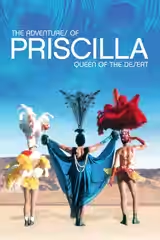
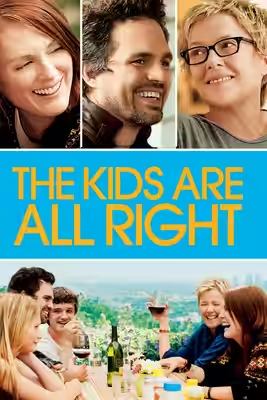
After Lost Boys and Fairies, try The Adventures of Priscilla, Queen of the Desert (1994, Fi1m 81): Drag, a difficult father, and a small boy, played for warmth. Then The Kids Are All Right (2010, Fi1m 80): A same-sex couple’s family tested, without music, and with a sharp script.

Cast

If you liked this, try…

  1. It's a Sin (2021) · not reviewed yetAnother British series that puts gay men’s whole lives on screen, grief included.

  2. The Adventures of Priscilla, Queen of the Desert (1994, Fi1m 81)Drag, a difficult father, and a small boy, played for warmth.

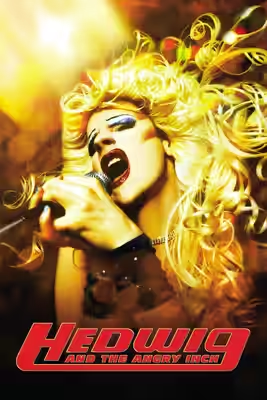
  3. Hedwig and the Angry Inch (2001) · not reviewed yetA stage act used to say what the performer cannot say offstage.

  4. Big Boys (2022) · not reviewed yetGrief, coming out and a dead parent handled with jokes and real tenderness.

  5. The Kids Are All Right (2010, Fi1m 80)A same-sex couple’s family tested, without music, and with a sharp script.

Free account

Know what to watch tonight

Two lists that know where things are streaming, collections you can share, your own score beside ours, and Discover that remembers what you have seen.

  • Want to see, sorted by what is streaming now
  • Seen, with your score out of ten
  • No adverts, ever