Michelle Pfeiffer gives Taylor Sheridan’s six-part drama about grief more feeling than the script has earned, and Christina Alexandra Voros shoots the country handsomely. But the writing is thin, and every time the series turns towards the city it turns nasty.
Taylor Sheridan writes a six-episode drama about a family in grief, and for once he has taken his foot off the accelerator. Nobody is defending land at gunpoint. The stakes are a household trying to keep functioning after a loss, and Christina Alexandra Voros, who directs and photographs, gives it long looks, long silences and long shots of country under weather. That is a reasonable way to make a series about mourning. The trouble is that it is not a story, and by the third episode we could see how little was underneath.
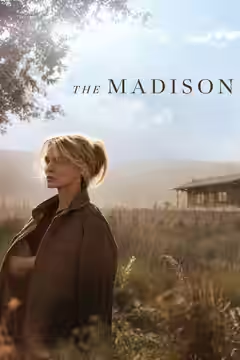
Michelle Pfeiffer plays Stacy Clyburn as a woman who has decided that falling apart would be a discourtesy to everyone else. She does most of her acting with her hands and her breathing, and Voros has the sense to hold on her rather than cut away to somebody reacting. It moved us more than we expected, and the reason is plain: Sheridan has written her almost nothing to say, and Pfeiffer has treated the silence as the part rather than the gap between parts. She is better than the series around her in every episode.
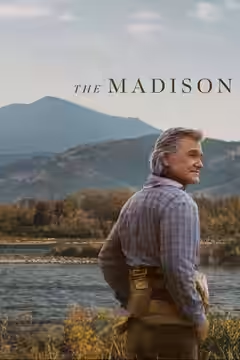
Kurt Russell’s Preston Clyburn is the other reason to keep watching. He plays an older man who does not narrate his feelings, and the scenes between him and Pfeiffer, two people who know each other well enough to skip the sentences, are the most natural writing here. Sheridan has always written older couples well. He is less sure what to do with anyone under fifty.
Voros the cinematographer serves Voros the director too readily. The land is shot wide and low, the horizon parked a third of the way up the frame, and the weather is asked to do the work a plot would normally do. Breton Vivian’s score lays strings under it whenever the writing runs dry, which is often, and Chad Galster cuts to that rhythm, letting shots run past the point where they have said anything. Charisse Cardenas’s production design is handsome and, like everything else, is asked to stand in for incident. It is all very easy on the eye and very hard to stay awake through.
Then there is the city. Whenever the series turns to New York it turns sour. Sheridan writes it as a place where nothing decent can grow, and the characters who stand for it are written as a complaint about the city rather than as people. It is the one thing the series is emphatic about and the least interesting thing in it. We were irritated, and then bored by the irritation, because a drama about grief does not need a villain and this one keeps handing us a postcode.
The supporting cast are given attitudes rather than parts. Beau Garrett, Patrick J. Adams and Elle Chapman are asked to be tense or brittle on cue, and the romance running underneath the mourning is stated politely and never dramatised. Ben Schnetzer and Kevin Zegers come and go. Amiah Miller and Alaina Pollack, as the younger Reeses, get the most life of anyone below the top of the bill, mostly by being allowed to be ordinary.
Hell or High Water, which Sheridan wrote in 2016, showed he could make men who say very little carry a great deal. The best of The Madison comes from the same place; the worst comes from his habit of telling us who to dislike. Most critics have landed where we have, admiring Pfeiffer and doubting the rest, and we see no reason to argue with them.
Six episodes, a 15 certificate, and one performance worth the time. Watch it for Pfeiffer, at home, in the evening, and do not feel guilty about reaching for your phone during the landscape shots. The series has only itself to blame for that.