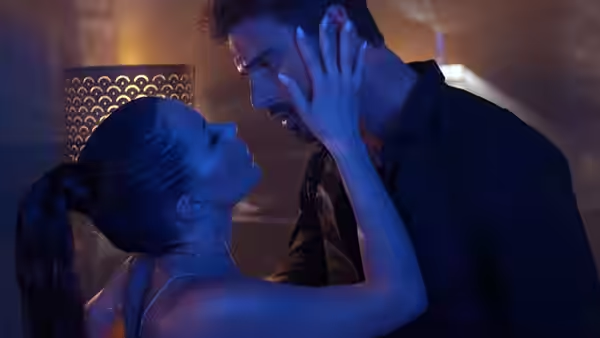
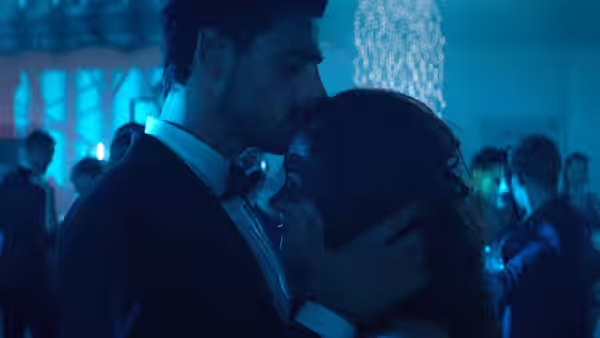
Laura Biel (Anna-Maria Sieklucka) lies atop Don Massimo Torricelli (Michele Morrone) on a yacht deck
Film review

365 Days

2020 · Directed by Barbara Białowąs, Tomasz Mandes · 1h 54m · Eirin R18+

In a sentenceAll that effort to make a kidnapper attractive, and nobody thought to give him better dialogue

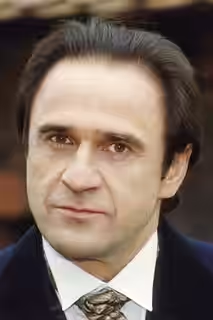
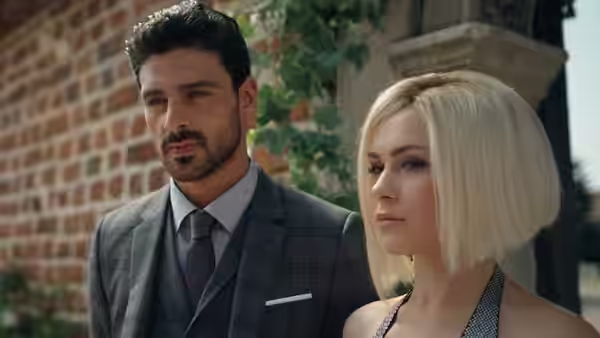
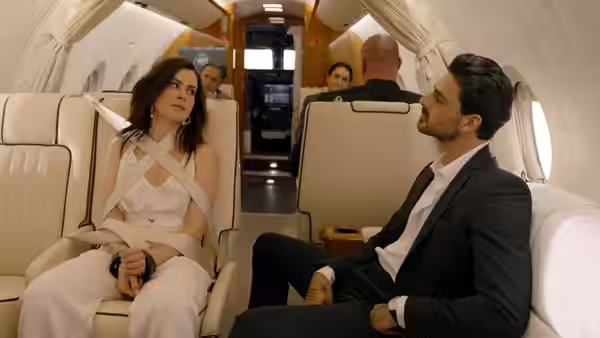
Laura Biel (Anna-Maria Sieklucka) becomes the focus of Don Massimo Torricelli (Michele Morrone), whose pursuit of her involves kidnapping and captivity. He wants the woman he holds to fall in love with him; she faces an encounter whose terms he controls, including her freedom to leave. Mario (Bronisław Wrocławski), Domenico (Otar Saralidze) and Olga (Magdalena Lamparska) also figure in their story. Sexual attraction becomes entangled with her confinement as she has to contend with the demands of the man holding her.

Fi1m review

An erotic romance with attractive sex scenes, awkward performances and no convincing reason to believe in its central relationship. We cannot recommend a film that treats kidnapping as sufficient preparation for love.

365 Days is a poor erotic romance because it cannot make the attraction convincing, even when it makes the sex look attractive. Barbara Białowąs and Tomasz Mandes direct a story built around kidnapping and captivity, then ask us to accept those circumstances as an invitation to fall in love. The screenplay by Tomasz Klimala, adapted from the novel by Blanka Lipińska, gives the relationship far less care than it needs. The film takes its central proposition seriously without giving us much reason to.

Anna-Maria Sieklucka plays Laura Biel, with Michele Morrone as Don Massimo Torricelli, the man whose pursuit involves holding her captive. Erotic fantasy can accommodate disturbing desires; nobody needs these characters to be sensible or morally instructive. Such fantasies can be troubling, funny or revealing about the people who entertain them. Here, the promise of attraction is supposed to settle our objections to the kidnapping. We felt queasy at that invitation, because the film keeps asking us to find coercion romantic.

The performances make the persuasion harder. Anna-Maria Sieklucka and Michele Morrone struggle with lines that need to carry both desire and the strain of this arrangement, and the delivery too often sounds merely awkward. We laughed at some of those readings, then found the film’s solemnity exhausting. Accidental comedy offers a little relief, but neither actor is given enough convincing behaviour to make the relationship matter between the sexual encounters.

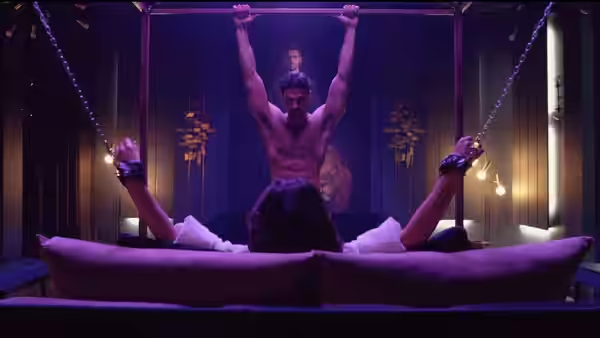
Bartek Cierlica’s cinematography provides the clearest virtue: the sexual encounters can be attractive to look at. There is enough visual appeal to explain why someone might stay with the film despite the dialogue. Agnieszka Bartold’s production design also serves the seduction, though the effort to make captivity inviting receives little scrutiny from the film itself. The care taken over appearances makes the thinness of the characters harder to overlook.

Marcin Drewnowski’s editing does little to make the relationship develop convincingly over 114 minutes. A succession of sexual encounters still needs some change in what the participants understand about each other if it is to sustain a drama. The music credited to Mateusz Sarapata and Michał Sarapata encourages the romance without helping us believe in it. These attempts to supply feeling become tiring when the characters have given us so little reason to care.

For an erotic drama, this is a basic failure. A look, a hesitation or a conversation can be worth watching for what it tells us about an attraction. This film offers little beyond the coercive situation and the promise of sex, then treats that combination as sufficient to keep us involved. Even viewers content to accept its fantasy are left with poor dialogue and a relationship that cannot support the running time.

The hostile reviews are justified, although the photography deserves the small allowance made for it. That allowance does not extend to the writing, which rarely gives the actors something credible to say or a persuasive reason to say it. Accepting the premise still leaves a great deal of dull drama to sit through. For an evening of erotic romance, choose something that gives its actors more to do than try to make captivity look desirable.


Critical consensus AI synthesised

2 of 6
Positive
0
Mixed
0
Negative
2
The Times
19 June 2020 · ★☆☆☆☆ · Kevin Maher
38*

The critic deems the film execrable Polish soft porn that inexplicably topped Netflix charts. He singles out the poor line readings, repugnant central conceit of coercive kidnapping leading to love, and an over-the-top sex sequence for particular scorn.

Read the full review →
Variety
10 June 2020 · festival review · Jessica Kiang
10*

The critic finds the film thoroughly terrible and politically objectionable, a ludicrous softcore fantasy that glorifies problematic themes like non-consensual captivity, but notes some enjoyable inadvertent comedic moments and attractive sex scenes.

Read the full review →

Straight answers AI written, from our review

Is 365 Days worth watching?
365 Days is not worth watching for most viewers seeking erotic romance; we score it 24 out of 100. The sexual encounters are attractively photographed, but awkward performances and poor dialogue make the central relationship unconvincing, even for viewers willing to accept its fantasy of captivity becoming love.
How long is 365 Days, and what is it rated?
365 Days runs 1h 54m and is rated R18+ by the Eirin in Japan. It is a romance and drama film.
Where can I watch 365 Days in Japan?
365 Days is streaming on Netflix in Japan. Availability is checked daily; the links above go straight to each service.
How violent or frightening is 365 Days, and is it suitable for children?
365 Days has a UK 18 certificate and is unsuitable for children, with sexual encounters and a central relationship built around kidnapping and captivity. We find its treatment of coercion as romance queasy; adults troubled by confinement or a partner controlling another person's freedom have particular reason to avoid it.
How does 365 Days compare to The Handmaiden?
365 Days is a much weaker choice than The Handmaiden, which we recommend for erotic suspense with precise plotting and women whose desires matter. Where 365 Days struggles to make its central attraction convincing, The Handmaiden gives its romance feeling, humour and room to survive the complications of its thriller plot.
Is 365 Days based on a true story or a book?
365 Days is adapted from a novel by Blanka Lipińska, rather than presented as a true story. No prior reading is needed to grasp its premise of a captive woman and the man who wants her love; our criticism concerns the film's unconvincing relationship, not its fidelity to the book.
What should I watch after 365 Days?
After 365 Days, try The Handmaiden (2016, Fi1m 85): Erotic suspense with precise plotting and women whose desires actually matter. Then Bound (1996, Fi1m 80): Desire and criminal danger, with enough intelligence to make both compelling; and The Piano (1993, Fi1m 88): A difficult attraction given emotional weight through performances, music and physical detail.

Cast

If you liked this, try…

  1. Secretary (2002) · not on Fi1m yetA stranger, funnier courtship that gives its awkward participants recognisable inner lives.

  2. The Handmaiden (2016, Fi1m 85)Erotic suspense with precise plotting and women whose desires actually matter.

  3. Bound (1996, Fi1m 80)Desire and criminal danger, with enough intelligence to make both compelling.

  4. Belle de jour (1967) · not on Fi1m yetFor a more unsettling look at the distance between fantasy and everyday life.

  5. The Piano (1993, Fi1m 88)A difficult attraction given emotional weight through performances, music and physical detail.

365 Days (2020) review: Sex cannot save this lifeless romance (Japan) | Fi1m