Franz Osten’s silent fable of two kings who cannot stop rolling dice was shot in India in 1929 with real palaces and real crowds, and it still looks remarkable. The story is thin and the villain is broad, but Seeta Devi and the photography carry it.
A Throw of Dice was made in India in 1929 by Franz Osten and Himanshu Rai, who produced it and also plays the villain. Their idea was a spectacle built out of things a studio could not fake: palaces, rivers, tiger hunts, processions of elephants and what looks like the population of several towns. Niranjan Pal’s story is a fable about two cousin kings undone by gambling, and Max Jungk and W. A. Burton’s script tells it in 74 minutes without a wasted scene. Our verdict is that it holds up, and holds up better than most silent spectacles of its size, though it is a fairy tale rather than a drama and asks to be watched as one.
The plot is set going by a hunt. King Sohat (Rai) has his henchman Kirkbar (Modhu Bose) put an arrow into his cousin Ranjit (Charu Roy), and Ranjit is nursed back to health by Sunita (Seeta Devi), the daughter of the hermit Kanwa (Sarada Gupta). Both kings want Sunita; both kings want the dice; the rest follows. Osten does not pretend there is more to it than that. He lets each turn of the story arrive with a clean intertitle and moves on, and there is something restful about a film that knows exactly how much plot it has.
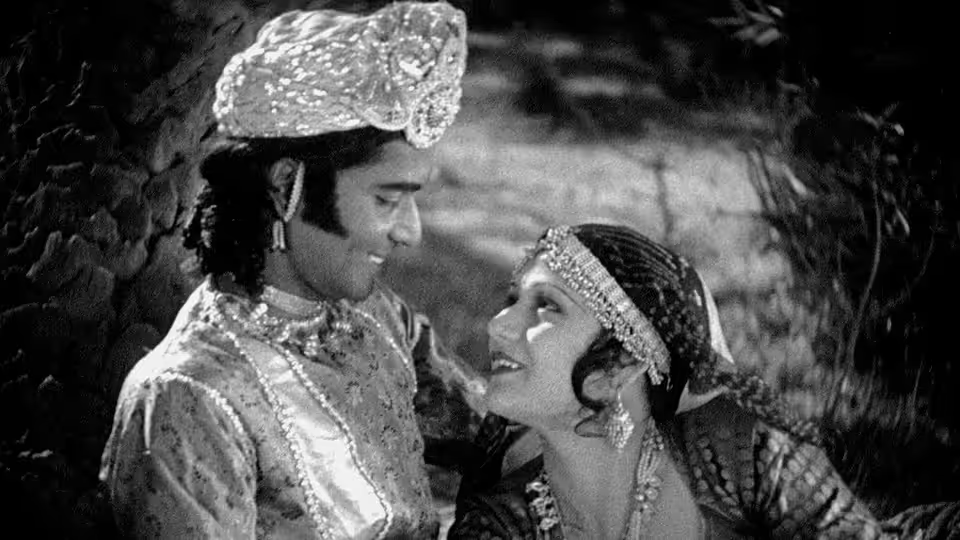
Emil Schünemann’s photography is the reason to see it. He shoots the hunt from low down, so the elephants come through the tall grass at the height of a man’s head, and he holds the palace exteriors wide enough that the crowds fill the frame from edge to edge with nobody obviously looking at the camera. The river scenes at Kanwa’s hermitage are quieter: Sunita in mid-shot against water and light, the background gone soft. Interiors are sparer and staged like a play, and the difference tells you where the money went, which is outdoors, where it shows.
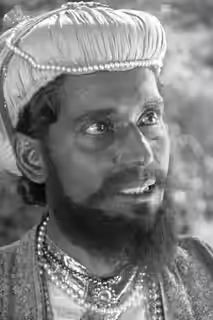
Seeta Devi is the best thing in front of the camera. Silent acting of this period tends to shout, and she does not; she watches, waits and lets a small change of expression do the work. Charu Roy’s Ranjit is handsome and slightly vacant, which suits a king whose only firm intention is to have another go. Rai plays Sohat with lowered eyebrows and a way of leaning into doorways, and he is enjoyable in the manner of a pantomime baron, which is not a compliment to the writing.
We did not expect to be moved by any of this, and we were, once. It comes when Sunita realises what Ranjit’s habit is going to cost her, and Seeta Devi plays it without moving anything but her eyes while the intertitle waits its turn. For a moment a fable about kings becomes a film about a woman who has fallen in love with a man who cannot be trusted with his own hands. Osten does not linger on it. He should have.
The print released in 2007 carries a score by Nitin Sawhney, written for that release; Willy Schmidt-Gentner is credited for the original. Sawhney uses strings, tabla and a low pulse underneath, and he is careful not to comment on every gesture. The love scenes get a theme and the hunt gets rhythm, and he leaves the big processions alone to be big. It is a better match for the pictures than most new scores for old films, which tend either to apologise for the silence or to fill it.
The faults are the period’s. Sohat is a villain and nothing else, the intertitles explain what the faces have already told us, and the second half, which we will not describe, turns on a plot device you will see coming from the title. There is also the awkward fact that the camera’s interest in elephants and jewellery is a tourist’s interest; this is India arranged for people who have never been, and every crowd is there to be looked at rather than lived in. The grandeur is real. What it is for is decoration.
It is 74 minutes and it moves. Watch it with the sound up for Sawhney and the lights down for Schünemann, and do not expect the kings to learn anything.