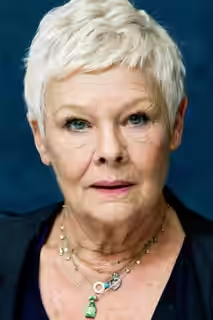
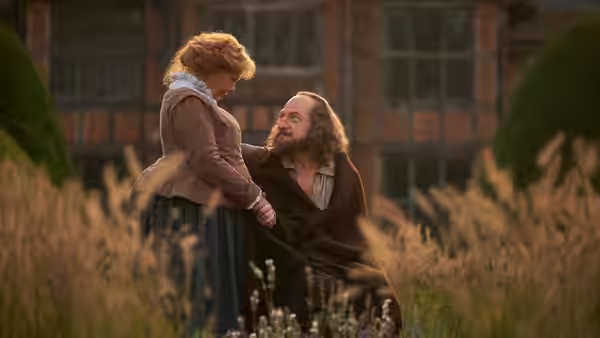
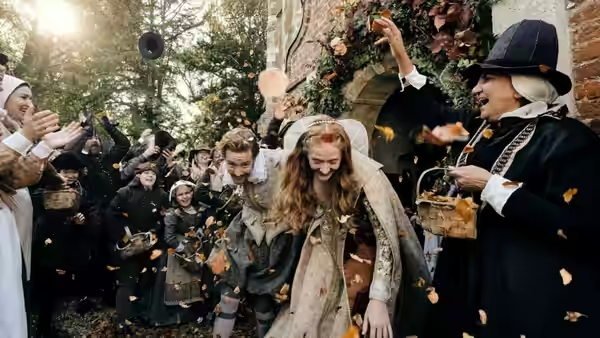
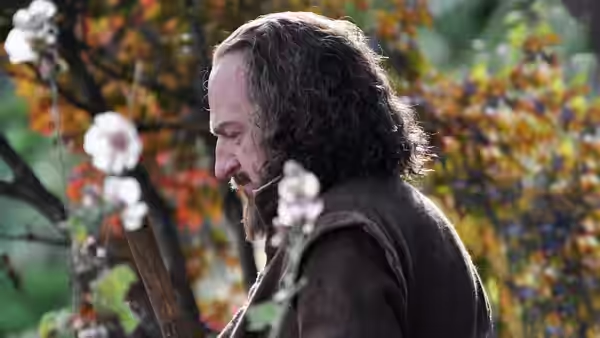
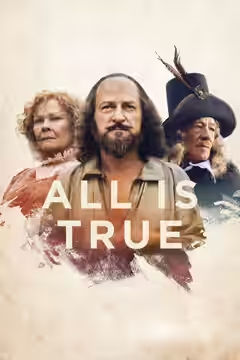
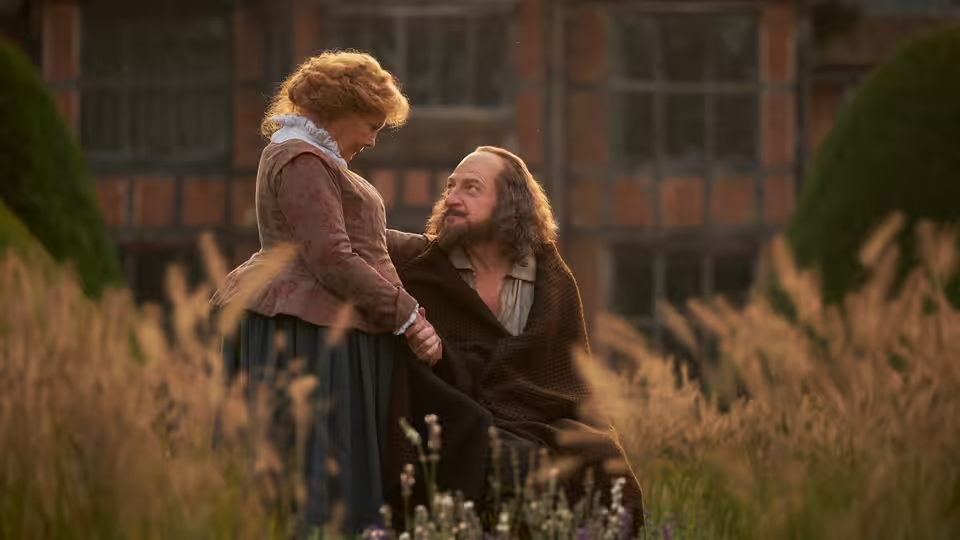
William Shakespeare (Kenneth Branagh) kneels beside Anne Shakespeare (Judi Dench) in a garden
Film review

All Is True

2018 · Directed by Kenneth Branagh · 1h 41m

In a sentenceA film about the greatest writer in English in which everybody says exactly what they mean, at length, twice

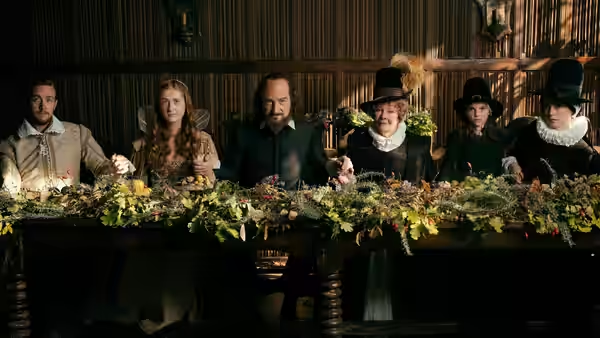
It is 1613 and the Globe has burned to the ground during a performance of Henry VIII, the play also known as All Is True. William Shakespeare (Kenneth Branagh) decides he has written his last and goes home to Stratford-upon-Avon, where his wife Anne (Judi Dench) has run the house without him for twenty years and gives him the guest bed. His daughter Susanna (Lydia Wilson) is married to the Puritan physician John Hall (Hadley Fraser); his daughter Judith (Kathryn Wilder) is unmarried, sharp-tongued and being courted by the vintner Tom Quiney (Jack Colgrave Hirst). Shakespeare wants to plant a garden for his son Hamnet, dead seventeen years, and finds that nobody in the house wants to talk about the boy. The Earl of Southampton (Ian McKellen) is expected to pass through.

Plays from YouTube when you press play; nothing loads from them until then.

Fi1m review

Kenneth Branagh’s Shakespeare goes home to Stratford to grieve, dig a garden and be told off by his family. Judi Dench and one firelit scene with Ian McKellen are worth the evening; Ben Elton’s script keeps explaining what the actors have already shown us.

Kenneth Branagh directs and plays William Shakespeare in a 101-minute film written by Ben Elton about the three years after the playwright stopped writing. The idea is a fair one. Here is a man who put more grief on a stage than anyone before or since, and who has never once sat with his own. The Globe burns, he goes home to Stratford, and the house he paid for is full of people who have managed without him. We will say plainly what we thought: there are two or three scenes here that justify the price of a ticket, and between them a great deal of talking about feelings that the actors had already made perfectly clear.

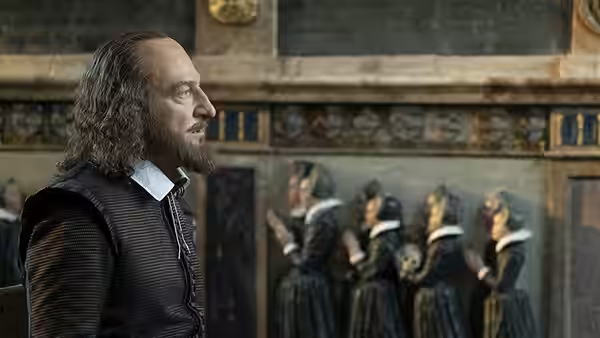
The first problem is the nose. Branagh has given himself a prosthetic beak and a receding hairline modelled, we assume, on the famous engraving, and for the first twenty minutes we were looking at the make-up rather than the man. That settles, eventually. Underneath it he plays Shakespeare as a soft-spoken, hesitant figure, apologising his way around his own kitchen, and it is a decent choice. The trouble is that Elton keeps handing him lines that announce what he is feeling, so that a face that has just told us he is ashamed is followed by a speech saying so.

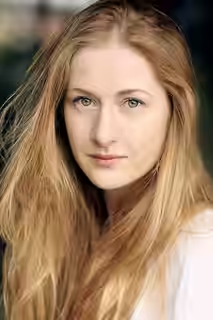
Judi Dench is the reason the domestic half of the film holds. Her Anne cannot read a word her husband wrote, and she has not forgiven him for being famous somewhere else. Dench plays her flat, patient and watchful, and when she shows him to the guest bed she does it as a woman settling an account rather than making a point. Kathryn Wilder’s Judith is the other live wire, angry with her father and unable to stop looking at him. Lydia Wilson has less to do as Susanna, and Hadley Fraser’s John Hall is written as a Puritan scold and played as one.

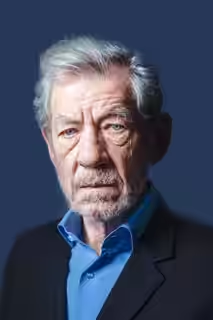
Then Ian McKellen arrives, and for ten minutes the film is what it wanted to be. Southampton sits by the fire with the man who once wrote him love poems, and the two of them speak a sonnet to each other, first as courtesy, then as something else. Zac Nicholson keeps the camera still and lets the candles do the work, so that two old faces hang in the dark. Patrick Doyle’s score stops. It moved us more than we expected, and the reason is simple: for once nobody is explaining anything, and two actors who have spent their lives inside this verse are allowed to show us what it does to them.

The rest of the craft is sober and handsome. Nicholson shoots the interiors by candlelight and the exteriors in flat grey Warwickshire weather, and James Merifield’s house is all low beams and dark wood, a place where sound carries. Michael O’Connor dresses everyone in black wool and keeps the collars plain. Úna Ní Dhonghaíle cuts at the pace of a man walking to his garden, which is right for the mood and hard on the middle hour. Doyle’s strings, so well held back by the fire, elsewhere lean on scenes that did not need leaning on.

The middle hour is where we drifted. Elton has strung together the documented incidents of the Stratford years, Judith’s courtship, an accusation against Susanna from a neighbour called John Lane (Sean Foley), a visit from Ben Jonson (Gerard Horan), and each arrives as an episode, is discussed, and is put away. We were bored, and then we were irritated with ourselves for being bored in the company of Dench and Branagh, and then we decided the fault was the script’s. The second half holds revelations about the family we will not describe. They are not bad ideas. They are delivered as speeches.

Branagh’s Henry V and Hamlet were films by a man who could not wait to get the words out. This one treats its subject with a hush that keeps the words at arm’s length, as if the great man might be disturbed. Most critics split down the middle on it and so, in the end, did we.

See it for Dench and for the fire. It is a film for a wet evening at home, where its slowness becomes companionable and the nose is smaller, and where you can be forgiven for going to put the kettle on while somebody explains a hollyhock.
Critical consensus AI synthesised

54
Positive
3
Mixed
10
Negative
7

The reviews lean mixed, and the warmest of them are modest. Most critics find the film quiet, melancholy and sincere, a small portrait of Shakespeare’s last years that is more likeable than compelling. The praise lands almost entirely on one scene: the firelit exchange between Branagh and Ian McKellen’s Earl of Southampton, which even the harshest reviews single out as a reminder of how well both men speak the verse. Judi Dench and Kathryn Wilder are also credited with giving the household more spirit than the writing allows them.

The reservations cluster on that writing. Critics call the script expository, solemn and short on incident, and several find Branagh’s prosthetic nose and wig a distraction. The spread is wide. The Telegraph gives the film four stars as a witty meditation on legacy, while Variety dismisses it as a sloppy soap opera, and most of the twenty sit somewhere in the unenthusiastic middle.

The Telegraph
7 February 2019 · ★★★★ · Tim Robey
80

Robey gives the film a positive review. He praises its witty, lovely meditation on Shakespeare’s legacy.

Read the full review →
The AV Club
7 May 2019 · B · Mike D'Angelo
77

D’Angelo finds the film a credible, engrossing melodrama, though its family drama cannot compete with Shakespeare’s enduring genius. He especially praises Branagh’s ardent recitation of a sonnet to the Earl of Southampton.

Read the full review →
Slant Magazine
6 May 2019 · ★★★/4 · Wes Greene
75

Greene finds the film an intimate, thoughtful portrait that makes Shakespeare feel human, despite occasional clunky dialogue. He especially praises the monologue about Shakespeare’s deceased son as a striking expression of the playwright’s flaws.

Read the full review →
The Guardian
21 December 2018 · Peter Bradshaw
68*

Bradshaw finds the film sentimental, likable and melancholy, though some moments feel less sure. He particularly praises the elegantly managed exchange between Shakespeare and the Earl of Southampton.

Read the full review →
Empire
6 February 2019 · Helen O'Hara
65*

O’Hara finds the film quiet and meditative, with an elegiac sense of regret, though it lacks incident and high stakes. She singles out the confrontation between Shakespeare and the Earl of Southampton as quietly devastating.

Read the full review →
RogerEbert.com
64*

The blocked page provides no critic verdict. It offers no information about what the critic praised or criticized.

Read the full review →

Straight answers AI written, from our review

Is All Is True worth watching?
All Is True is worth watching for Judi Dench and one firelit scene with Ian McKellen, and not for much else; we scored it 58. Kenneth Branagh's hushed, grieving Shakespeare is a fair idea, but Ben Elton's script keeps explaining what the actors have already shown, and the middle hour drifts. Best for a wet evening at home with the kettle within reach.
How long is All Is True, and what is it rated?
All Is True runs 1h 41m. It is a drama and history film.
Where can I watch All Is True in Slovenia?
All Is True is not on any streaming or rental service in Slovenia at the moment. It is available in 47 other countries; change your country at the top of the page to see where. Availability is checked daily.
How violent or frightening is All Is True, and is it suitable for children?
All Is True is a 12A and contains nothing violent or frightening; it is a quiet domestic drama about a family that will not talk about a dead child. The Globe burns in the opening minutes, but the rest is grief, candlelight and conversation. Children will be bored rather than upset; teenagers who know the plays may find more in it.
How does All Is True compare to Shakespeare in Love?
All Is True and Shakespeare in Love share a subject and almost nothing else: Branagh's film is the same man thirty years older, grieving in Stratford, while John Madden's is a young playwright falling in love, played for comedy. The earlier film is the livelier and the better of the two. Choose All Is True only for Dench, McKellen and a slower, sadder evening.
What should I watch after All Is True?
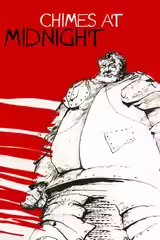
After All Is True, try Shakespeare in Love (1998, Fi1m 79): The same man thirty years younger, played for comedy, and the better for it. Then Mr. Turner (2014, Fi1m 84): Another English genius grunting round a house; Mike Leigh never once explains him; and Chimes at Midnight (1965, Fi1m 88): Orson Welles’s Falstaff, the finest film ever made from the plays themselves.

Cast

If you liked this, try…

  1. Shakespeare in Love (1998, Fi1m 79)The same man thirty years younger, played for comedy, and the better for it.

  2. Mr. Turner (2014, Fi1m 84)Another English genius grunting round a house; Mike Leigh never once explains him.

  3. Chimes at Midnight (1965, Fi1m 88)Orson Welles’s Falstaff, the finest film ever made from the plays themselves.

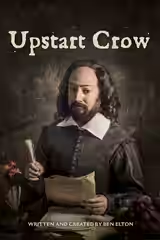
  4. Upstart Crow (2016) · not reviewed yetBen Elton’s sitcom Shakespeare, same household quarrels, far more jokes landing.

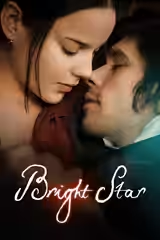
  5. Bright Star (2009, Fi1m 82)Jane Campion on Keats; grief, verse and candlelight handled with a lighter touch.