Justine Triet’s courtroom drama refuses to say whether Sandra Hüller’s novelist pushed her husband, and is the better for it. Hüller is remarkable, the script is exact, and the 151 minutes could lose ten without anyone noticing.
Justine Triet’s film opens with an interview that cannot happen. Sandra Voyter (Sandra Hüller), a novelist, is talking to a student (Camille Rutherford) in the kitchen of her chalet when her husband, Samuel Maleski (Samuel Theis), upstairs, puts on a steel-band cover of 50 Cent’s P.I.M.P. at a volume that ends the conversation. The title tells you there is a fall. The film never shows it, and the rest of its 151 minutes is a trial in which Sandra must account for what she did or did not do that afternoon. That is the first thing to know about it.
Triet and Arthur Harari’s script understands that once the physical evidence runs out, and here it runs out early, a trial becomes an argument about what sort of person the accused is. So the court hears about the marriage: who worked and who did not, whose career was going well, whose book borrowed from whose life. The prosecutor, played by Antoine Reinartz as a man who enjoys his job a little too visibly, reads passages from Sandra’s novels aloud as if they were confessions. Her lawyer, Vincent Renzi (Swann Arlaud), an old friend who may once have been more, tells her early on that the truth is not the point; being believed is.
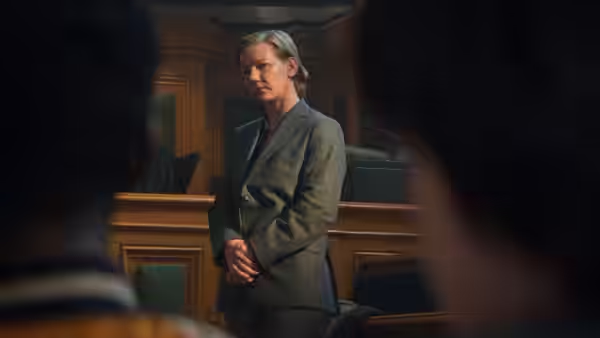
Hüller is remarkable, and the way she is remarkable is hard to describe because she does so little. Sandra is German, living in France, and she speaks English at home because it is the language neither she nor her husband grew up in. In court she is made to speak French, imperfectly, and the film lets us hear how each hesitation counts against her. Hüller gives her a face that does not perform grief or innocence for anyone’s benefit, and the court keeps trying to read it. We could not read it either.
Simon Beaufils shoots the chalet in flat winter light, pale pine and snow glare through the windows, so the house looks unfinished, which it is. Emmanuelle Duplay’s production design gives it exposed insulation and half-built rooms, a renovation Samuel Maleski was doing himself. In the courtroom Beaufils keeps drifting off whoever is speaking to whoever is listening, so testimony becomes something we watch land on faces. Laurent Sénéchal cuts the reconstructions the court demands as if they were memories, which nobody in the court has. There is no composer credited and no score; the only music is what people in the story choose to play, and that 50 Cent cover is the film’s best joke.
Around Hüller the cast is exact. Arlaud plays Renzi as a decent man who has to be a little indecent to do his job, and shows the discomfort. Milo Machado-Graner, as Daniel, the only other person at the house that day, carries the film’s last hour without one false note of child-actor sweetness. Jehnny Beth is quietly good as Marge Berger, the court officer sent to live with him during the trial. Samuel Theis, as Samuel Maleski, appears mostly in other people’s accounts of him, and makes the man real enough that the accounts hurt.
There is a scene in the second half, the one everyone talks about, and we will not describe it beyond saying that it is a marital argument, that the script gives neither party the last word, and that we sat through it rigid. It is the most honest row we have seen in a film for years. What did it was the ordinariness: nobody says anything they could not have said in your kitchen.
The film has faults. At 151 minutes it repeats itself; there are two stretches of expert testimony about angles and blood that make the same point, and the second could go. The prosecution’s case, late on, leans on a reading of fiction as autobiography that the film has already taken apart, and Triet lets the court restate it once more than she needs to. And Reinartz is pitched a shade too close to villainy for a film that is otherwise so careful not to take sides.
Triet’s earlier films, Victoria and Sibyl, were also about clever women whose private lives got into their work, and this is the one where the form finally fits. As a courtroom film it stands with the best of them, because it would rather you left arguing than satisfied. Watch it with someone whose opinion you trust, and expect to disagree with them on the way home.