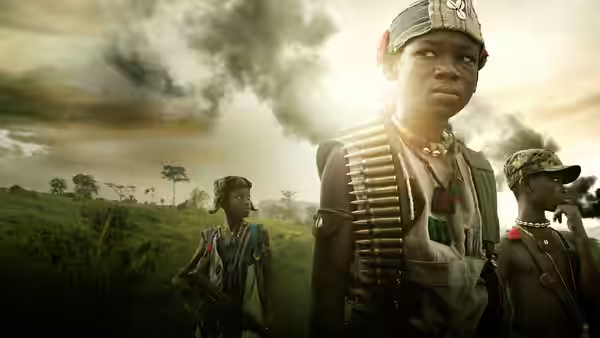
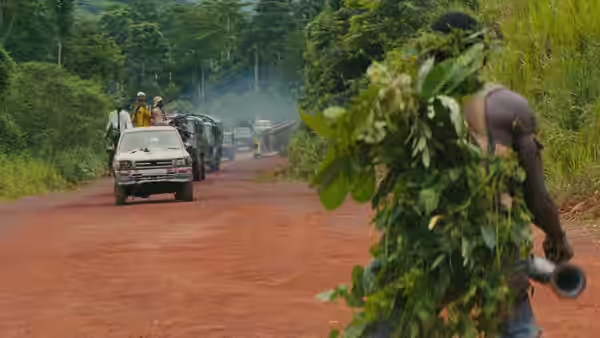
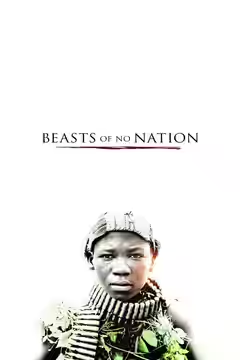
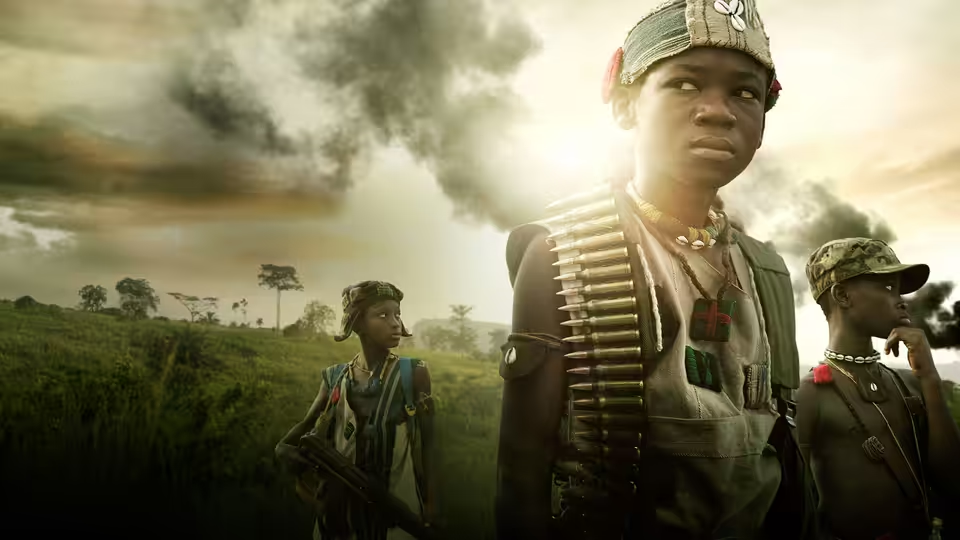
Agu (Abraham Attah) stands armed with fellow child soldiers beneath drifting smoke
Film review

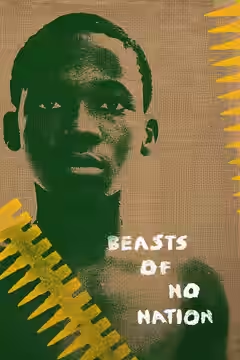
Beasts of No Nation

2015 · Directed by Cary Joji Fukunaga · 2h 17m

In a sentenceIdris Elba builds a battalion out of children, and the frightening thing is how reasonable he sounds

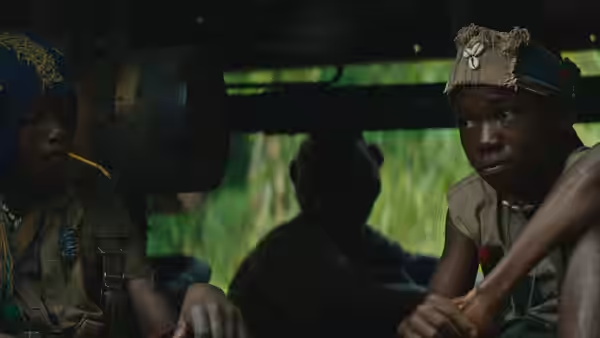
An unnamed West African country, in the middle of a civil war. Agu (Abraham Attah) lives in a village inside the buffer zone, where his father (Kobina Amissah-Sam) teaches and his mother (Ama K. Abebrese) keeps the house, and spends his days with friends trying to sell an “imagination TV”, a television with no insides, to the soldiers at the checkpoint. The fighting reaches the village. His mother and baby sister are put on a bus to the capital; the men stay, and government troops arrive. Agu runs into the bush alone and is picked up by a battalion of rebel fighters, many of them boys, led by a man known only as the Commandant (Idris Elba). A mute boy, Strika (Emmanuel Nii Adom Quaye), becomes his closest companion as the Commandant sets about making him a soldier.

Plays from YouTube when you press play; nothing loads from them until then.

Fi1m review

Cary Joji Fukunaga’s drama about a boy swept into a West African civil war is beautifully made and, for an hour, close to unbearable in the right way. The second hour goes on too long and the horrors start to blur into a list.

Cary Joji Fukunaga wrote, directed and shot this adaptation of Uzodinma Iweala’s novel, about a boy taken by a civil war in a West African country the film never names. It is serious, well acted and for its first hour close to unbearable, which is to its credit. It then runs another hour and ten minutes, and the longer it goes on the less it has to add. Good, then, and worth your evening, with a warning about what the evening will be like.

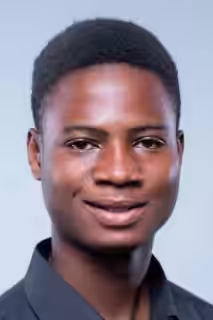
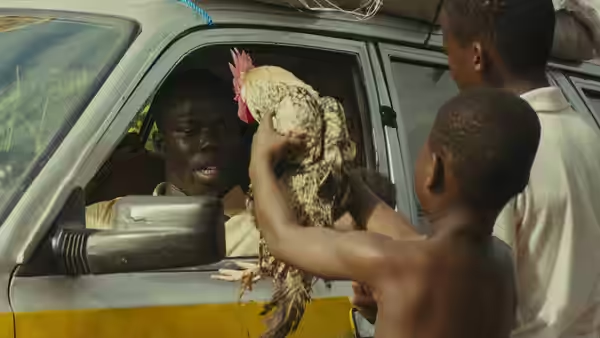
The opening is the best stretch. Agu (Abraham Attah) is trying to sell an “imagination TV”, a television set with the insides taken out, to soldiers at a checkpoint: you look through the empty frame and the boys act the programmes for you. Fukunaga shoots the village in deep green and hard afternoon light, and for half an hour there is a father (Kobina Amissah-Sam) who teaches, a mother (Ama K. Abebrese), a baby sister, and a war that is somewhere else. Then it is not somewhere else. Attah had never acted before this and never seems to be acting; he watches, and the film trusts us to watch him.

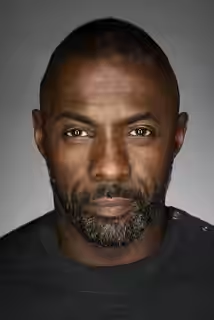
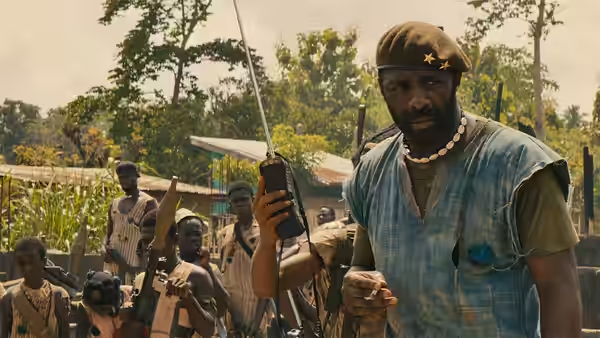
Idris Elba, who also produced, plays the Commandant of the rebel battalion that finds Agu in the bush. It is a performance built on talk. He gives his boys speeches about courage and family and the enemy in a slow, rolling voice that rarely needs to rise, and what frightened us was that we could feel the pull of it from a sofa; Agu is a child with nobody left. The beret and the swagger are the easy part. The hard part, which Elba gets, is that this man is both a father to these children and the worst thing that will ever happen to them.

The craft holds up throughout. Fukunaga’s long take through a village under attack, following Agu from doorway to doorway while the shooting carries on around him, is the set piece and it earns the name: we were holding our breath without having decided to. Later an assault is filmed with the colour drained to a flat pink, after the boys have been given a drug, so the violence looks like a bad dream, which is how Agu is seeing it. Inbal Weinberg’s rebel camp is tarpaulins, looted furniture and a radio. Jenny Eagan puts the boys in football shirts and wigs a size too big, so a line of them looks like a school trip gone wrong. Dan Romer’s score is a low electronic hum under the pictures, and it never tells us when to cry.

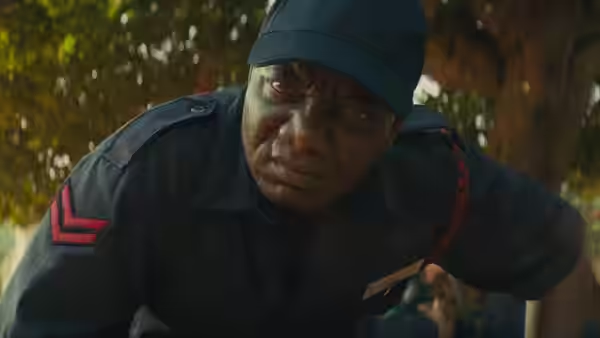
The trouble is length and shape. Mikkel E.G. Nielsen and Pete Beaudreau have cut it to 137 minutes, and from the midpoint the film becomes a series of atrocities joined by marching. We were horrified by the first killing, as we were meant to be; by the fifth we noticed we were counting, and a film about a child going numb should not let its audience go numb beside him. Agu’s voiceover, addressed to God and to his mother, tells us what we have just seen and how he feels about it, when the pictures have usually said it already. A visit to the rebels’ headquarters in the city, where Jude Akuwudike’s Supreme Commander Dada Goodblood receives the Commandant, is the one point where the war acquires a politics, and it is over quickly.

The second half goes places we will not describe. We will say that the film handles the worst of them with a restraint some critics have called a failure of nerve, and that we were grateful for it. The ending is quieter than everything before it, and it is the right one.

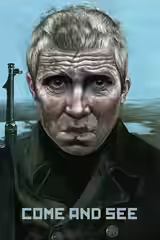
Come and See (1985) remains the standard for films about a child inside a war, and it has the same shape: a boy’s face recording horrors until the face itself is the subject. Klimov holds on that face far longer than on anything the boy sees. Fukunaga shows us more of what Agu sees, and by the end we felt less. It is a good film all the same, with a fine performance from Elba and an unaffected one from Attah, and it would be a better one with half an hour gone. Watch it at home with the door shut and nothing planned for afterwards. It carries a 15, and the certificate is not being cautious.
Critical consensus AI synthesised

70
Positive
15
Mixed
7
Negative
2
IndieWire
2 September 2015 · festival review · Demetrios Matheou
90*

Matheou finds the film harrowing, heartbreaking, and every bit as good as hoped. He singles out Idris Elba’s nuanced performance and Fukunaga’s forceful storytelling as giving the film its power.

Read the full review →
Los Angeles Times
15 October 2015 · 4 stars · Michael Phillips
88*

Phillips calls the film gripping, empathetic, and dramatically indelible. He singles out Idris Elba’s richly troubling performance and Abraham Attah’s striking portrayal of Agu for praise.

Read the full review →
Empire
16 October 2015 · David Hughes
80*

Hughes calls the film searingly powerful and unflinchingly brutal, while noting its bleakness may be difficult for audiences to stomach. He particularly praises Abraham Attah’s assured performance and Idris Elba’s formidable presence.

Read the full review →
Radio Times
★★★★ · Damon Wise
80

Wise calls the film overlong but intense and extraordinary. He singles out its powerful depiction of a child forced into war.

Read the full review →
The Guardian
11 October 2015 · ★★★★ · Mark Kermode
80

Kermode finds the film harrowing and heartbreaking, praising its uncompromising depiction of a child soldier’s descent into violence. He singles out Idris Elba’s terrifying charisma and the film’s cinematography and score for giving the story epic sweep.

Read the full review →
Total Film
5 October 2015 · ★★★★ · Neil Smith
80

The critic finds the film gripping and harrowing, though somewhat overlong. He praises Abraham Attah’s portrayal of Agu’s gradual loss of innocence.

Read the full review →

Straight answers AI written, from our review

Is Beasts of No Nation worth watching?
Beasts of No Nation is worth watching for anyone prepared for a serious, well-made and often harrowing drama about a child soldier, and we scored it 72. The first hour is close to unbearable in the right way, with a fine performance from Idris Elba and an unaffected one from Abraham Attah. The second hour runs too long and the horrors start to blur.
How long is Beasts of No Nation, and what is it rated?
Beasts of No Nation runs 2h 17m. It is a drama and war film.
Where can I watch Beasts of No Nation in the UAE?
Beasts of No Nation is streaming on Netflix in the UAE. Availability is checked daily; the links above go straight to each service.
How violent or frightening is Beasts of No Nation, and is it suitable for children?
Beasts of No Nation is a 15 in the UK and R in the US, and the certificate is not being cautious; this is not a film for children. It shows a boy drafted into a rebel battalion, killings filmed at close quarters, a drugged assault and worse in its second half, handled with some restraint. The squeamish should think carefully.
How does Beasts of No Nation compare to Come and See?
Beasts of No Nation is measured against Come and See, and the earlier film is the stronger of the two. Both follow a boy whose face records the horrors of a war, but Klimov holds on that face far longer, while Fukunaga shows more of what Agu sees, and by the end we felt less. Fukunaga's is the gentler way in.
Is Beasts of No Nation based on a true story or a book?
Beasts of No Nation is based on Uzodinma Iweala's novel of the same name, adapted for the screen by Cary Joji Fukunaga, who also directed and shot it. It is not a true story, and the West African country in which it is set is never named. You do not need to have read the book to follow the film.
What should I watch after Beasts of No Nation?
After Beasts of No Nation, try Come and See (1985, Fi1m 92): Klimov’s Belarusian boy in the war; the film this one is measured against. Then Empire of the Sun (1987, Fi1m 81): Spielberg’s boy in a Shanghai camp, learning to admire the men who hold him.

Cast

If you liked this, try…

  1. Come and See (1985, Fi1m 92)Klimov’s Belarusian boy in the war; the film this one is measured against.

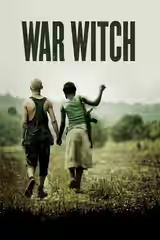
  2. War Witch (2012) · not on Fi1m yetA Congolese girl soldier, told with ghosts and far fewer gunshots.

  3. Johnny Mad Dog (2008) · not on Fi1m yetLiberia’s child fighters played by former child fighters; rougher and angrier.

  4. Empire of the Sun (1987, Fi1m 81)Spielberg’s boy in a Shanghai camp, learning to admire the men who hold him.

  5. Sin Nombre (2009) · not on Fi1m yetFukunaga’s first film: a gang boy on a train north, shot with the same eye.