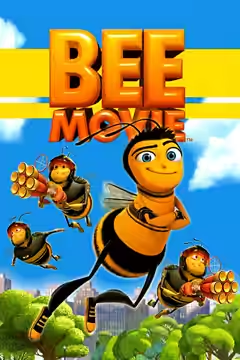
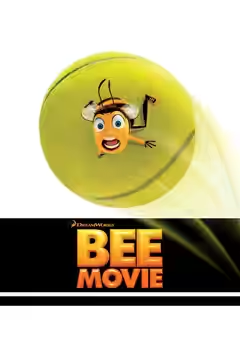
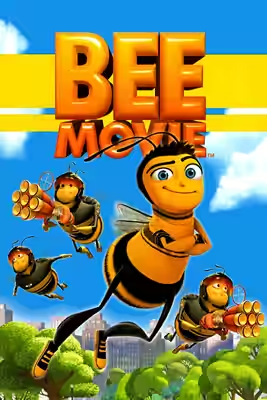
Jerry Seinfeld gives Bee Movie an amiable, fussy comic voice, but the jokes never quite become a story. Some of the absurdity is welcome; the thin animation and muddled writing make it hard to recommend.
A bee learning how to work ought to give a comedy plenty to complain about. Bee Movie gets some amusement out of that premise, then struggles to find a story that can sustain its chatter. Directors Simon J. Smith and Steve Hickner keep things amiable, and Jerry Seinfeld’s voice gives the film a pleasingly aggrieved tone. It is a mixed family comedy with appealing performers and too many jokes that seem to have arrived before anyone asked where they belonged.
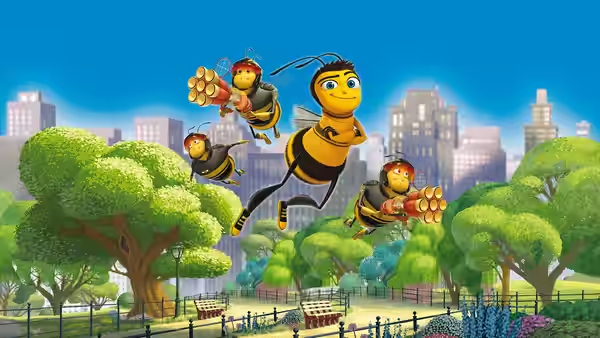
We laughed at Barry learning how to be a working bee. Jerry Seinfeld’s delivery makes the business of employment sound faintly unreasonable, which is a useful attitude for a creature expected to get on with it. The performance is conversational enough to let a small complaint remain small, without treating every line as the cue for an enormous reaction. Matthew Broderick, voicing Adam Flayman, supplies an agreeable gentleness, although the film does not give the surrounding characters enough weight.
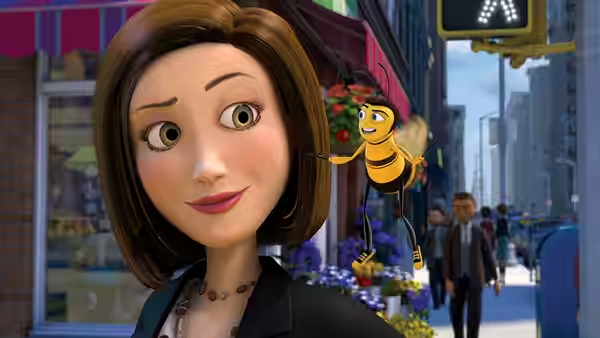
The larger difficulty is Barry’s relationship with Vanessa Bloome, voiced by Renée Zellweger. She gives Vanessa warmth, and the strangeness of the pairing has comic possibilities, yet the writing never makes their interest in each other convincing enough. We are willing to accept a talking bee; we still need a reason to care whom he talks to. Too many of these exchanges feel like opportunities for another line rather than scenes between characters with anything at stake.
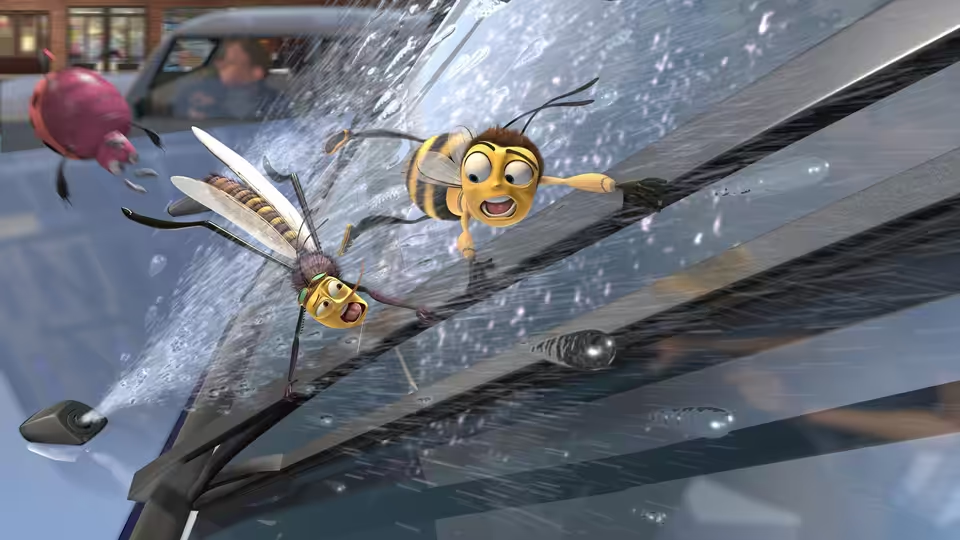
Barry getting trapped in a car is more immediately engaging because the problem is visible. David C. Lawson’s cinematography makes the disparity in scale easy to follow, and a small insect in a large vehicle is a sound basis for physical comedy. Alex McDowell’s production design is less rewarding: the settings are clear enough, but seldom interesting enough to draw the eye away from whoever is speaking. The animation can look flat, especially for a film whose change of scale ought to offer so much to look at.
The screenplay, credited to Barry Marder, Andy Robin, Jerry Seinfeld and Spike Feresten, is much happier making individual observations than connecting them. Its questions about individuality and conformity get tangled, so that Barry’s frustrations never develop into much worth thinking about. A family comedy need not settle a philosophical dispute, but it should know what it admires in its hero. Here the changes of direction too often suggest another sketch has started, with the previous one left unfinished.
Nick Fletcher’s editing gives the shorter comic exchanges a reasonable pace, but the action material exposes how little momentum the story has built. Movement starts to feel like a way of filling the running time, even though that is only 91 minutes. Rupert Gregson-Williams’s music supplies a cheerfulness the dialogue does not always earn, keeping us company without making the comedy much funnier. The action stretches are where the film most needs a joke that can justify the interruption.
There is no need for a family comedy to be noisy or frantic, and we would not trade this one’s mildness for either. What it needs is a stronger reason to follow Barry once the pleasure of hearing his voice has worn off. The performers provide scattered amusement, but not enough to make this an easy recommendation. Try it only if Jerry Seinfeld’s conversational grumbling is already part of the appeal.