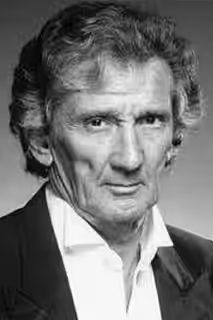
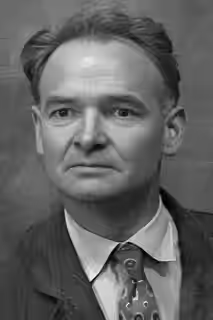
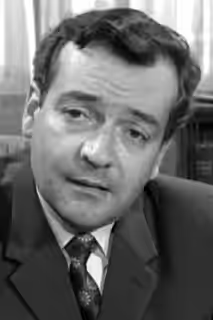
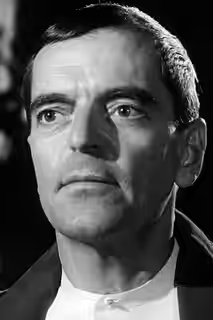
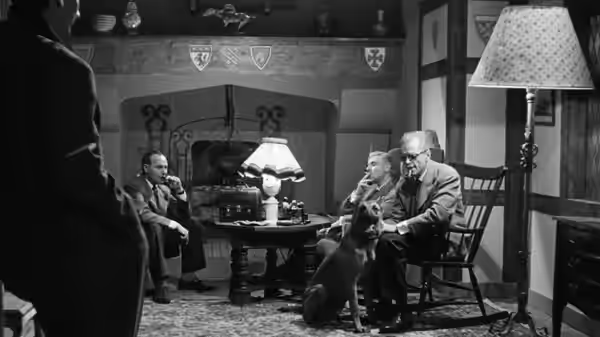
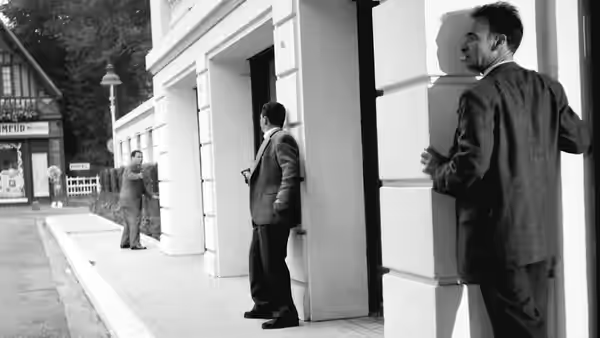
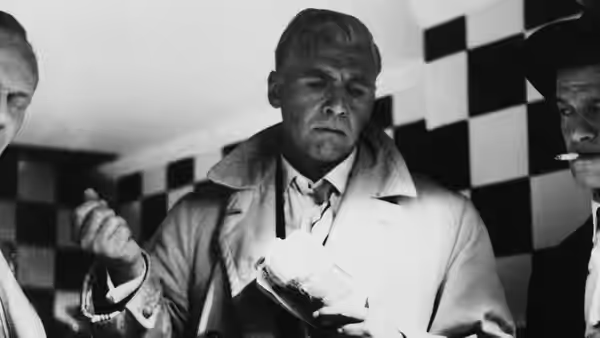
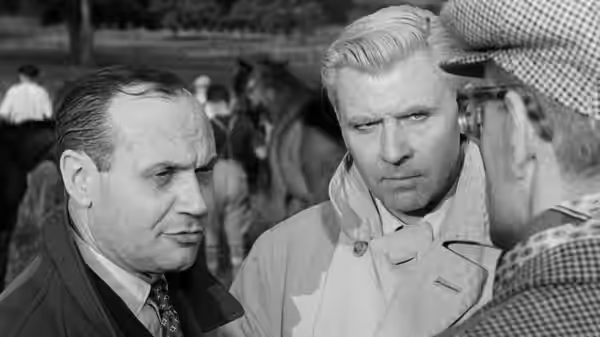
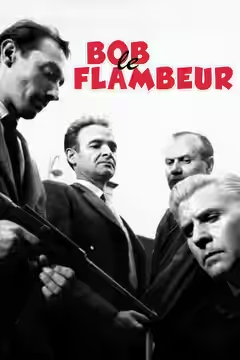
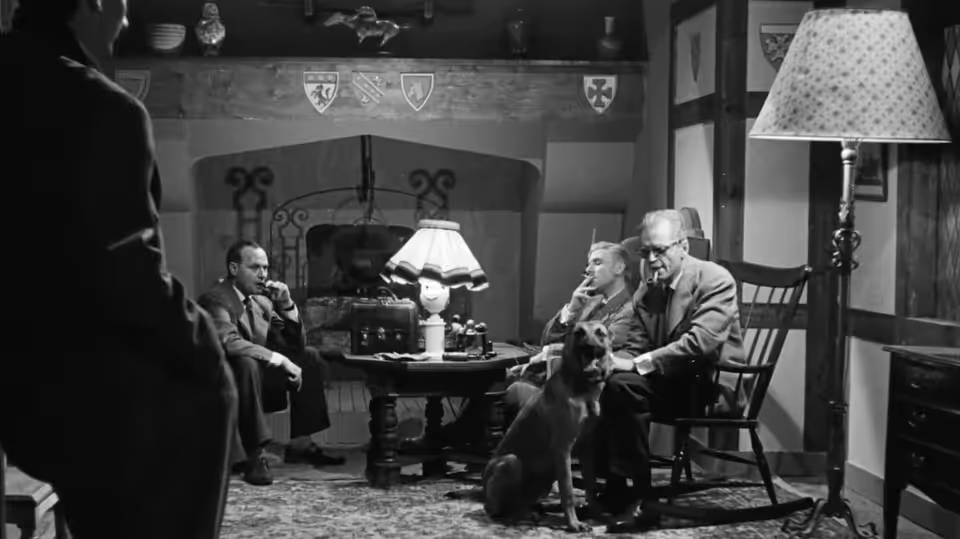
A group of men gather around a table in a dimly lit room
Film review

Bob le Flambeur

1956 · Directed by Jean-Pierre Melville · 1h 43m

In a sentenceRoger Duchesne makes being a respectable criminal look considerably less tiring than having a proper job

Robert ‘Bob le Flambeur’ Montagné (Roger Duchesne) is the criminal at the centre of Jean-Pierre Melville’s drama, set amid the night-time life of Montmartre. Anne (Isabelle Corey) and Paulo (Daniel Cauchy) share his surroundings, while Police Commissary Ledru (Guy Decomble) represents the law. The circle also includes Marc (Gérard Buhr) and Jean, the Croupier (Claude Cerval). Between Montmartre and Pigalle, with neon still burning towards dawn, the film follows people whose independence matters to them, taking its time over the neighbourhood in which their paths cross.

Fi1m review

Jean-Pierre Melville’s leisurely crime film earns its appeal through Roger Duchesne and a persuasive feeling for nocturnal company. We recommend it for the people and the atmosphere, with a caveat: its dramatic urgency is considerably less reliable.

Bob le Flambeur is a good crime film for an evening when the company matters more than the pace. Jean-Pierre Melville gives individual character enough attention that we become interested in people before demanding to know what they will do. That patience produces an appealing warmth, although it also leaves stretches in which the film seems rather too satisfied with merely spending time in its own surroundings. At 103 minutes, it is hardly an endurance test, but its relaxed manner will not suit every appetite for criminal business.

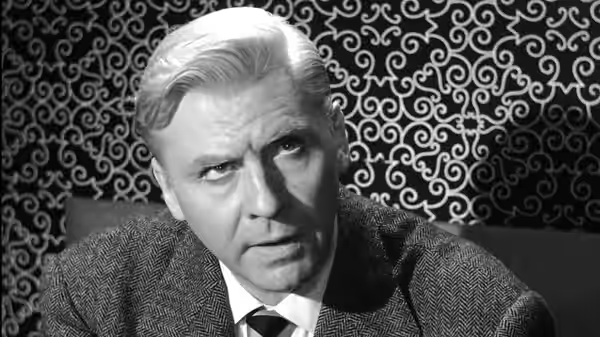
Roger Duchesne is the principal reason to stay. As Robert ‘Bob le Flambeur’ Montagné, he has a composure that makes the character’s independence attractive without requiring us to mistake him for a model citizen. We felt unexpectedly fond of Bob; the performance’s lack of pleading allows affection to develop without the usual insistence that a criminal must secretly deserve our approval. There is pleasure in watching an actor give a character this much assurance without making every moment an announcement of how interesting he is.

Henri Decaë’s cinematography gives the nocturnal surroundings comparable importance. The movement from Montmartre towards Pigalle, and the neon lingering into dawn, establish a neighbourhood with hours and habits of its own. We liked the sense that daylight is an inconvenience these people have learned to accommodate, rather than a signal that the film must immediately become brisker. Claude Bouxin’s production design belongs comfortably within that atmosphere; it serves the people occupying these spaces without making their surroundings compete for our attention.

The difficulty is that atmosphere can carry a scene only so far, and the writing by Jean-Pierre Melville and Auguste Le Breton sometimes asks it to carry more than it should. Anne, played by Isabelle Corey, and Paulo, played by Daniel Cauchy, do not command the same sustained interest as Bob, leaving an imbalance that charm cannot entirely disguise. Monique Bonnot’s editing respects the leisurely approach, giving the performances room, though we occasionally wanted a firmer decision about when a scene had supplied enough. The patience is welcome until we begin noticing ourselves being patient.

The music by Eddie Barclay and Jo Boyer supplies a useful lightness, helping the film avoid treating every criminal association as grounds for solemnity. Its contribution suits a director interested in the appeal of these people as well as their questionable occupations. Against the crime genre’s appetite for pressure and escalation, this is an unusually companionable approach, and one we mostly enjoy. The drawback is that our involvement remains strongest when Roger Duchesne holds our attention; the surrounding characters do not always sustain it with equal ease.

There is enough personality here to forgive the uneven momentum, provided momentum is not the chief attraction. Jean-Pierre Melville trusts an audience to enjoy manners, company and place, and that trust makes the film easy to settle into. We would recommend it to anyone who enjoys a crime story taking time to notice the people inside it. Choose another evening if what you need is a film that keeps checking the clock.
Critical consensus AI synthesised

3 of 6
Positive
1
Mixed
2
Negative
0
Empire
1 January 2000 · Alan Morrison
75*

The review recommends this cool, elegant crime caper. It praises Melville’s focus on individualistic characters and the night-time mood of Montmartre.

Read the full review →
Time Out
· CPea
65*

The available page identifies this as a review, but its verdict is not visible. The teaser singles out the cable car’s descent from Montmartre to Pigalle and the neon-lit dawn.

Read the full review →
The New York Times
23 June 1982
64*

The page appears to be a review of the 1956 film, but its text is inaccessible, so the critic’s verdict cannot be determined. The URL describes Bob as a gentle criminal, but no praise or complaint from the review is available.

Read the full review →

Straight answers AI written, from our review

Is Bob le Flambeur worth watching?
Bob le Flambeur is worth watching for its characters and nocturnal atmosphere rather than its suspense; we score it 76 out of 100. Roger Duchesne’s quietly assured performance makes the leisurely company appealing, though the supporting characters hold our interest less consistently. We recommend it for an evening when pace is not the priority.
How long is Bob le Flambeur, and what is it rated?
Bob le Flambeur runs 1h 43m. It is a drama and action film.
Where can I watch Bob le Flambeur in Austria?
Bob le Flambeur is not on any streaming or rental service in Austria at the moment. It is available in 12 other countries; change your country at the top of the page to see where. Availability is checked daily.
How violent or frightening is Bob le Flambeur, and is it suitable for children?
Bob le Flambeur carries a US PG certificate, which suggests parental guidance rather than unrestricted suitability for children. The certificate alone does not establish how violent or frightening individual scenes are, so we would not offer a firm reassurance for sensitive children. Its leisurely crime story is more likely to interest viewers who enjoy character and atmosphere.

Cast

If you liked this, try…

  1. Rififi (1955) · not on Fi1m yetFor a more concentrated dose of criminal work and mounting pressure.

  2. The Killing (1956) · not on Fi1m yetAnother criminal enterprise, with considerably less room for anyone to relax.

  3. Le Trou (1960, Fi1m 88)Patient attention to practical work makes the suspense unusually absorbing.

  4. A Colt Is My Passport (1967) · not on Fi1m yetJapanese crime cinema with spare storytelling and an equally assured manner.

  5. The Friends of Eddie Coyle (1973) · not on Fi1m yetFor criminal company whose ordinary conversations carry an uncomfortable weight.