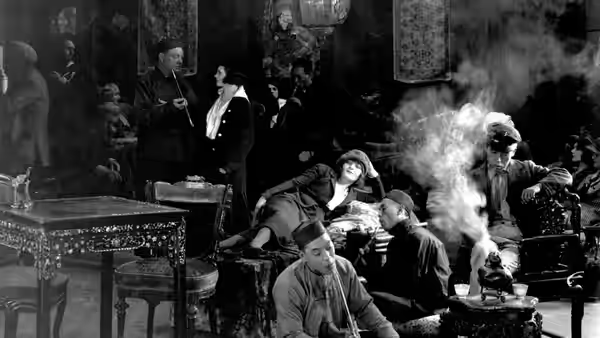
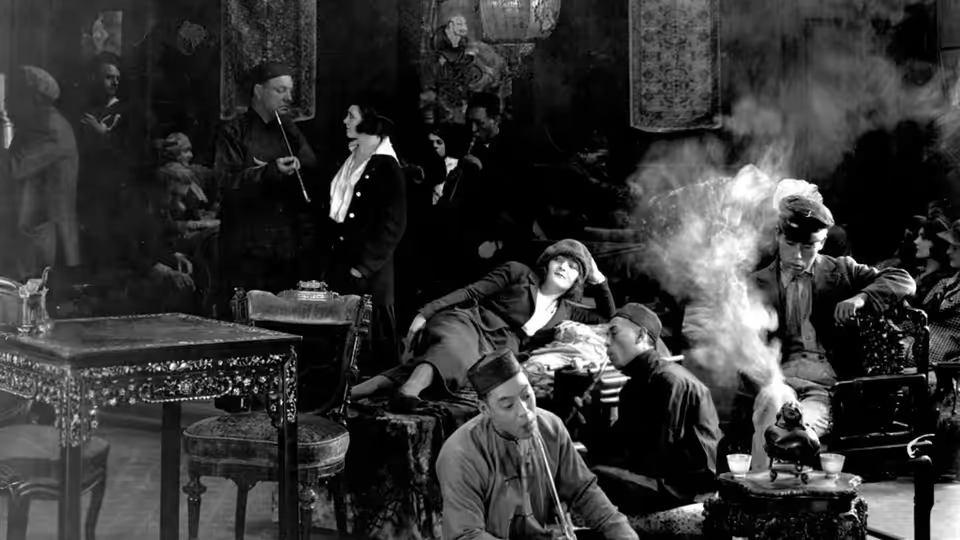
Men gather around tables in a smoky room as one man tends a pipe
Film review

Broken Blossoms or The Yellow Man and the Girl

1919 · Directed by D.W. Griffith · 1h 28m

In a sentenceA plea for tolerance whose own subtitle cannot quite manage it

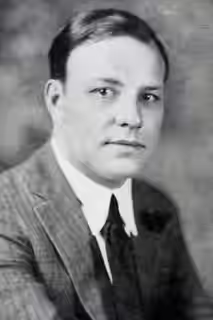
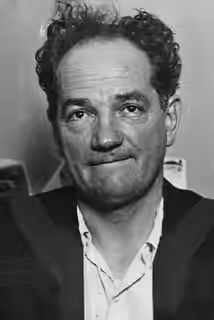
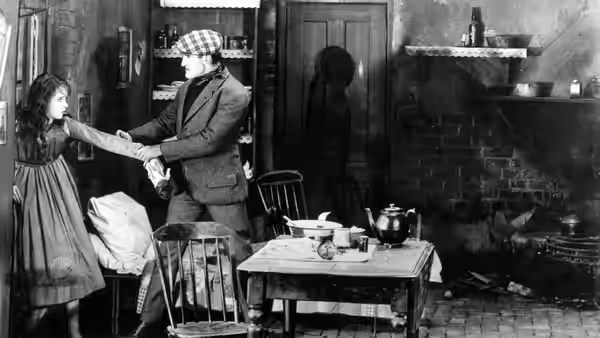
Cheng Huan (Richard Barthelmess) leaves China meaning to carry the Buddha’s message of peace to the West. Years later he keeps a small shop in Limehouse, in London’s docklands, and spends his nights in the opium den across the street. Nearby lives Lucy Burrows (Lillian Gish) with her father, Battling Burrows (Donald Crisp), a prizefighter who comes home from the ring, takes a whip to her and orders her to smile; she can only manage it by pushing the corners of her mouth up with two fingers. Her savings are a few coins wrapped in tinfoil. In the street, Evil Eye (Edward Peil) follows her. Cheng watches her from his doorway. After one beating she staggers out of the house and collapses on his shop floor.

Fi1m review

Griffith’s Limehouse melodrama is small, patient and beautifully photographed, and Lillian Gish gives one of the great silent performances in it. It is also a film about a Chinese man played by Richard Barthelmess in make-up, and no amount of fog softens that.

D.W. Griffith had spent the previous few years on The Birth of a Nation and Intolerance, films with armies in them. Broken Blossoms has three people and a fog machine. It runs 88 minutes, it takes place in a few rooms and one street in Limehouse, and Griffith adapted it himself from a short story by Thomas Burke. It is worth your evening if silent melodrama is a genre you can sit inside. Its two problems are large, and we will name them, but its best half hour is as fine as anything Griffith made.

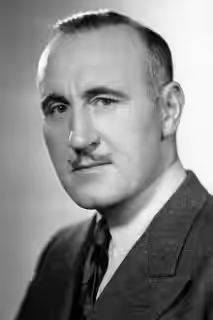
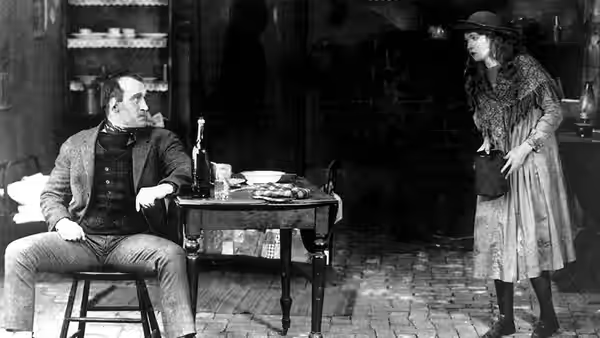
The film belongs to Lillian Gish. Lucy Burrows has never been given a reason to smile, so when her father demands one she pushes the corners of her mouth up with two fingers and holds them there. Gish does this several times, and each time it is worse, because by then we know exactly how much fear is behind the fingers. Donald Crisp’s Battling Burrows is a prizefighter who comes home from the ring and carries on the work on his daughter with a whip, and we were horrified by him in a way we had not expected from a film this old. Crisp does not play him as a monster. He plays him as a man in a good mood who has found something to do with it.

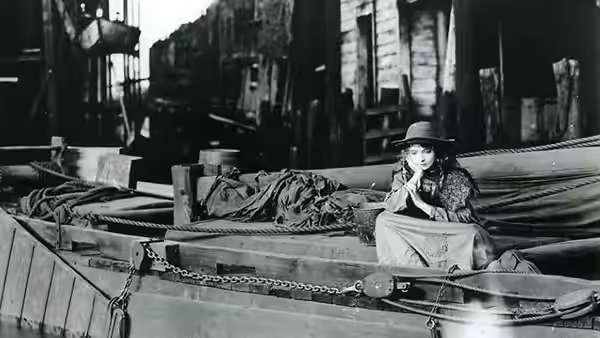
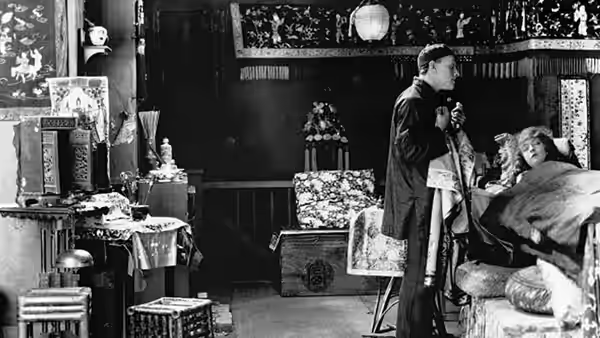
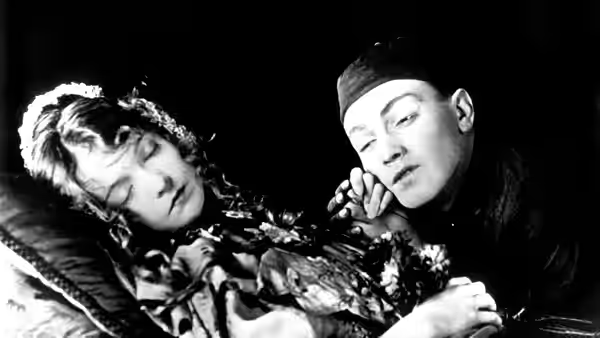
Billy Bitzer photographs Limehouse as a place where the lamps never quite reach the ground. The street is narrow and wet and the dock behind it is a blur of masts. For Gish’s close-ups he softens the focus until her face seems lit from inside, and he shoots Crisp hard and flat. The two rooms are dressed to match: Cheng Huan’s lodging above his shop is silk hangings, a small Buddha and a bowl of incense; the Burrows room is a table, a bed and the whip on a hook. The moment most people remember comes when Cheng looks at the sleeping girl and imagines scattering moonbeams over her, and Griffith lets the picture do it without a title card. We were moved, and slightly surprised to be.

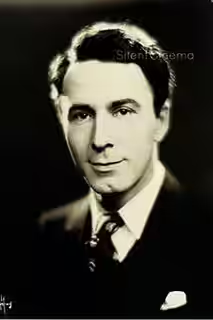
Now the first problem. Cheng Huan is played by Richard Barthelmess, who is white, in make-up, with his eyes narrowed and his hands folded into his sleeves, and the intertitles call him “the Yellow Man” from start to finish. The full title on the print is Broken Blossoms or The Yellow Man and the Girl. Barthelmess is gentle and still, and the film plainly loves the character, but it loves him the way it loves Lucy: as something small and helpless that needs looking after. The other Chinese man of any size in the film is Edward Peil’s Evil Eye, a lecher who trails Lucy down the street. The kindest Chinese man in London and the worst come out of the same make-up box, and the film does not notice. We winced, more than once, and the wince does not go away.

The second problem is the middle. Griffith cuts between Burrows’s bout in the ring and what is happening at home, an old trick of his that still works, and James Smith’s editing there is tight. Elsewhere it is not. Arthur Howard’s manager and Norman Selby’s prizefighter get scenes that exist to give Crisp a reason to leave the house, and George Beranger’s Spying One is a plot device in a hat. For a film of 88 minutes it drags for a good ten of them. The second half takes a turn we will not describe, except to say that Griffith handles it with more restraint than his reputation suggests.

Against Griffith’s own standard it is his most concentrated film, and the one in which he seems least interested in telling us what to think. That is a relief after Intolerance. Gish went on to work with directors who gave her more room, but we have not seen her do anything stronger than the smile.

There is no fixed score; the music you hear will depend on the print you find, and it will make more difference than you expect. Choose one with a piano rather than an orchestra. The film is small and it should sound small.

Critical consensus AI synthesised

74
Positive
3
Mixed
2
Negative
0

With only 5 reviews in so far, the lean is warm without being unanimous. Most critics single out Lillian Gish, whose delicacy against terror is the performance the praise gathers around, with Barthelmess and Crisp noted alongside her. Slant admires Griffith’s picture of Limehouse as a place that kills women; Time Out fixes on one tender moment, Barthelmess’s character imagining moondust for Gish’s. The reservation comes from Variety, which finds the film draggy and padded with extraneous material even while rating the leads. One review cannot be assessed at all, so the spread is provisional.

Slant Magazine
10 August 2003 · ★★★★/4 · Ed Gonzalez
100

Gonzalez finds the film works best as an ode to selfless love and misdirected contempt. He praises Griffith’s photojournalistic evocation of Limehouse as a deathtrap for women.

Read the full review →
Empire
30 March 2006 · David Parkinson
80*

The critic finds it a profound silent drama that challenges the form’s limitations and strict social mores. He particularly praises Lillian Gish’s moving performance and the contrast between her delicacy and terror.

Read the full review →
Time Out
· TM
75*

The review singles out a memorable moment of tenderness. It praises Barthelmess’s character imagining a spray of moondust for Gish’s character.

Read the full review →
RogerEbert.com
65*

The review's verdict is unavailable because the page is blocked. No specific praise or complaint can be confirmed from the accessible text.

Read the full review →
Variety
31 December 1918 · Variety Staff
50*

The review finds the film draggy, with extraneous material slowing the story, but recognizes its central performances. It especially praises Lillian Gish, Donald Crisp, and Richard Barthelmess for their portrayals.

Read the full review →

Straight answers AI written, from our review

Is Broken Blossoms or The Yellow Man and the Girl worth watching?
Broken Blossoms or The Yellow Man and the Girl is worth watching for anyone who can sit inside silent melodrama, and we scored it 73. Lillian Gish's Lucy, forcing a smile with two fingers, is one of the great silent performances, and Billy Bitzer's foggy Limehouse is beautifully photographed. Its Chinese hero is played by Richard Barthelmess in make-up, and the film never notices the problem.
How long is Broken Blossoms or The Yellow Man and the Girl, and what is it rated?
Broken Blossoms or The Yellow Man and the Girl runs 1h 28m. It is a drama and romance film.
Where can I watch Broken Blossoms or The Yellow Man and the Girl in Malaysia?
Broken Blossoms or The Yellow Man and the Girl is not on any streaming or rental service in Malaysia at the moment. It is available in 7 other countries; change your country at the top of the page to see where. Availability is checked daily.
How does Broken Blossoms or The Yellow Man and the Girl compare to Sunrise: A Song of Two Humans?
Broken Blossoms or The Yellow Man and the Girl is the smaller and more troubling of the two, Sunrise: A Song of Two Humans the warmer recommendation. Both are silent melodramas wrapped in city fog, but Murnau's mobile camera makes a marriage painfully intimate, while Griffith's film is three people in a few rooms, with a whip on a hook. Come to Griffith for Gish; come to Murnau for the whole film.

Cast

If you liked this, try…

  1. Way Down East (1920) · not on Fi1m yetGriffith and Gish again, this time with an ice floe and a longer running time.

  2. The Wind (1928) · not on Fi1m yetGish alone on the Texas prairie, driven half mad by weather; Sjöström directs.

  3. Piccadilly (1929) · not on Fi1m yetLondon’s Chinatown again, but with Anna May Wong actually in the role.

  4. Sunrise (1927, Fi1m 88)Murnau’s silent melodrama of a marriage nearly wrecked; the city fog rivals Bitzer’s.

  5. The Goddess (1934) · not on Fi1m yetShanghai silent about a mother and a bully; Ruan Lingyu does what Gish does.

Broken Blossoms (1919) review: Gish astonishes; the rest has aged (Malaysia) | Fi1m