Mark Haddon’s drama about a teenager who wants his brother with Down’s syndrome dead is funnier and kinder than that sounds, and Tommy Jessop is the best thing in it. The writing underlines itself in places, and the ending is neater than the setup deserves.
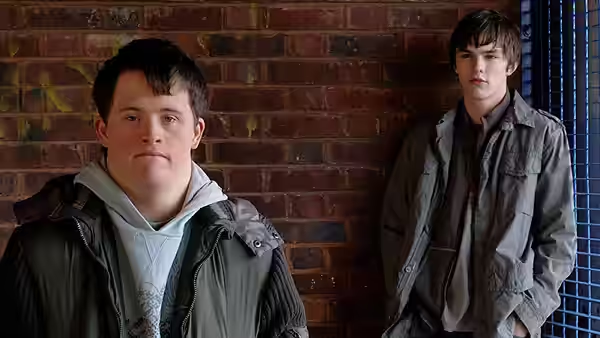
David Philips (Nicholas Hoult) is a teenager, and he hates his brother. He says so in the first minute, in a voiceover so level that it takes a moment to register he has just described a murder plan. Ben (Tommy Jessop) has Down’s syndrome, and the Philips household runs on his timetable: the school, the holidays, the arguments, every decision that comes back to what Ben needs. Mark Haddon writes from the other side of the bedroom wall, from the brother nobody is making allowances for, and the result is worth an evening of anyone who grew up with a sibling.
The reason is Jessop. It would have been easy, and it has been done often enough, to make Ben a saint who exists to teach his brother a lesson. Jessop plays him as a person who knows exactly how annoying he is being and is enjoying it. He has the timing of a comic who has been at it for years: he lets a pause run until Hoult cracks, and then says the mild thing anyway. We laughed, and then we noticed we were laughing with Ben at David, which is the reverse of what the opening promised and is the whole point.
Hoult has the harder job. David has to be unpleasant for most of 80 minutes and keep us with him, and Hoult does it by never asking for sympathy. He plays a boy nobody is looking at, and he makes the self-pity accurate rather than endearing. The narration could have sunk it. Haddon gives David lines that are cleverer than a boy his age would manage, and once or twice the voiceover explains a feeling the face has already shown. Mostly it works, because the gap between what David says and what we can see is where the comedy lives.
Julie Anne Robinson directs plainly, and plain is right. Danny Cohen shoots the family house in flat daylight, with the clutter of a home that has stopped tidying for anyone’s benefit, and saves anything handsome for outside, which is the correct order. Grenville Horner’s design gives Ben a bedroom that is unmistakably his and David one that could belong to anybody. Rob Lane’s score stays out of the kitchen and the classroom and comes in when the film leaves the house, and Anthony Combes cuts it without a wasted scene. Nothing here draws attention to itself.
The parents are less well served. Julia Ford’s Sheila and Neil Dudgeon’s John are played with care, especially by Ford, whose tiredness is in her shoulders before it is in her lines, but Haddon has written them as two people who made a decision years ago and stopped discussing it, and the film never gets them alone together long enough to find out what the decision cost. The school, with Rob (Josh Cohen) as David’s friend and Gail (Emer Kenny) as the girl he would like to impress, is a sketch rather than a world. Those scenes play like a series that was never commissioned.
We will say nothing about the last act except that it is the one stretch where the film arrives somewhere we could have predicted. Haddon spends an hour refusing the obvious version of this story, and then the ending is a little tidier than the hour deserved. It is not a cheat. It is a drama finishing on time.
What stayed with us is smaller than the ending. The scenes we keep returning to are the ones where David talks about Ben in front of him and Jessop simply listens, with a flicker in the face of someone who has heard every word and decided not to mind. That moved us more than any speech in the film. Watch it with a teenager if you have one to hand. They will recognise David well before you do, and they will not thank you for pointing it out.