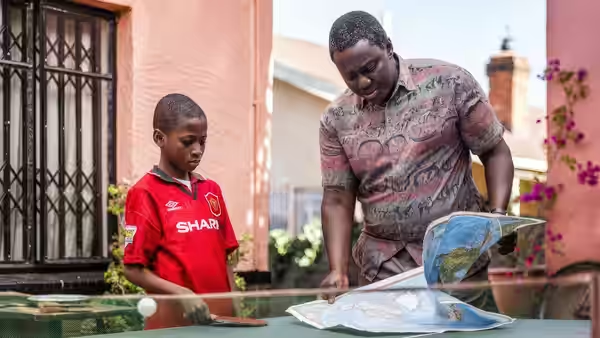
Damilola Taylor (Sammy Kamara) laughs with his father Richard (Babou Ceesay), holding a football
Film review

Damilola, Our Loved Boy

2016 · Directed by Euros Lyn · 1h 30m

In a sentenceBabou Ceesay gives Richard Taylor room to be complicated

Richard Taylor (Babou Ceesay), Gloria Taylor (Wunmi Mosaku) and Damilola Taylor (Sammy Kamara) are the central characters in this drama, directed by Euros Lyn and written by Levi David Addai. The Taylor family also includes Tunde Taylor (Juwon Adedokun) and Gbemi Taylor (Juma Sharkah). Robert Pugh plays DCI Nick Ephgrave, with John Hollingworth as Detective Wallace. Shola Adewusi appears as Auntie Dorcas, alongside Raphel Famotibe as Dapo, McKell David as Nathan, Megan Parkinson as Leanne and Gamba Cole as Junior. The film runs for 90 minutes.

Fi1m review

A quietly affecting drama led by Babou Ceesay’s complex performance as Richard Taylor. Its sustained sadness can become wearing, but the acting makes it worth considering for an evening when comfort is not the priority.

Damilola, Our Loved Boy is a quietly affecting drama, carried by Babou Ceesay’s performance as Richard Taylor. Euros Lyn directs and Levi David Addai writes with a seriousness that suits the material, though the sustained sadness can become wearing. We recommend it for the acting, with that reservation. The interest lies in the people, particularly a central character who is allowed to be complicated without losing our sympathy.

Ceesay makes Richard worth attending to even when his feelings are difficult to untangle. There is enough in the performance to prevent us deciding that we have understood everything about him simply because we recognise his pain. We were moved by Richard’s complexity, by the sense of a person who has more to him than the sadness we are watching. His performance rewards close attention without making us feel that we are being instructed how to respond.

With Wunmi Mosaku as Gloria Taylor and Sammy Kamara as Damilola Taylor, the film has an ensemble suited to this demanding material. The acting makes staying with the characters worthwhile even when the mood grows heavy. It also gives Lyn good reason to keep the approach quiet, trusting that the performances can hold our attention without much insistence. Ceesay remains the strongest presence, and the wider drama sometimes feels less searching than his portrayal of Richard.

Ross McLennan’s cinematography and Catrin Meredydd’s production design serve the performances without competing for attention. The lack of showiness helps: there is little to distract us from the difficult feelings the actors are being asked to convey. We would give the acting more of the credit for the film’s impact, but that need not diminish the work around it. Both contributions feel properly judged for a drama which needs us to keep looking at people, even when doing so becomes uncomfortable.

Jamie Pearson’s editing and Dru Masters’s music contribute to the same sombre mood, and the 90 minutes feel heavier than the running time suggests. That weight is sometimes effective, making it difficult to put the characters’ feelings aside. There are also stretches when we wanted more variation in how insistently we were asked to feel the same thing. The quiet approach avoids obvious excess, yet it can become repetitive, and the sadness begins to lose some of its force through familiarity.

Among serious character dramas, this belongs firmly at the restrained end of the scale. Addai gives Ceesay a role worth sustained attention, and Lyn allows the performance to remain the principal reason for watching. That is a sound choice, though it does not quite resolve the difference between the complexity of Richard and the narrower range of feeling around him. A less uniform tone would have helped the supporting work stand out and made the difficult passages harder to become accustomed to.

This is an emotionally demanding watch whose acting earns the patience it asks for. Our reservation concerns the sameness of the mood, rather than the decision to take these characters seriously. Choose it when there is time afterwards to sit quietly; it is not a film to squeeze in between distractions.


Critical consensus AI synthesised

1 of 6
Positive
1
Mixed
0
Negative
0
The Guardian
8 November 2016 · Sam Wollaston
75*

Wollaston finds the drama unbearably sad but quietly powerful and affecting. He especially praises the performances, singling out Babou Ceesay’s complex portrait of Richard Taylor.

Read the full review →

Straight answers AI written, from our review

Is Damilola, Our Loved Boy worth watching?
Damilola, Our Loved Boy is worth watching for its carefully observed acting, particularly Babou Ceesay’s complex performance as Richard Taylor, and we score it 75 out of 100. We recommend it to those who value restrained character drama, though its sustained sadness becomes repetitive and makes the 90 minutes feel longer; comfort is not its priority.
How long is Damilola, Our Loved Boy, and what is it rated?
Damilola, Our Loved Boy runs 1h 30m. It is a drama film.
Where can I watch Damilola, Our Loved Boy in Indonesia?
Damilola, Our Loved Boy is not on any streaming or rental service in Indonesia at the moment. It is available in 2 other countries; change your country at the top of the page to see where. Availability is checked daily.
How does Damilola, Our Loved Boy compare to Secrets & Lies?
Damilola, Our Loved Boy is a more uniformly sombre choice than Secrets & Lies, which we recommend more readily for its mixture of humour and painful family conversations. Both reward patient attention to performances, but Ceesay’s complicated Richard Taylor is the chief reason to choose Damilola, Our Loved Boy; Secrets & Lies offers greater emotional variety, despite sometimes spelling out feelings already clear.
What should I watch after Damilola, Our Loved Boy?
After Damilola, Our Loved Boy, try Secrets & Lies (1996, Fi1m 88): For family tensions explored through patient scenes and carefully observed performances. Then Rabbit Hole (2010, Fi1m 76): Parents grieve differently in a drama that avoids easy reassurance; and The Son's Room (2001, Fi1m 82): An Italian family drama attentive to the daily disruption of bereavement.

Cast

If you liked this, try…

  1. A Long Way from Home (2013) · not reviewed yetFor another restrained British drama that gives its actors room.

  2. Secrets & Lies (1996, Fi1m 88)For family tensions explored through patient scenes and carefully observed performances.

  3. Still Walking (2008) · not reviewed yetA family gathering makes room for grief, resentment and ordinary domestic chores.

  4. Rabbit Hole (2010, Fi1m 76)Parents grieve differently in a drama that avoids easy reassurance.

  5. The Son's Room (2001, Fi1m 82)An Italian family drama attentive to the daily disruption of bereavement.

Free account

Know what to watch tonight

Two lists that know where things are streaming, collections you can share, your own score beside ours, and Discover that remembers what you have seen.

  • Want to see, sorted by what is streaming now
  • Seen, with your score out of ten
  • No adverts, ever