A quietly affecting drama led by Babou Ceesay’s complex performance as Richard Taylor. Its sustained sadness can become wearing, but the acting makes it worth considering for an evening when comfort is not the priority.
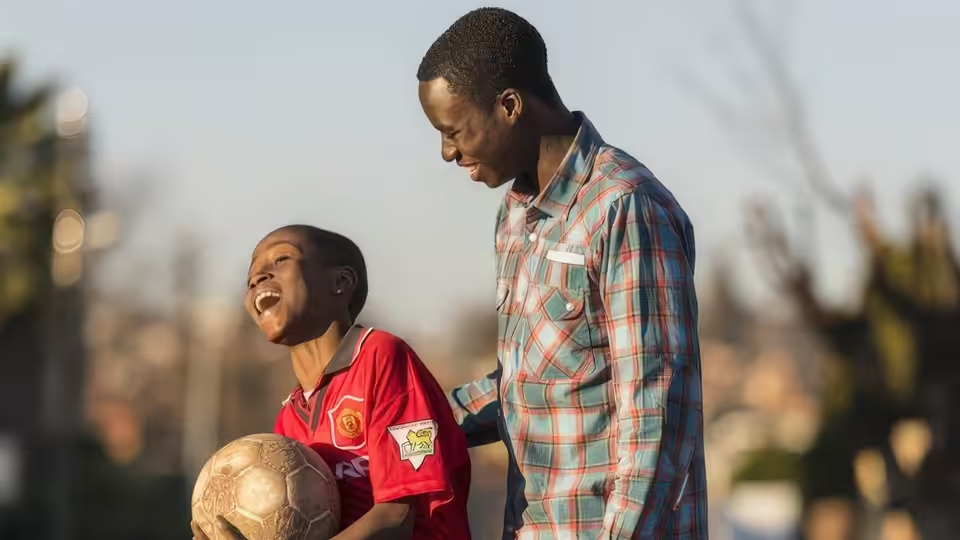
Damilola, Our Loved Boy is a quietly affecting drama, carried by Babou Ceesay’s performance as Richard Taylor. Euros Lyn directs and Levi David Addai writes with a seriousness that suits the material, though the sustained sadness can become wearing. We recommend it for the acting, with that reservation. The interest lies in the people, particularly a central character who is allowed to be complicated without losing our sympathy.
Ceesay makes Richard worth attending to even when his feelings are difficult to untangle. There is enough in the performance to prevent us deciding that we have understood everything about him simply because we recognise his pain. We were moved by Richard’s complexity, by the sense of a person who has more to him than the sadness we are watching. His performance rewards close attention without making us feel that we are being instructed how to respond.
With Wunmi Mosaku as Gloria Taylor and Sammy Kamara as Damilola Taylor, the film has an ensemble suited to this demanding material. The acting makes staying with the characters worthwhile even when the mood grows heavy. It also gives Lyn good reason to keep the approach quiet, trusting that the performances can hold our attention without much insistence. Ceesay remains the strongest presence, and the wider drama sometimes feels less searching than his portrayal of Richard.
Ross McLennan’s cinematography and Catrin Meredydd’s production design serve the performances without competing for attention. The lack of showiness helps: there is little to distract us from the difficult feelings the actors are being asked to convey. We would give the acting more of the credit for the film’s impact, but that need not diminish the work around it. Both contributions feel properly judged for a drama which needs us to keep looking at people, even when doing so becomes uncomfortable.
Jamie Pearson’s editing and Dru Masters’s music contribute to the same sombre mood, and the 90 minutes feel heavier than the running time suggests. That weight is sometimes effective, making it difficult to put the characters’ feelings aside. There are also stretches when we wanted more variation in how insistently we were asked to feel the same thing. The quiet approach avoids obvious excess, yet it can become repetitive, and the sadness begins to lose some of its force through familiarity.
Among serious character dramas, this belongs firmly at the restrained end of the scale. Addai gives Ceesay a role worth sustained attention, and Lyn allows the performance to remain the principal reason for watching. That is a sound choice, though it does not quite resolve the difference between the complexity of Richard and the narrower range of feeling around him. A less uniform tone would have helped the supporting work stand out and made the difficult passages harder to become accustomed to.
This is an emotionally demanding watch whose acting earns the patience it asks for. Our reservation concerns the sameness of the mood, rather than the decision to take these characters seriously. Choose it when there is time afterwards to sit quietly; it is not a film to squeeze in between distractions.