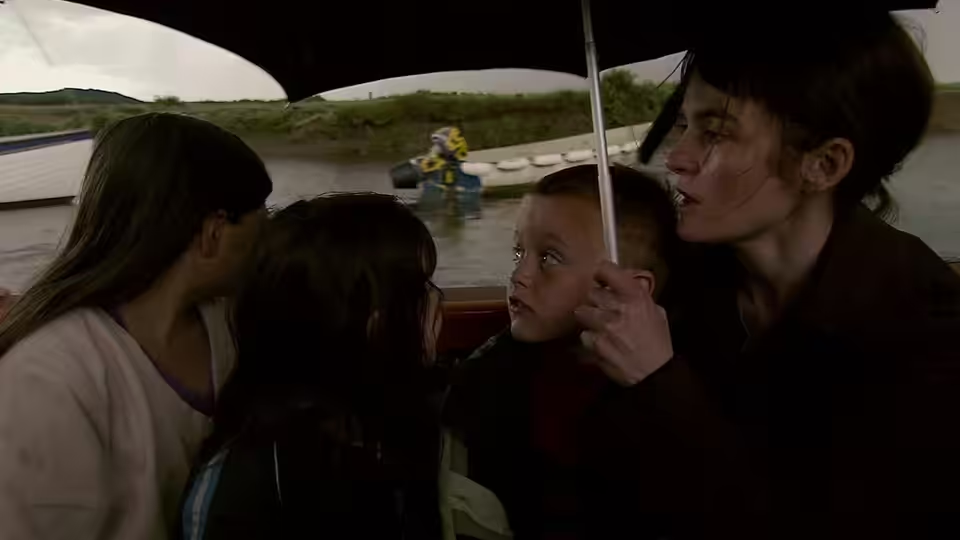
A woman and three children ride beneath a boat canopy, watching a person in the water
Film review

Everyday

2012 · Directed by Michael Winterbottom · 1h 46m

In a sentenceThe children grow up before our eyes; we could have used a little more help with the adults

Imprisonment shapes the lives of Karen (Shirley Henderson), Ian (John Simm), Shaun (Shaun Kirk) and Robert (Robert Kirk). For the family, separation becomes part of ordinary life rather than an event with a quick solution. Karen tries to carry on while conflicting feelings complicate what is already difficult. The children keep growing, with needs and lives that do not wait for the adults’ problems to be resolved. The story follows the family’s experience of time apart, concentrating on the demands of carrying on while a prison sentence determines how much they can share.

Fi1m review

Michael Winterbottom’s Everyday finds real feeling in the slow damage imprisonment does to a family, with Shirley Henderson giving its most persuasive performance. The patience is sometimes rewarded; the thin writing is harder to excuse.

Michael Winterbottom’s Everyday is a modestly affecting family drama whose patience sometimes leaves too much work to us. It follows the costs of imprisonment through the people obliged to live with them, allowing the children’s growth to carry much of the feeling. We can see why Winterbottom avoids turning that experience into a succession of crises. But ordinary life still needs enough detail to make these particular people matter, and the film supplies that unevenly.

Shirley Henderson gives the film its strongest reason to stay. As Karen, she keeps conflicting feelings close together without making a display of sorting them out. Her restraint gives Karen a private life even where the writing supplies little explanation, and makes us willing to wait for a clearer understanding of her. Henderson conveys the effort involved in carrying on without asking us to admire Karen for it.

The children give Winterbottom his clearest sense of what separation costs. As they grow older over five years, the passage of time becomes visible in people who cannot put their development on hold. We were moved by that growth, by the simple fact that the children keep changing while the family remains affected by imprisonment. It is an effective use of time, though the children’s presence can also make the adult drama feel underwritten by comparison.

Sean Bobbitt’s cinematography serves the children best: their growing presence gives these observational images a reason to hold our attention. The candid quality of those passages lets us look without needing every moment to announce its importance. Elsewhere, the editing allows uncertainty to settle into inertia, with too little new information to sharpen our interest in the people we are watching. Those passages slow the film without deepening our understanding of the family.

The screenplay, by Michael Winterbottom and Laurence Coriat, is too willing to leave the adults indistinct. We do not need a complete history of the family, but we do need to understand what a conversation or a silence changes between them. Too often the film makes that difficult, and the lack of explanation begins to feel like work left undone. The gaps matter because Karen’s contradictions invite closer attention than the screenplay is prepared to sustain.

Michael Nyman’s score supplies the energy that the drama sometimes lacks, and its boldness is welcome. There is pleasure in hearing music prepared to move with some force through a film otherwise so reluctant to hurry. Yet it can also seem to be doing emotional work that a better-developed scene would have done for itself. The contrast makes the quieter observation feel thinner than it should, even as the music gives us a reason to remain engaged.

As an observational drama, Everyday is strongest when time passing is something we can see in the children. Its problem is the assumption that staying close to ordinary experience will always be enough to explain it. At 106 minutes, the film asks for more patience than all its scenes repay. Give it that time for Henderson and the children, provided a family portrait with important details left indistinct sounds like an acceptable evening.

Critical consensus AI synthesised

56
Positive
2
Mixed
1
Negative
1
The Guardian
13 September 2012 · festival review · Catherine Shoard
90*

Shoard finds the film almost unbearably moving and calls it a strange, stirring treat. She especially praises the candid, hypnotic portrayal of the children growing up over five years.

Read the full review →
Slant Magazine
18 November 2013 · ★★★/4 · David Lee Dallas
75

The critic finds the film jarring and sometimes frustrating, but ultimately a strange, affecting experiment. Shirley Henderson’s restrained performance is singled out for revealing the contradictions in Karen with particular emotional richness.

Read the full review →
Variety
3 September 2012 · festival review · Peter Debruge
45*

Debruge finds the film fitfully engaging but often too opaque and slow to hold attention. He praises its portrayal of the tedium and family costs of imprisonment, while noting that the story could use more explanation.

Read the full review →
The Hollywood Reporter
10 September 2012 · festival review · Todd McCarthy
15*

The critic finds the film tedious and underdeveloped, arguing that its observational approach makes for a patience-testing experience. He singles out Michael Nyman’s bold, invigorating score as the one dynamic element.

Read the full review →

Straight answers AI written, from our review

Is Everyday worth watching?
Everyday is worth considering for viewers who enjoy patient family dramas, though our score of 67 reflects reservations about its thin writing. Shirley Henderson’s performance and the children’s visible growth moved us, but the adults remain indistinct, and too many scenes ask for patience without deepening our understanding of the family.
How long is Everyday, and what is it rated?
Everyday runs 1h 46m. It is a drama film.
Where can I watch Everyday in Norway?
Everyday is not on any streaming or rental service in Norway at the moment. It is available in 6 other countries; change your country at the top of the page to see where. Availability is checked daily.
How does Everyday compare to Boyhood?
Everyday is the more narrowly focused family portrait, concentrating on separation through imprisonment, while Boyhood follows family life across twelve years. We recommend Boyhood more readily for its humour, tenderness and the force of its ordinary moments, despite some drift; Everyday rewards an interest in quiet observation, but its underwritten adults make it harder to recommend.
What should I watch after Everyday?
After Everyday, try Boyhood (2014, Fi1m 88): Another patient family portrait that lets growing children do the explaining. Then Time (2020, Fi1m 77): For a more urgent account of imprisonment measured in family years; and Nobody Knows (2004, Fi1m 87): Childhood observed with tenderness, without pretending that tenderness can keep children safe.

Cast

If you liked this, try…

  1. Boyhood (2014, Fi1m 88)Another patient family portrait that lets growing children do the explaining.

  2. Time (2020, Fi1m 77)For a more urgent account of imprisonment measured in family years.

  3. Nobody Knows (2004, Fi1m 87)Childhood observed with tenderness, without pretending that tenderness can keep children safe.

  4. A Separation (2011, Fi1m 93)A family drama with the moral detail and dramatic pressure missing here.

  5. The Railway Children (1970) · not reviewed yetA gentler choice about children learning to live with an absent father.

Free account

Know what to watch tonight

Two lists that know where things are streaming, collections you can share, your own score beside ours, and Discover that remembers what you have seen.

  • Want to see, sorted by what is streaming now
  • Seen, with your score out of ten
  • No adverts, ever