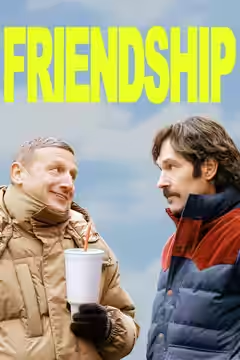
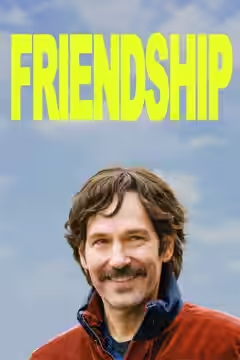
Tim Robinson’s man who cannot read a room gets a full-length film, and Andrew DeYoung shoots him like a thriller. It is often painfully funny and Paul Rudd is a pleasure; it is also a sketch stretched thin, and by the last half hour it shows.
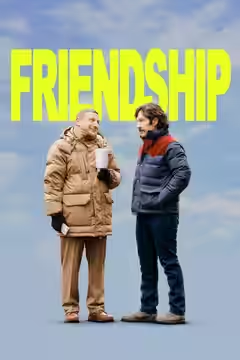
Tim Robinson’s sketch series I Think You Should Leave is full of men who say the wrong thing and then defend it to the death. Friendship gives one of them a mortgage, a family and a hundred minutes. Craig Waterman has a job, a house, a wife Tami (Kate Mara) and a son Steven (Jack Dylan Grazer), and no friends. A new neighbour moves in, Austin Carmichael (Paul Rudd), and asks him in. The film is often painfully funny and Rudd is a pleasure in it. It is also a sketch stretched to feature length, and once the friendship sours, which happens early, it has less to do than it thinks.
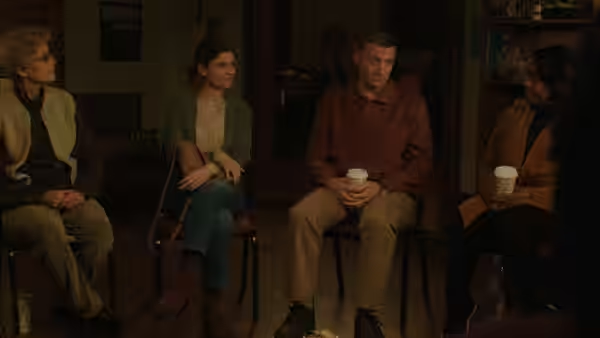
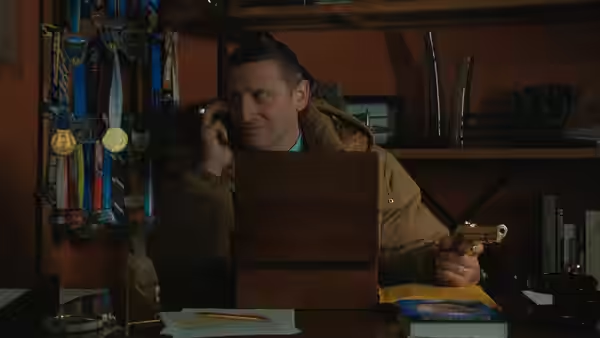
Andrew DeYoung, who wrote and directed, made the decision that gives the film its character: he shoots a comedy as if it were a thriller. Andy Rydzewski frames the suburb in wide, level shots under a good deal of grey sky and holds on Robinson’s face well past the point a comedy would cut. Keegan DeWitt’s score is low synths and slow pulses, and it treats a walk to a neighbour’s front door as if someone might not come back from it. Rocio Gimenez fills Austin’s house with records, drums and things picked up on walks, and gives Craig’s a sofa and a large television. Chloe Karmin puts Craig in a padded jacket he never seems to take off.
Robinson’s Craig agrees a beat too late, laughs a beat too early, and when cornered shouts a sentence nobody could have predicted at a volume nobody asked for. The first act, in which Austin takes Craig along on whatever he happens to be doing, is the film’s happiest stretch: Craig is being given what he wants and cannot work out what to do with it. Then Craig meets Austin’s friends, Ian (Whitmer Thomas), Stan (Daniel London), Mike (Eric Rahill) and Nathan (Jacob Ming-Trent), and in the space of one scene does the thing that turns them against him. We will not say what it is. We laughed until it hurt at a Subway order, of all things, with Craig repeating Austin’s sandwich word for word as though it were a password. And there is a stretch near the middle involving a toad, which we will also not describe, where we stopped laughing and sat with a hand over our mouth, which is the film working exactly as intended.
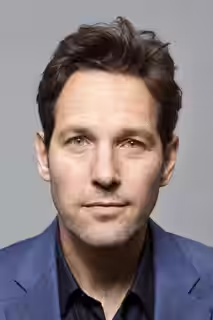
Rudd is the surprise. Austin could have been the straight man; instead Rudd plays someone who has built a personality out of being the cool one on the street and needs an audience more than he would admit. Craig is an audience. Their scenes together, ordering at a Subway, walking home, standing on a doorstep at the moment Austin decides to step back, are the best in the film, because Rudd lets you see Austin enjoying the attention right up until it frightens him.
The second half is where the sketch shows. Craig is on his own, and the film becomes a run of set pieces built the same way: a bad idea, a room of people who can see it is a bad idea, a detonation, and Sophie Corra cutting hard to black. Corra does it well. Done a dozen times, the rhythm becomes a pattern, and we began to know when the shout was coming. Tami is the other casualty. Mara plays her straight and with real patience, but the script gives her a job and a history and never says what she sees in Craig or wants from the marriage. Steven is a good joke and only a joke.
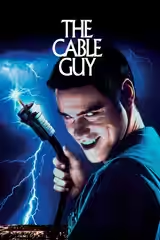
Against the awkward comedies it descends from, this sits closer to The Cable Guy than to Ricky Gervais or Larry David: Craig is not a man who fails to notice he is awful but one who notices and cannot stop. The tagline says men should not have friends; we do not think DeYoung is making a case about lonely men in general. Craig is a specific disaster, and the film is best when it treats him as one.
Watch it with someone, so that there is somebody else to look at when Craig starts talking. It runs a hundred minutes, and it is the right length for about eighty of them.