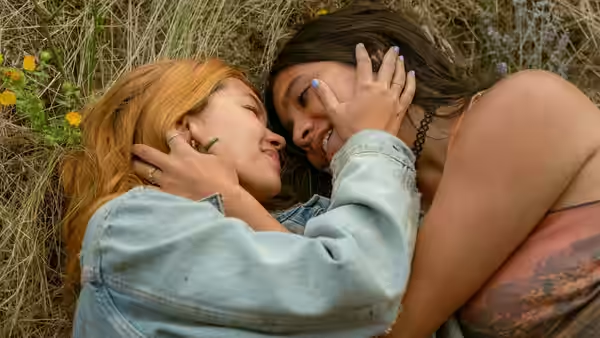
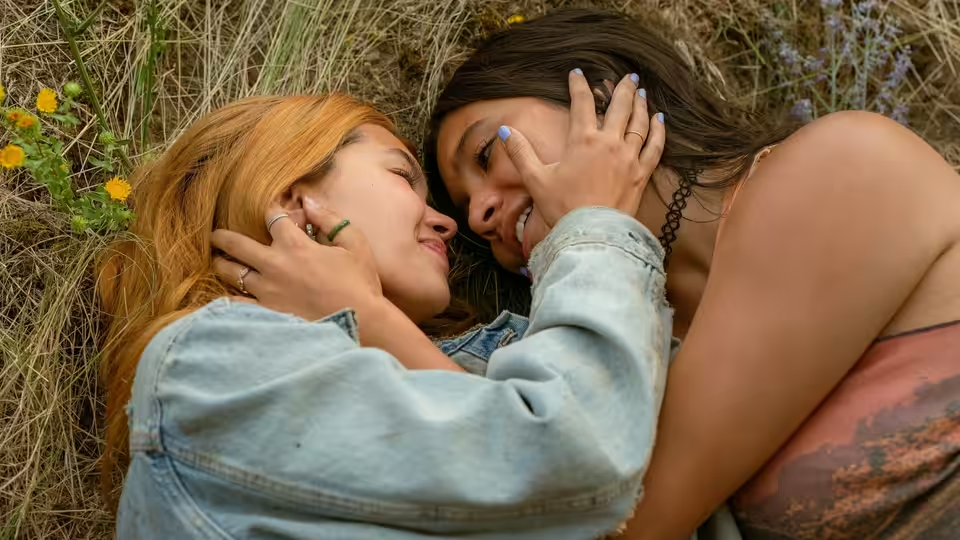
Two women lie in grass and wildflowers with faces close and hands touching cheeks
Film review

Girls Like Girls

2026 · Directed by Hayley Kiyoko · 1h 35m

In a sentenceTwo girls, one summer, one boyfriend in the way, and a soundtrack that already knows how it ends

Summer, 2006, small-town Oregon. Coley (Maya da Costa) has lost her mother and been sent to live with Curtis (Zach Braff), the father who was never around and does not know what to say to her now that he is. The house is quiet, the town is quieter, and Coley intends to get through the summer speaking to nobody. Then she meets Sonya (Myra Molloy), who is loud, restless, surrounded by friends, and has a boyfriend, Trenton (Levon Hawke), who is there more often than either girl would like. Sonya’s friends Alex (Alozie LaRose) and SJ (Sierra Sidwell) hover at parties and in car parks. Coley wants Sonya and cannot say so. Sonya wants to be wanted and will not admit what she wants back.

Plays from YouTube when you press play; nothing loads from them until then.

Fi1m review

Hayley Kiyoko’s first feature is tender, well acted and about as surprising as a sunset. Maya da Costa and Myra Molloy make the wanting real; the script around them keeps choosing the safe line, and the film is smaller for it.

Hayley Kiyoko wrote a song called Girls Like Girls in 2015, then a novel of the same name, and now she has directed the film, from a screenplay she wrote with Stefanie Scott. It is the summer of 2006 in small-town Oregon. Coley (Maya da Costa) has lost her mother and been delivered to Curtis (Zach Braff), the father who was never around, and within a week she has met Sonya (Myra Molloy) and the summer has stopped being about grief. What follows is a first love story told with warmth, two good central performances and a script that flinches whenever it could have gone somewhere harder. It runs 95 minutes, it is likeable company, and we wanted it braver.

Da Costa carries it. She plays Coley as a girl who has learnt to take up as little room as possible, arms folded, eyes on the floor, and then what happens to that posture when Sonya comes into a room. Molloy has the harder part. Sonya knows what she wants and pretends not to, and Molloy plays the pretending as a show Sonya puts on for her friends and for Trenton (Levon Hawke), a boyfriend decent enough that the film cannot quite make him the villain. When the two girls are alone together the film is alive.

Sonja Tsypin shoots the summer in late-afternoon light, mostly from close, so that a shared cigarette or a hand resting on a car door fills the frame. Morgan Lindsey Price’s production design does the period work quietly: bedroom walls papered in magazine pages, a family computer in a hallway, a CD wallet on a passenger seat. Kelli Dunsmore puts the girls in low-slung jeans and layered vests without winking at them. Jessica Rose Weiss’s score is soft piano and guitar under nearly everything, and there is too much of it; the best scenes are the ones where it stops.

The trouble is the writing. Kiyoko and Scott give the girls things to say to each other that sound written rather than said, speeches about letting people in that a real seventeen-year-old would die before delivering. Curtis is a sketch, a man who grills and apologises, and Braff plays him gently with nothing underneath to play. Alex (Alozie LaRose) and SJ (Sierra Sidwell) exist to be in the way at parties. The story, credited to Kiyoko and Chloe Okuno, has one turn, and anyone who has seen a film about a girl, a boyfriend and a new best friend will see it coming from the first reel. Christine Armstrong and Sabine Hoffmann cut it briskly enough that the waiting never becomes a chore.

And yet. There is a scene late at night, when the others have gone, in which Sonya asks Coley something ordinary and Coley cannot answer, and da Costa lets us watch her decide not to. It moved us more than we expected from a film this careful. It is the look of someone who has spent a year being sad and has just noticed she is frightened instead. For about four minutes the film is exactly what it wants to be.

Kiyoko is not sentimental about Sonya, either. The crush has a cruelty in it, a hot-and-cold the film watches without excusing, and that honesty is its best quality. The second half takes a turn we will not describe; what we can say is that things resolve more tidily than the previous hour has earned.

Films about girls falling for girls used to be about the falling being forbidden. This one takes it as given, which most critics have rightly welcomed. That also removes the one pressure the genre used to supply, and Kiyoko has not found another. Show Me Love (1998) and My Summer of Love (2004) both understood that the world outside the pair has to push back, hard, for the pair to matter. Here the world mostly waits politely for the girls to work it out.

See it if the subject is yours, or if you were seventeen in 2006 and would like to be reminded, gently. Bring someone who will not mind you predicting the ending, because you will.

Critical consensus AI synthesised

71
Positive
7
Mixed
1
Negative
1

Most critics are warm on Girls Like Girls, and the praise gathers in two places. The first is the young leads, whose chemistry is remarked on in nearly every review; The Wrap singles out Maya da Costa’s performance as Coley as the film’s breakout. The second is Kiyoko’s handling of first love, which the reviews find tender and unforced, treating the heroine’s queerness as a given rather than a problem to be solved. The mid-2000s setting and its period detail also draw approval.

The reservations are about weight rather than warmth. Several reviews find the film conventional, its stakes muted and some passages undercooked; Vulture thinks it darker than expected but lets itself off with an easy happy ending. The spread is wide because of one outlier: The Guardian dismisses it as precious and predictable, with groan-inducing dialogue, though even there the leads’ chemistry is allowed to survive. The New York Times, gentler, notes that some of the source novel’s verve is lost.

Variety
16 June 2026 · Guy Lodge
85*

The critic describes it as a warmly assured debut that refreshingly treats the heroine's queerness as given, delivering an emotionally pure tale of first love and yearning. It highlights the young leads' superb performances and the director's skill in capturing the charged rush of nascent desire.

Read the full review →
Los Angeles Times
19 June 2026 · Robert Abele
80*

The review calls it a sincere and warmly assured directorial debut that captures the blush of first love and friendship with unadorned charm and heart. It singles out the committed performances and nostalgic 2006 setting for praise while noting its conventional but appealing approach.

Read the full review →
The Hollywood Reporter
16 June 2026 · Angie Han
80*

The critic praises the film's tender capture of the giddy thrills and crushing devastations of first love, highlighting the chemistry between the leads and the naturalistic portrayal of young queer romance.

Read the full review →
The AV Club
16 June 2026 · B · Natalia Keogan
77

The film is a sweet, naturalistic coming-of-age romance set in the Y2K era that effectively portrays queer desire as timeless and worth embracing, though its stakes feel somewhat muted.

Read the full review →
The New York Times
18 June 2026 · Lisa Kennedy
75*

The critic praises Kiyoko's adaptation of her song and novel into a touching queer coming-of-age romance centered on grief and first love. It highlights the lead performance's vulnerability and the film's personal provenance while noting some loss of the source material's verve.

Read the full review →
Vulture
26 June 2026
60*

The review notes that the directorial debut is surprisingly dark in its portrayal of a volatile crush and emotional turmoil, though it ultimately opts for a neat happy ending that feels a bit easy.

Read the full review →

Straight answers AI written, from our review

Is Girls Like Girls worth watching?
Girls Like Girls is worth watching if a tender, predictable first-love story is your kind of evening, and we scored it 67. Maya da Costa and Myra Molloy make the wanting real, and the film is alive whenever the two are alone together. The script plays safe, the one twist is visible from the first reel, and the piano score rarely stops.
How long is Girls Like Girls, and what is it rated?
Girls Like Girls runs 1h 35m. It is a romance and drama film.
Where can I watch Girls Like Girls in Türkiye?
Girls Like Girls is not on any streaming or rental service in Türkiye at the moment. It is available in 4 other countries; change your country at the top of the page to see where. Availability is checked daily.
How violent or frightening is Girls Like Girls, and is it suitable for children?
Girls Like Girls is a UK 15 and US R romance, not a violent or frightening film. It is about two teenage girls falling for each other in 2006 Oregon, with cigarettes, parties and a crush that has some cruelty in it, and the certificate points to adult themes and language rather than anything alarming. It is not for young children, but teenagers of fifteen and up are its natural audience.

Cast

If you liked this, try…

  1. Show Me Love (1998) · not reviewed yetTwo girls in a dead-end Swedish town; funnier, rougher and far less polite about it.

  2. My Summer of Love (2004) · not reviewed yetYorkshire, a hot summer, a rich girl and a poor one; the wanting turns dangerous.

  3. Water Lilies (2007) · not reviewed yetCéline Sciamma’s first film watches teenage desire at a swimming pool without a single speech.

  4. The Half of It (2020) · not reviewed yetA shy girl writes love letters for a boy to the girl she wants herself.

  5. But I'm a Cheerleader (1999) · not reviewed yetSame subject, played as candy-coloured farce; the jokes land and the romance still does.

Free account

Know what to watch tonight

Two lists that know where things are streaming, collections you can share, your own score beside ours, and Discover that remembers what you have seen.

  • Want to see, sorted by what is streaming now
  • Seen, with your score out of ten
  • No adverts, ever