The anime trilogy ends with a sermon rather than a fight. Gen Urobuchi’s script has a real idea about despair and faith, and Ghidorah’s arrival is a fine image, but the film sits still for most of its 91 minutes.
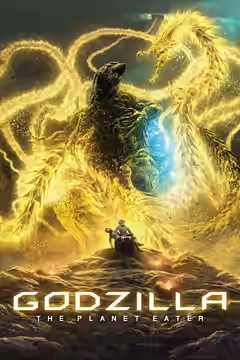
This is the last third of a trilogy that began with Godzilla: Planet of the Monsters (2017) and continued with Godzilla: City on the Edge of Battle (2018), and it does not pretend to stand alone. Humanity fled Earth, came back twenty thousand years later to find Godzilla still on it, and lost twice. Captain Haruo Sakaki (Mamoru Miyano) has destroyed the one weapon that might have worked because of what it was doing to his people. Now he has a comatose pilot, a mothership on which the Bilusaludo blame him for everything, and a priest who says the only way to kill a god is to call a bigger one. Directors Kōbun Shizuno and Hiroyuki Seshita and writer Gen Urobuchi have decided the finale will be about whether a beaten species should be allowed to die. That is a bolder subject than most monster films choose, and the film means it.
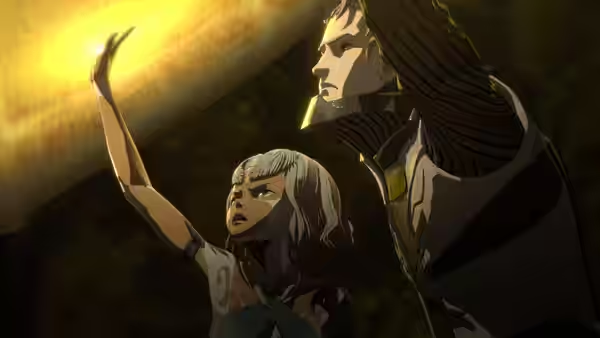
The preaching is the best of it. Metphies (Takahiro Sakurai) gathers the survivors at night, speaks softly about the emptiness of the universe, and the grieving kneel. Sakurai never raises his voice and never sounds anything but kind, which is the point; the horror of the sermons is that they make sense to people who have watched everyone they know die. Takayuki Hattori scores these scenes with low choir and a slow organ line, and it is properly unsettling. Urobuchi’s interest has always been in what people do when hope is gone, and the middle of this film is a patient argument between Metphies’s despair and the plainer stubbornness of the scientist Martin Lazzari (Tomokazu Sugita), who would rather keep measuring things.
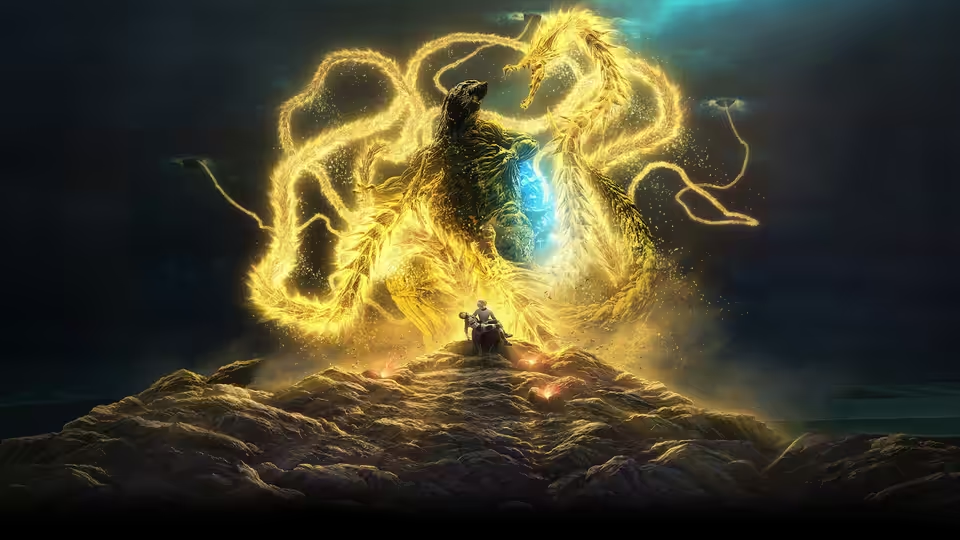
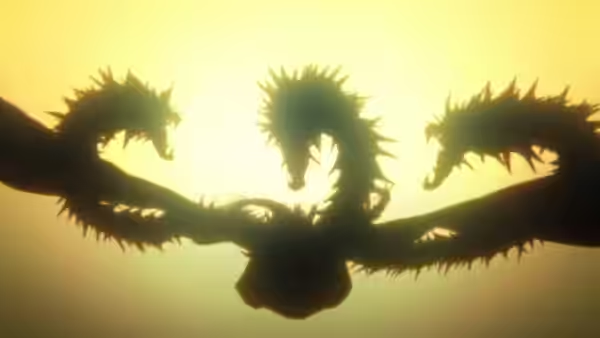
Then Ghidorah comes, and for a few minutes the film is as good as anything in the trilogy. Black spheres open in the sky and out of each pours a golden neck with no end to it, coiling through cloud, with no body anywhere. Instruments fail. The production design, credited to Naoya Tanaka and Ferdinando Patulli, gives the thing no face you can read and no shape you can measure, and we sat forward. It is a real idea about what a god would look like: a thing the rules do not apply to.
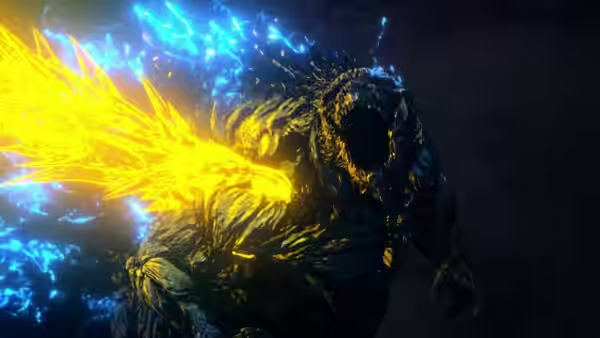
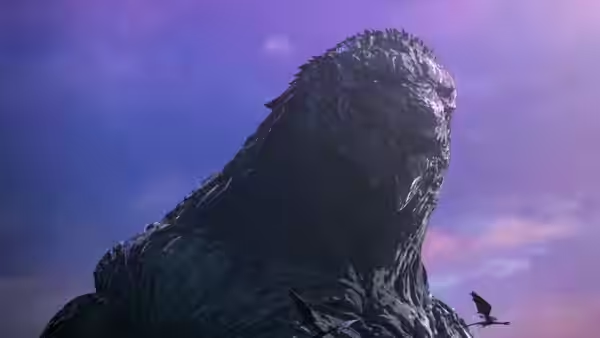
The trouble is what the film does with it. Godzilla stands. Ghidorah bites him, and holds, and the mountain of him glows hotter, and time on the ground begins to slow. That is all, for what feels like a quarter of an hour, while Martin explains from a tent that gravity has stopped behaving and Metphies explains from a hilltop that this is what worship looks like. Aya Hida cuts between the monitor and the mouth and the monitor and the mouth. We were held at first, then we drifted, then we noticed we were waiting for Godzilla to do something and that the film had no intention of letting him. A monster film may put a god above its monster; it may not put its monster to sleep.
The animation was never this trilogy’s strength and it is not here. The cel-shaded computer figures walk stiffly and their faces hold two expressions, grim and grimmer. Miyano gives Haruo a hoarse, shouted grief that the drawings cannot match. Yuko Tani (Kana Hanazawa) lies in a bed and is talked about. The Houtua twins Maina (Reina Ueda) and Miana (Ari Ozawa) are given one warning to deliver and deliver it twice. Only Sakurai and Sugita get scenes that let them act, and the film knows it, because it keeps returning to the two of them.
Ishirō Honda’s Godzilla (1954) was about a bomb. This one is about giving up, and there is something to admire in a franchise picture that ends on a question about whether survival is worth what it costs. The reviews so far are warmer than we are, mostly from people who had followed Haruo through both earlier films and were glad to see him finished properly. They are not wrong that he is. They are kinder than we can be about the 91 minutes of grey rooms and standing still it takes to get there.
If you have seen the first two, see this one; it closes the door, and Metphies’s last scenes are worth the wait. If you have not, do not start here, because nothing in it will land and a great deal of it will be explained to you anyway.