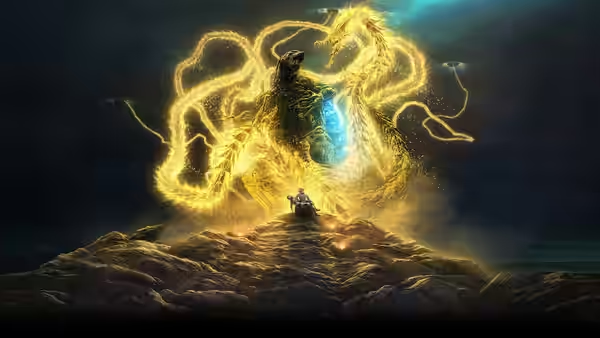
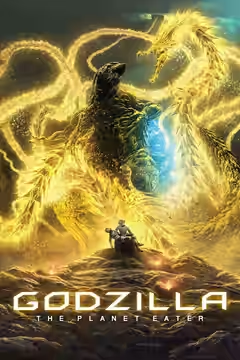
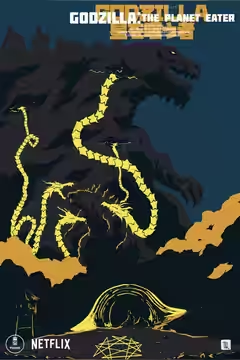
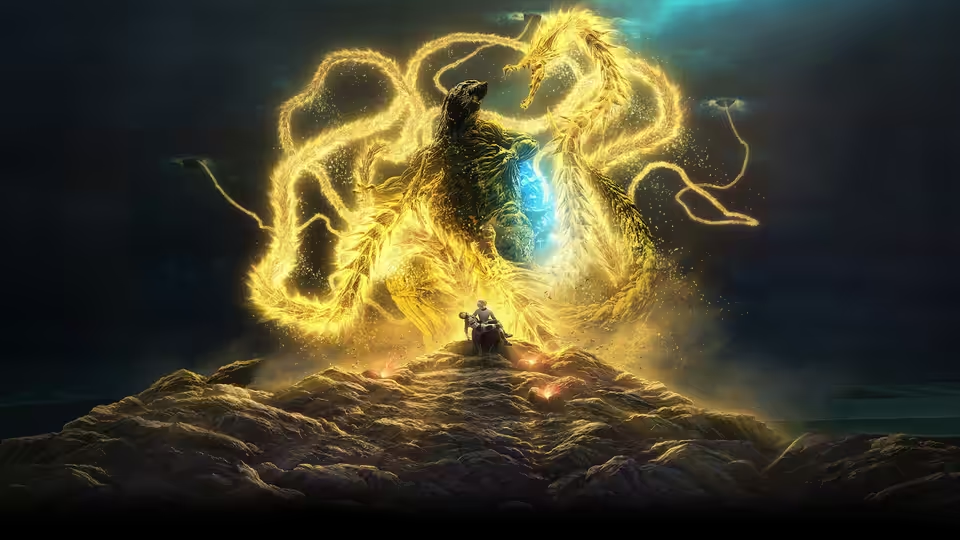
A lone figure faces a towering golden, three-headed creature from a rocky ridge
Film review

Godzilla: The Planet Eater

2018 · Directed by Hiroyuki Seshita, Kōbun Shizuno · 1h 31m

In a sentenceGodzilla has to stand still for a quarter of an hour while a golden snake bites him and a scientist explains why

Earth, twenty thousand years after humanity fled it. Captain Haruo Sakaki (Mamoru Miyano) has destroyed Mechagodzilla City rather than let its nanometal take over his own people, and Godzilla still stands. His pilot Yuko Tani (Kana Hanazawa) lies in a coma. Aboard the mothership Aratrum the Bilusaludo, spoken for by Halu-elu Dolu-do (Kazuya Nakai), hold him responsible and want him handed over. Among the survivors on the ground, the Exif priest Metphies (Takahiro Sakurai) preaches that only a god can kill Godzilla, and the grieving begin to kneel. The scientist Martin Lazzari (Tomokazu Sugita) and the Houtua twins Maina (Reina Ueda) and Miana (Ari Ozawa) suspect what Metphies means to summon, and the twins have a name for it: the one who eats stars.

Fi1m review

The anime trilogy ends with a sermon rather than a fight. Gen Urobuchi’s script has a real idea about despair and faith, and Ghidorah’s arrival is a fine image, but the film sits still for most of its 91 minutes.

This is the last third of a trilogy that began with Godzilla: Planet of the Monsters (2017) and continued with Godzilla: City on the Edge of Battle (2018), and it does not pretend to stand alone. Humanity fled Earth, came back twenty thousand years later to find Godzilla still on it, and lost twice. Captain Haruo Sakaki (Mamoru Miyano) has destroyed the one weapon that might have worked because of what it was doing to his people. Now he has a comatose pilot, a mothership on which the Bilusaludo blame him for everything, and a priest who says the only way to kill a god is to call a bigger one. Directors Kōbun Shizuno and Hiroyuki Seshita and writer Gen Urobuchi have decided the finale will be about whether a beaten species should be allowed to die. That is a bolder subject than most monster films choose, and the film means it.

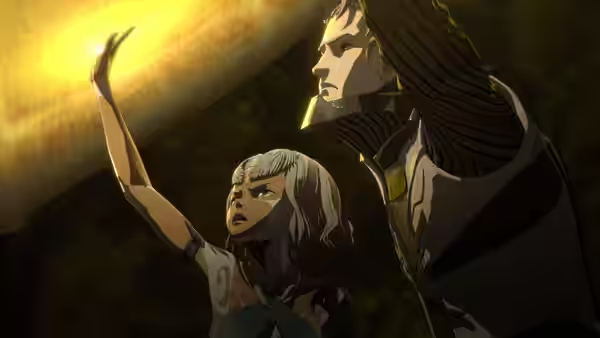
The preaching is the best of it. Metphies (Takahiro Sakurai) gathers the survivors at night, speaks softly about the emptiness of the universe, and the grieving kneel. Sakurai never raises his voice and never sounds anything but kind, which is the point; the horror of the sermons is that they make sense to people who have watched everyone they know die. Takayuki Hattori scores these scenes with low choir and a slow organ line, and it is properly unsettling. Urobuchi’s interest has always been in what people do when hope is gone, and the middle of this film is a patient argument between Metphies’s despair and the plainer stubbornness of the scientist Martin Lazzari (Tomokazu Sugita), who would rather keep measuring things.

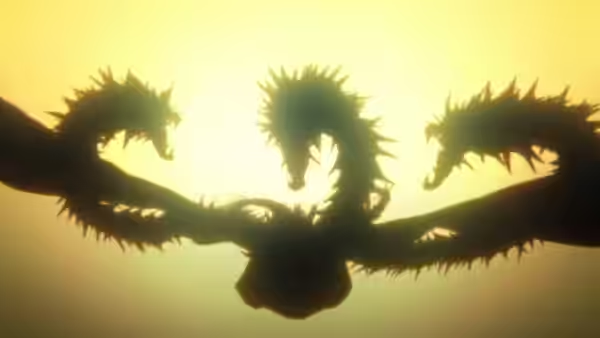
Then Ghidorah comes, and for a few minutes the film is as good as anything in the trilogy. Black spheres open in the sky and out of each pours a golden neck with no end to it, coiling through cloud, with no body anywhere. Instruments fail. The production design, credited to Naoya Tanaka and Ferdinando Patulli, gives the thing no face you can read and no shape you can measure, and we sat forward. It is a real idea about what a god would look like: a thing the rules do not apply to.

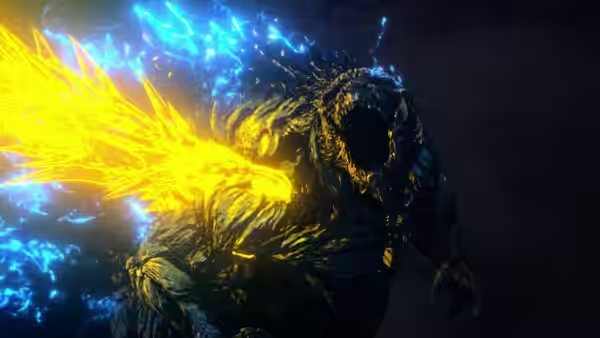
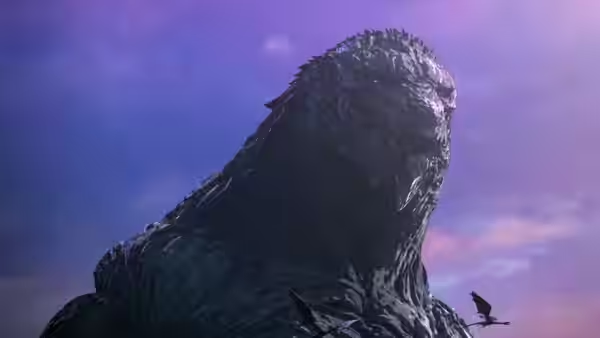
The trouble is what the film does with it. Godzilla stands. Ghidorah bites him, and holds, and the mountain of him glows hotter, and time on the ground begins to slow. That is all, for what feels like a quarter of an hour, while Martin explains from a tent that gravity has stopped behaving and Metphies explains from a hilltop that this is what worship looks like. Aya Hida cuts between the monitor and the mouth and the monitor and the mouth. We were held at first, then we drifted, then we noticed we were waiting for Godzilla to do something and that the film had no intention of letting him. A monster film may put a god above its monster; it may not put its monster to sleep.

The animation was never this trilogy’s strength and it is not here. The cel-shaded computer figures walk stiffly and their faces hold two expressions, grim and grimmer. Miyano gives Haruo a hoarse, shouted grief that the drawings cannot match. Yuko Tani (Kana Hanazawa) lies in a bed and is talked about. The Houtua twins Maina (Reina Ueda) and Miana (Ari Ozawa) are given one warning to deliver and deliver it twice. Only Sakurai and Sugita get scenes that let them act, and the film knows it, because it keeps returning to the two of them.

Ishirō Honda’s Godzilla (1954) was about a bomb. This one is about giving up, and there is something to admire in a franchise picture that ends on a question about whether survival is worth what it costs. The reviews so far are warmer than we are, mostly from people who had followed Haruo through both earlier films and were glad to see him finished properly. They are not wrong that he is. They are kinder than we can be about the 91 minutes of grey rooms and standing still it takes to get there.

If you have seen the first two, see this one; it closes the door, and Metphies’s last scenes are worth the wait. If you have not, do not start here, because nothing in it will land and a great deal of it will be explained to you anyway.

Critical consensus AI synthesised

3 of 6
Positive
2
Mixed
1
Negative
0

With only 3 reviews in so far, the early word is warm. All three take this as a fitting close to the trilogy, and the praise clusters in the same places: Ghidorah’s arrival, the distinctive animation and monster designs, and the weight given to Haruo’s story. Two of the three find the ending rewarding for anyone who stayed with the earlier films, uneven as that journey was. The reservations concern the monsters themselves: the main battle disappoints, the CGI wobbles in places, and Den of Geek, the most muted of the three, warns that the bleak tone and scarcity of kaiju action will frustrate viewers who came for the fights.

/Film
30 October 2018 · Joshua Meyer
80*

The critic finds the trilogy’s finale a satisfying, thematically ambitious conclusion that vindicates the series. Ghidorah’s striking arrival and the kaiju action are praised, though some CGI and the main battle’s presentation disappoint.

Read the full review →
HeyUGuys
75*

The critic finds the trilogy’s finale rewarding and its character-driven conclusion satisfying for viewers who followed the story. They praise the distinctive animation and monster designs, while noting that the journey to this point was uneven.

Read the full review →
Den of Geek
9 January 2019 · ★★★ · Daniel Kurland
60

Kurland finds this the trilogy’s most complete and thematically fitting conclusion, though its bleakness and limited monster action may frustrate some viewers. He praises Ghidorah’s striking introduction and the powerful arc given to Haruo.

Read the full review →

Straight answers AI written, from our review

Is Godzilla: The Planet Eater worth watching?
Godzilla: The Planet Eater is worth watching only if you have seen the first two films in the anime trilogy, and we scored it 58. Gen Urobuchi's script has a real idea about despair and faith, and Ghidorah's arrival is a fine image, but Godzilla stands still for what feels like a quarter of an hour while scientists explain why. Newcomers should not start here.
How long is Godzilla: The Planet Eater, and what is it rated?
Godzilla: The Planet Eater runs 1h 31m. It is an animation and science fiction film.
Where can I watch Godzilla: The Planet Eater in South Africa?
Godzilla: The Planet Eater is streaming on Netflix in South Africa. Availability is checked daily; the links above go straight to each service.
How does Godzilla: The Planet Eater compare to Shin Godzilla?
Godzilla: The Planet Eater is the weaker of the two, and Shin Godzilla is the one we recommend. Both are solemn, talky films that put meetings and arguments ahead of monster action, but Anno and Higuchi's procedural keeps things happening and produces the strangest creature the series has had, while the anime finale sits in grey rooms and lets its monster sleep.
What should I watch after Godzilla: The Planet Eater?
After Godzilla: The Planet Eater, try Shin Godzilla (2016, Fi1m 74): Committee meetings against a mutating monster; the same solemnity, with far more happening. Then Sunshine (2007, Fi1m 74): A spaceship crew, a dying star and a man convinced he has been chosen by God.

Cast

If you liked this, try…

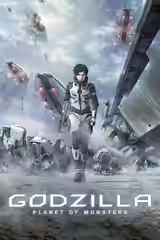
  1. Godzilla: Planet of the Monsters (2017) · not on Fi1m yetWhere Haruo’s story starts; the shooting is livelier and the despair not yet total.

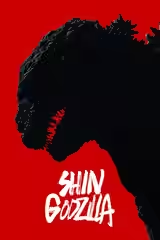
  2. Shin Godzilla (2016, Fi1m 74)Committee meetings against a mutating monster; the same solemnity, with far more happening.

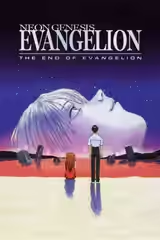
  3. The End of Evangelion (1997) · not on Fi1m yetJapanese animation asking whether humanity deserves to continue, and answering with more images than words.

  4. Puella Magi Madoka Magica (2011) · not on Fi1m yetUrobuchi’s series about hope and its price, sharper and stranger than this film manages.

  5. Sunshine (2007, Fi1m 74)A spaceship crew, a dying star and a man convinced he has been chosen by God.