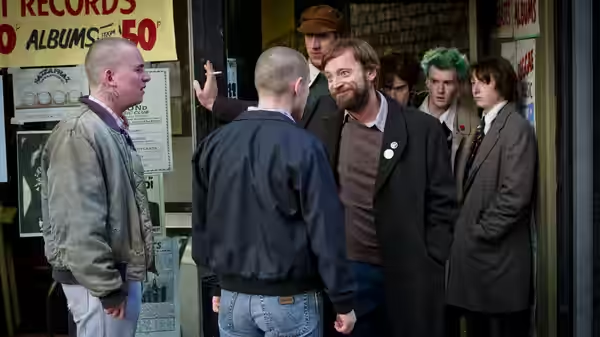
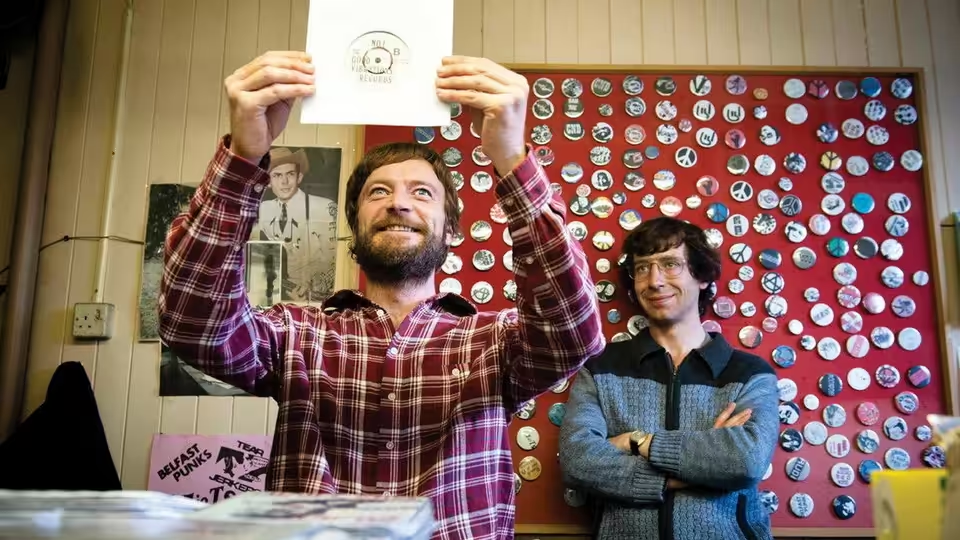
Terri Hooley (Richard Dormer) holds up a record sleeve inside his shop as a man watches
Film review

Good Vibrations

2012 · Directed by Glenn Leyburn, Lisa Barros D'Sa · 1h 51m

In a sentenceRichard Dormer could persuade us to join a pogoing crowd, though we would still worry about our knees

Belfast during the Troubles gives Terri Hooley (Richard Dormer) little reason for optimism, but he finds one in music. His efforts to promote the city’s musicians bring him towards punk and a pogoing crowd. Around him are Ruth (Jodie Whittaker) and George Hooley (Karl Johnson), while his commitment to music competes with his responsibilities to his family. Hooley wants to help a music scene grow in a city divided by conflict. The bands offer a reason to bring people together, though his enthusiasm does not make the divisions disappear.

Fi1m review

Richard Dormer gives Good Vibrations the warmth and conviction its Belfast music story needs. The film is too forgiving of Terri Hooley’s failings, but its pleasure in discovering punk is hard to resist.

Good Vibrations is a good music film with a generous performance at its centre and a habit of forgiving its subject too quickly. Directors Lisa Barros D’Sa and Glenn Leyburn follow Terri Hooley’s music-promotion work in Belfast during the Troubles, finding ample reason to take his enthusiasm seriously. They want us to understand how hearing a band can change what someone expects from the place they live. When they stay with that experience, we are happily persuaded.

Richard Dormer gives Terri Hooley the sort of charisma that explains why other people might tolerate him beyond the point of good sense. His enthusiasm is infectious, and we can understand the attraction of this man without believing that all his decisions are sensible. That matters in a film about someone whose musical conviction puts demands on the people around him. Dormer makes the charm persuasive enough that the film sometimes seems reluctant to examine his behaviour.

We were moved by Hooley discovering punk among a pogoing crowd. The pleasure comes from watching someone recognise a reason to be hopeful in people making a tremendous noise together. Ivan McCullough’s cinematography makes that crowd feel inviting, and David Holmes’s music work helps the performances explain an enthusiasm that dialogue could easily flatten. For a while, the film gives us the simple satisfaction of understanding why a person would want to spend his life doing this.

The Belfast setting also gives the music a purpose beyond the familiar ambitions of a performer. Derek Wallace’s production design makes the period convincing, and the archival footage prevents the film from becoming entirely absorbed in its hero. Its use is restrained enough to leave room for the pleasure of hearing a band, rather than making every song the cue for a history lesson. Music matters here because there is so much keeping people apart.

Colin Carberry and Glenn Patterson’s screenplay is less convincing about the cost to Hooley’s family. It acknowledges neglect but gives that neglect too little weight, so that the same charm Dormer supplies becomes an excuse to move on. Those who have to live with his choices deserve more attention. A sympathetic portrait can admit that its subject is difficult, but this one too often treats the admission as sufficient and gets back to the music.

That indulgence is also where the familiar musical-biography habits begin to show. Once the film has established Hooley’s conviction, its continuing faith in him becomes predictable; the people around him cannot always compete with the pleasure of watching Dormer take charge. Nick Emerson’s editing keeps the musical passages lively, but across 111 minutes the film has more time for Hooley’s appeal than it needs. The family scenes could have used some of that time.

These are real limitations, although they do not cancel the pleasure of seeing musical discovery taken seriously. The directors understand that a listener’s excitement can carry a scene as surely as the performance on stage, and Dormer gives them plenty to work with. Anyone drawn to stories about local music scenes has good reason to spend an evening here. Allow for a generous view of Hooley, especially when the music stops.

Critical consensus AI synthesised

72
Positive
8
Mixed
2
Negative
1

Most critics respond warmly to Good Vibrations, finding an energetic, hopeful biopic about Terri Hooley’s music-promotion work amid Belfast’s Troubles. Praise centres on Richard Dormer, whose charismatic performance gives the film much of its warmth and momentum. The reviews also value its sense of Belfast’s music scene and its understanding of how music can matter personally and politically, with the musical sequences drawing particular enthusiasm.

The spread is fairly wide, though even the less persuaded critics tend to admire Dormer. Reservations concern familiar musical-biopic plotting, uneven emphasis and occasional excess length. Time Out remains positive despite finding the genre clichés conspicuous, while Total Film questions the sidelining of Hooley’s neglect of his family. Variety is the clearest dissent, finding that the familiar trajectory and the central character’s contradictions weigh down the film despite its energy and convincing period atmosphere.

The Guardian
28 March 2013 · Peter Bradshaw
90*

Bradshaw finds the biopic warm, lovable and terrific. He especially praises the scene where Hooley discovers punk amid a pogoing crowd.

Read the full review →
Radio Times
★★★★ · Damon Wise
80

Wise finds the biopic an exciting, feel-good reminder of rock’s power. He praises its portrayal of Terri Hooley’s music-promotion work amid Belfast’s Troubles.

Read the full review →
Time Out
18 September 2012 · ★★★★ · Tom Huddleston
80

The review calls the film genial but overly reliant on rock-movie clichés. It singles out familiar genre elements as its chief weakness.

Read the full review →
Empire
6 March 2013 · Damon Wise
78*

The critic finds it a joyous, hopeful story of music overcoming division. Richard Dormer’s electric performance as Terri Hooley is singled out for praise.

Read the full review →
Evening Standard
30 April 2013
70*

The review finds the biopic cheerful and observant, though somewhat overlong. It praises Richard Dormer’s rollicking performance and the film’s depiction of Belfast’s music scene.

Read the full review →
The Hollywood Reporter
5 July 2012 · festival review · Stephen Farber
70*

Farber finds the film charming and energetic, though lightweight and too parochial to attract much attention in America. He praises Richard Dormer’s performance and the lively musical numbers.

Read the full review →

Straight answers AI written, from our review

Is Good Vibrations worth watching?
Good Vibrations is worth watching for its infectious pleasure in musical discovery and Richard Dormer’s persuasive performance; we score it 77 out of 100. We recommend it especially to anyone interested in local music scenes, with the reservation that its affection for Terri Hooley means his neglect of his family gets off too lightly.
How long is Good Vibrations, and what is it rated?
Good Vibrations runs 1h 51m. It is a music and drama film.
Where can I watch Good Vibrations in Indonesia?
Good Vibrations is not on any streaming or rental service in Indonesia at the moment. It is available in 6 other countries; change your country at the top of the page to see where. Availability is checked daily.
How violent or frightening is Good Vibrations, and is it suitable for children?
Good Vibrations carries a UK 15 certificate, so it is not suitable for children under 15. Its Belfast setting during the Troubles provides a backdrop of conflict, but we cannot give a precise account of violence or frightening material from the certificate alone. For teenagers aged 15 and over, that classification is the clearest suitability guide.
How does Good Vibrations compare to The Commitments?
Good Vibrations is a warmer portrait of a music promoter, while The Commitments offers Dublin soul-band comedy and more unruly company; we give the latter the edge for an evening built around songs and humour. Both make musical enthusiasm persuasive, but we find Good Vibrations too forgiving of its central figure, whereas our reservation about The Commitments is its occasional excess of polish.
What should I watch after Good Vibrations?
After Good Vibrations, try The Commitments (1991, Fi1m 82): A band’s ambitions meet everyday friction, with the songs allowed their full force. Then The Harder They Come (1972, Fi1m 80): A harsher account of musical ambition, with songs that make the danger matter.

Cast

If you liked this, try…

  1. The Commitments (1991, Fi1m 82)A band’s ambitions meet everyday friction, with the songs allowed their full force.

  2. Linda Linda Linda (2005) · not on Fi1m yetSchoolgirls rehearse for a concert, and making music becomes its own reward.

  3. The Harder They Come (1972, Fi1m 80)A harsher account of musical ambition, with songs that make the danger matter.

  4. Leningrad Cowboys Go America (1989) · not on Fi1m yetFor the touring band whose persistence comfortably exceeds its prospects of success.

  5. 24 Hour Party People (2002) · not on Fi1m yetAnother music enthusiast makes questionable decisions and gives a city something worth hearing.