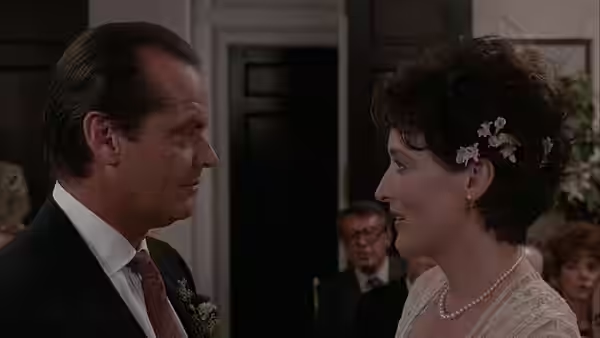
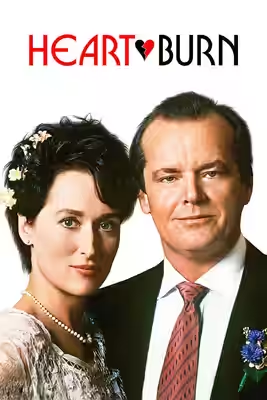
Rachel (Meryl Streep) and Mark (Jack Nicholson) share a candlelit dinner at a restaurant
Film review

Heartburn

1986 · Directed by Mike Nichols · 1h 48m

In a sentenceMeryl Streep and Jack Nicholson share a marriage, though the screenplay seems reluctant to introduce them properly

Rachel (Meryl Streep) and Mark (Jack Nicholson) are journalists whose marriage is at the centre of this comedy-drama. Their life together provides the setting, with sex, love and the question of when to quit shaping the story. Richard (Jeff Daniels), Vera (Maureen Stapleton) and Julie (Stockard Channing) are among the other characters. Adapted by Nora Ephron from her novel, the film follows the couple through their everyday life and the private difficulties of understanding what they want from one another.

Fi1m review

Mike Nichols makes Rachel and Mark’s daily life convincing, but Heartburn gives us too little sense of why they need each other. Meryl Streep and Jack Nicholson supply pleasures the thin writing cannot sustain.

Heartburn is a disappointing marriage comedy, despite two actors who can make an underwritten exchange worth listening to. Mike Nichols directs Nora Ephron’s adaptation of her own novel, and the care taken over the couple’s everyday life is evident. What remains obscure is what Rachel and Mark need from each other, a substantial problem when their relationship is meant to hold our attention. The film has enough incidental pleasure to avoid becoming a chore, but too little insight to make its disappointments seem worth the time.

Meryl Streep gives Rachel a credibility that the screenplay does not always earn, and we would put much of what works here down to her. The performance encourages us to stay interested even when the character’s wants remain indistinct. We were frustrated by how often that interest went unrewarded: the daily business of Rachel and Mark’s life feels convincing, yet their feelings about it remain difficult to read. Streep has to supply a good deal of what the script has failed to explain.

Jack Nicholson gets more immediate pleasure out of Mark, a thin role with lines that suit his delivery. He can make an amusing moment feel sufficient while it lasts, and that is a useful skill in a film so dependent on the attraction of its leads. The limitation becomes apparent when we try to see beyond the enjoyable performance to the husband he is playing. Nicholson makes the material entertaining, but the writing gives him too little to explore.

Néstor Almendros’s cinematography and Tony Walton’s production design are important to the film’s convincing sense of daily life. We accept the couple’s surroundings readily, and the attention given to that world makes the thin characterisation more noticeable. A marriage comedy needs this sort of ordinary detail, since people can reveal a great deal through the small business of living together. Here, though, the physical world is more fully realised than the people occupying it, and the attractive finish sometimes makes the drama feel over-careful.

Sam O’Steen’s editing preserves the appeal of individual moments, although the film struggles to build much interest from one to the next. Carly Simon’s music supplies warmth, but it cannot settle the more basic question of how we should feel about these two people. The running time is 108 minutes, which ought to be ample room for the screenplay to give each of them greater definition. Instead, too many of the pleasant touches leave our understanding of the marriage where it was.

A marriage comedy can leave us uncertain about who is right, so long as we understand what each person is asking for. Ephron’s writing gives us too little to work with, and the actors can only supply so much on their own. Nichols draws appealing work from the cast without making the couple’s problems especially involving. Consider it for the leads, and keep expectations of the writing low.


Critical consensus AI synthesised

51
Positive
0
Mixed
3
Negative
1
Time Out
· CPea
64*

The page is identified as a film review, but its critical verdict is not visible. The available description only notes the adaptation of Nora Ephron’s book and the journalists played by Meryl Streep and Jack Nicholson.

Read the full review →
Radio Times
★★★ · Joanna Berry
60

Berry gives the film a mixed verdict, noting that Nicholson makes the most of a shallow role. She finds Streep somewhat at sea, while praising Nicholson’s lines and performance.

Read the full review →
Variety
31 December 1985 · Variety Staff
50*

The review finds the film beautifully made but ultimately disappointing. It praises the vivid texture of the couple’s daily life and the performances, while faulting the script for not revealing enough about what they feel or want.

Read the full review →
Los Angeles Times
25 July 1986 · Sheila Benson
30*

Benson finds the film slick but ultimately hollow, lacking a clear point of view. She praises Streep’s performance and the actors’ memorable moments, while criticizing the screenplay’s thinness.

Read the full review →

Straight answers AI written, from our review

Is Heartburn worth watching?
Heartburn offers pleasures for admirers of Meryl Streep and Jack Nicholson, but we find it disappointing as a marriage comedy and score it 55 out of 100. The leads make individual exchanges entertaining, while the convincing everyday surroundings cannot compensate for writing that leaves us unsure what Rachel and Mark need from each other.
How long is Heartburn, and what is it rated?
Heartburn runs 1h 48m. It is a comedy and drama film.
Where can I watch Heartburn in Brazil?
Heartburn is not on any streaming or rental service in Brazil at the moment. It is available in 27 other countries; change your country at the top of the page to see where. Availability is checked daily.
How violent or frightening is Heartburn, and is it suitable for children?
Heartburn carries a US R certificate, making it an adult viewing choice rather than one for children; no UK certificate is supplied. Its marriage story concerns sex, love and private relationship difficulties, but the available detail does not establish the extent of violence, frightening material or sexual explicitness, so we cannot offer more specific reassurance for sensitive viewers.
How does Heartburn compare to An Unmarried Woman?
Heartburn is the weaker choice beside An Unmarried Woman, which we recommend for its humour and more honest, precise treatment of marriage and a woman reassessing her life. Streep and Nicholson provide incidental pleasures in Heartburn, but Jill Clayburgh’s character has more room to develop in the other film, even if a few scenes become lectures.
Is Heartburn based on a true story or a book?
Heartburn is adapted from Nora Ephron’s novel, with Ephron writing the screenplay herself. No prior reading is needed to follow the marriage at its centre, though we find the characters’ needs insufficiently explained. The supplied account establishes the book as its source, but does not establish a true-story basis or how faithfully the film follows the novel.
What should I watch after Heartburn?
After Heartburn, try An Unmarried Woman (1978, Fi1m 82): Another woman reassesses her life, with more room to become herself. Then The Squid and the Whale (2005, Fi1m 83): Family breakdown viewed through children, with sharp jokes and little comfort; and The Lunchbox (2013, Fi1m 75): Food and correspondence make an intimate drama of unmet emotional needs.

Cast

If you liked this, try…

  1. Scenes from a Marriage (1973) · not reviewed yetFor a closer, harsher examination of what spouses cannot tell each other.

  2. An Unmarried Woman (1978, Fi1m 82)Another woman reassesses her life, with more room to become herself.

  3. The Squid and the Whale (2005, Fi1m 83)Family breakdown viewed through children, with sharp jokes and little comfort.

  4. The Lunchbox (2013, Fi1m 75)Food and correspondence make an intimate drama of unmet emotional needs.

  5. Enough Said (2013) · not reviewed yetAdult attraction and small irritations get the patient attention they deserve.

Free account

Know what to watch tonight

Two lists that know where things are streaming, collections you can share, your own score beside ours, and Discover that remembers what you have seen.

  • Want to see, sorted by what is streaming now
  • Seen, with your score out of ten
  • No adverts, ever