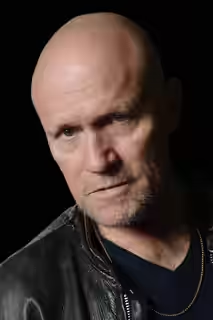
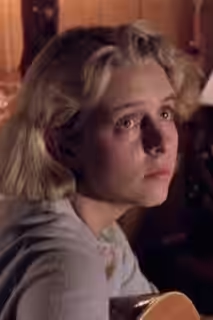
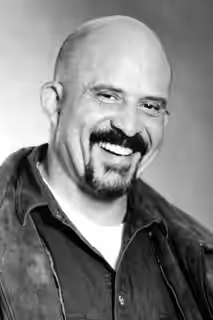
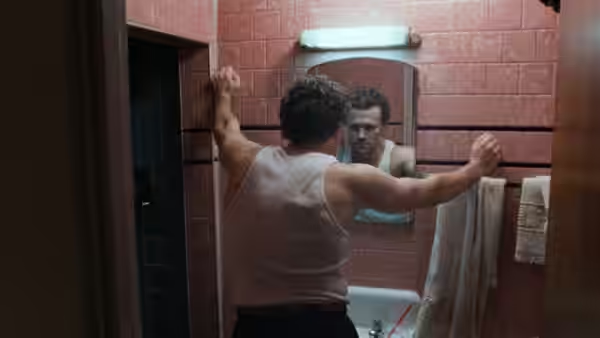
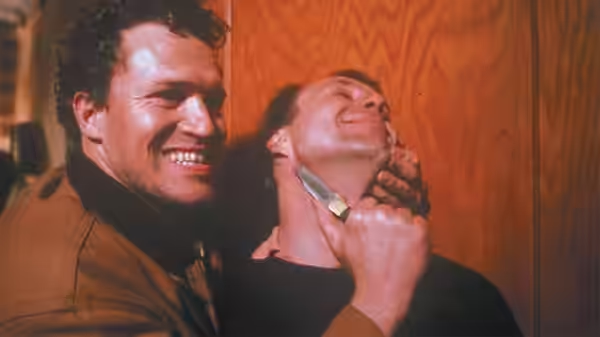
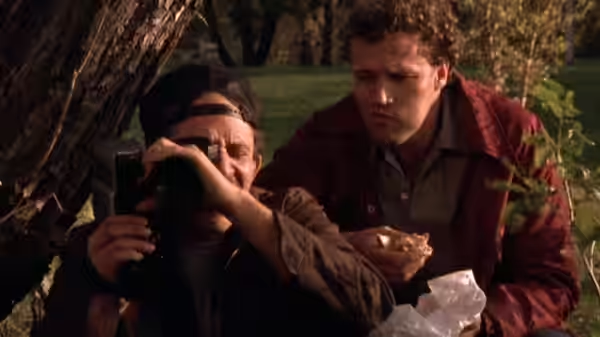
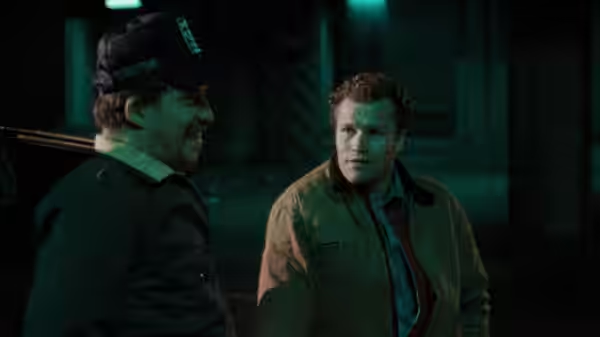
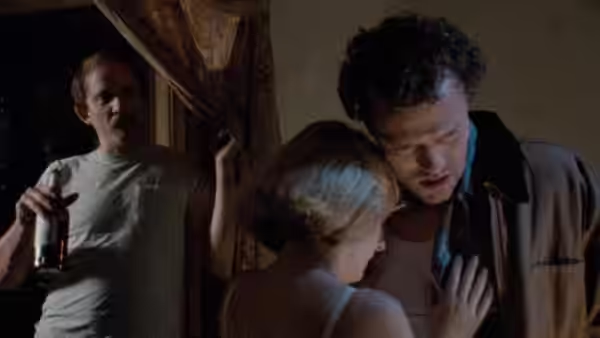
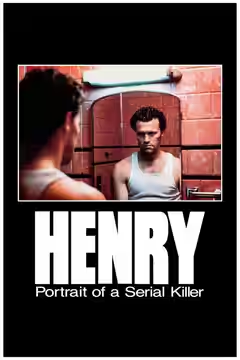
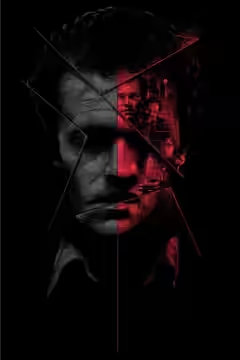
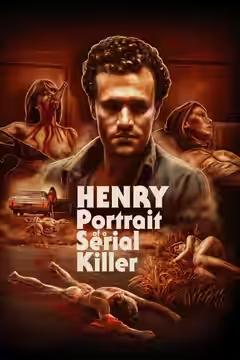
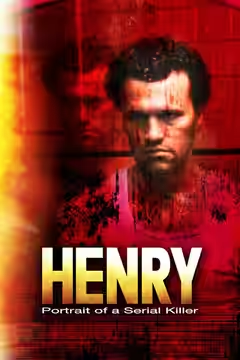
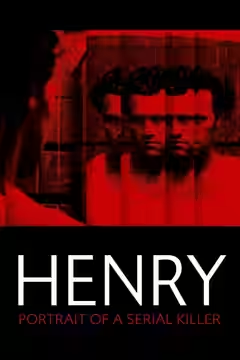
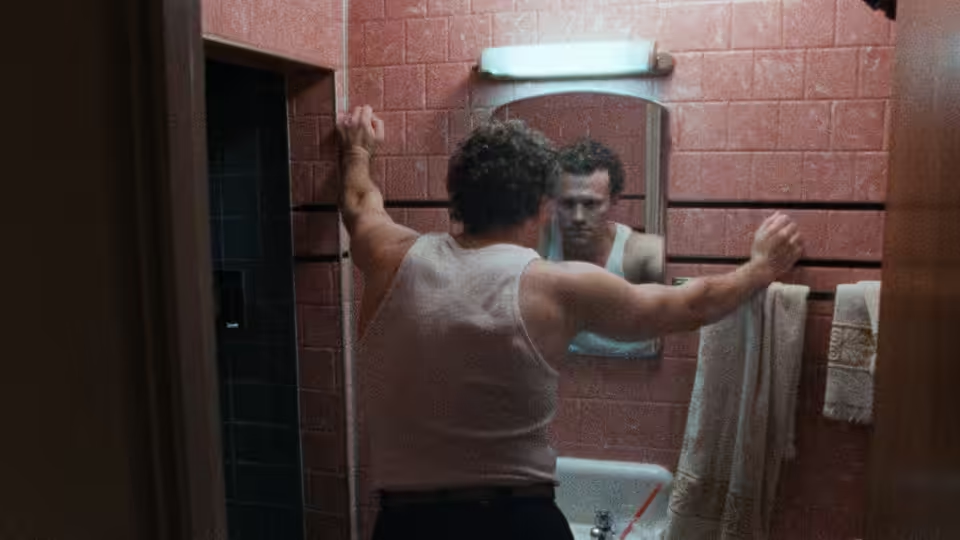
Henry (Michael Rooker) braces himself against a bathroom wall, studying his reflection in the mirror
Film review

Henry: Portrait of a Serial Killer

1986 · Directed by John McNaughton · 1h 23m

In a sentenceTwo men, a flat, a video camera and a synth score from a worse film; still nobody tells you when to flinch

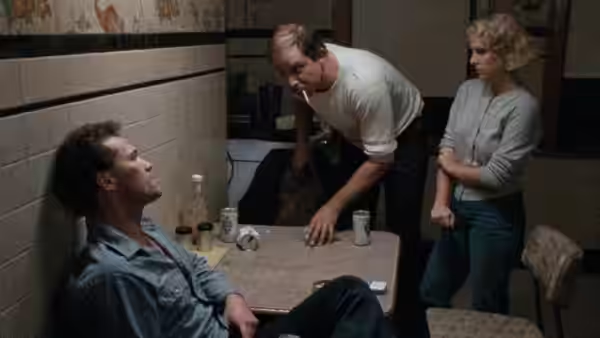
Henry (Michael Rooker) is a quiet, courteous man who kills strangers, without pattern or reason. The film opens on what he leaves behind: a dead woman, a floating woman, a dead couple, each held as a still picture. Then he finishes a meal, tips the waitress (Anne Bartoletti) and drives on. He shares a flat with Otis (Tom Towles), who has never asked what Henry does with his evenings. Otis’s sister Becky (Tracy Arnold) arrives with a suitcase, needing a bed and a job, and gets both. She also warms to Henry, who is gentler with her than the men she is used to. At the kitchen table he tells her about himself, and what he says does not quite add up. Becky notices and lets it go.

Plays from YouTube when you press play; nothing loads from them until then.

Fi1m review

McNaughton’s debut watches a murderer the way a security camera watches a car park: flatly, without comment, for as long as it takes. It is cheap and dated in places, uneven in its last stretch, and still hard to sit through, which is the point.

John McNaughton’s first film opens on the dead. A woman, a floating woman, a couple, each held as a still picture for a beat longer than is comfortable. Then the film cuts to Henry (Michael Rooker) finishing a meal in a diner, tipping the waitress and driving on. That is the method, laid out in the first five minutes, and it holds for the remaining 78.

Henry shares a flat with Otis (Tom Towles), who has never asked what Henry does with his evenings. Otis’s sister Becky (Tracy Arnold) turns up with a suitcase, needing somewhere to stay and a job, and she gets both; she also gets Henry, who holds doors for her and listens. Over a beer at the kitchen table he tells her about himself, and before the scene is over the account has shifted. Becky notices and lets it go.

Rooker plays him with almost nothing. He speaks softly, says thank you, pays his bills, and walks through a shopping mall with the same face he uses to order coffee. There is no twitch, no relish, no speech about why. Towles gives Otis all the appetite Henry lacks, and when Henry starts taking him along the film watches Otis discover that he likes it. Towles is broad where Rooker is still, and once or twice he tips into a leering cartoon, but the film needs the contrast and mostly gets it.

Charlie Lieberman shoots it in the light that was there: fluorescent strips, one bulb over the kitchen table, sodium orange on the street. The image is grainy and the colours are the colours of a rented flat, brown and beige and nicotine. The camera hardly moves, and when a killing happens it tends to happen at the edge of the frame or after a cut. Elena Maganini’s editing does the film’s most important work in that opening, holding each corpse and then cutting to Henry doing something dull. Patricia Hart puts everyone in work jackets and thin T-shirts that look slept in. The music, by Robert McNaughton, Steven A. Jones and Ken Hale, is a low electronic drone that works under the opening and dates the film badly whenever it reaches for a tune.

The sequence people talk about comes in the middle and involves a video camera and a family’s living room. We will not describe it. We will say that we felt sick, and that the sickness was not at what was on screen, because McNaughton shows less than most television crime dramas do. It was at the fact that we were still watching, and that Otis was watching too, on the flat’s own television, with the remote in his hand. McNaughton makes that point once, hard, and does not make it again.

It is a cheap film and it looks cheap, which is mostly a virtue and sometimes not. The sound recording is rough and lines go missing under traffic. Outside the three leads the acting is patchy. The script, by McNaughton and Richard Fire, has a development late on involving Otis and Becky that we found harder to believe than anything Henry does, and the film needs us to believe it. And the score, in its melodic moments, belongs to a different and worse film.

The tagline sold it against the slasher cycle: “He’s not Freddy, he’s not Jason… he’s real.” That is fair. A slasher tells you when to flinch, with a chord, a shadow, a hand on a doorknob. Here there is no cue, and after twenty minutes you stop waiting for one and start dreading the quiet. It was made in 1986 and did not reach British cinemas until 12 July 1991, and critics have been split down the middle ever since; roughly half find it still frightening and half find it creaky. We do not think creaky is the right word. The cars have changed. The men have not.

It runs 83 minutes and carries an 18. Watch it in the daytime. It will not help.
Critical consensus AI synthesised

68
Positive
5
Mixed
5
Negative
1

Most critics find Henry: Portrait of a Serial Killer still disturbing decades on, and they praise it for much the same reasons. The consensus is that McNaughton’s rough, documentary-style direction, which declines to judge its killer, is what makes the film so cold and so hard to shake off. Michael Rooker’s understated performance is singled out again and again as the source of the fright: an ordinary man doing terrible things without emphasis.

The reservations are about age and purpose. Several critics say the violence lands less hard than it once did, that the score has dated badly and that the cheap production shows. Empire questions what the film is for and finds one plot turn hard to credit. The Guardian goes furthest, finding little left in it beyond a few lingering shocks. The spread is wide, from five stars to near dismissal, and the doubters are mostly writing about later re-releases rather than the film’s first appearance.

Radio Times
★★★★★ · John Ferguson
100

Ferguson presents the film as a disturbing, chilling portrait of a random killer. He praises McNaughton’s rough, non-judgemental direction and the documentary-style feel it creates.

Read the full review →
Slant Magazine
7 September 2005 · ★★★½/4 · Jeremiah Kipp
88

Kipp sees the film as a raw, unrelenting challenge to viewers’ assumptions about their own moral distance from violence. He praises its minimalist realism and the way it makes spectators confront their complicity.

Read the full review →
Variety
4 October 1989 · festival review · Variety Staff
80*

The review finds the film riveting and a major debut, despite its disturbing violence. It singles out Michael Rooker’s understated performance as making Henry especially frightening.

Read the full review →
Los Angeles Times
27 October 2016 · Robert Abele
75*

Abele finds the restored film still powerfully disturbing, despite some tonally uneven and dated moments. He singles out Michael Rooker’s chilling performance and the film’s cold, everyday vision of evil.

Read the full review →
Time Out
· NF
75*

The review presents the film as a compelling, unsettling study of a sociopath. It singles out the portrayal’s ability to make the viewer recoil and think.

Read the full review →
The New York Times
23 March 1990 · Janet Maslin
64*

The page content is unavailable, so the critic’s verdict cannot be verified. No praise or complaint can be reliably identified from the accessible text.

Read the full review →

Straight answers AI written, from our review

Is Henry: Portrait of a Serial Killer worth watching?
Henry: Portrait of a Serial Killer is worth watching for anyone who can sit through 83 minutes of flat, uncued dread, and we scored it 65. Michael Rooker's still, courteous performance and the security-camera plainness of the filming make it hard to shake, but the sound is rough, the score dates it badly and a late development strains belief.
How long is Henry: Portrait of a Serial Killer, and what is it rated?
Henry: Portrait of a Serial Killer runs 1h 23m. It is a crime and horror film.
Where can I watch Henry: Portrait of a Serial Killer in Italy?
Henry: Portrait of a Serial Killer is not on any streaming or rental service in Italy at the moment. It is available in 2 other countries; change your country at the top of the page to see where. Availability is checked daily.
How violent or frightening is Henry: Portrait of a Serial Killer, and is it suitable for children?
Henry: Portrait of a Serial Killer carries a UK 18 certificate and is not suitable for children or younger teenagers. It shows less than most television crime dramas do, but the killings arrive without warning and the film watches them without comment, and one sequence involving a video camera in a family's living room left us feeling sick. The squeamish should stay away.
How does Henry: Portrait of a Serial Killer compare to Man Bites Dog?
Henry: Portrait of a Serial Killer is the grimmer and plainer of the two, while Man Bites Dog turns the same subject into a mock documentary that is funny before it is disturbing. The Belgian film has the sharper idea about the crew filming a killer, but it repeats its shocks; McNaughton's film makes its point about watching once, hard, and moves on. See Henry first and Man Bites Dog afterwards.
What should I watch after Henry: Portrait of a Serial Killer?
After Henry: Portrait of a Serial Killer, try Man Bites Dog (1992, Fi1m 78): A Belgian film crew follows a killer and the joke turns on them; watch it afterwards. Then The Vanishing (1988, Fi1m 88): Dutch and patient, with a villain as courteous as Henry; do not read about the ending.

Cast

Awards

Sitges Film Festival Best Feature-Length Film award, 1990

Won
Sitges Film Festival Best Feature-Length Film award

If you liked this, try…

  1. Angst (1983) · not on Fi1m yetAustrian, even less merciful, and shot from angles that make you feel followed home.

  2. Man Bites Dog (1992, Fi1m 78)A Belgian film crew follows a killer and the joke turns on them; watch it afterwards.

  3. The Vanishing (1988, Fi1m 88)Dutch and patient, with a villain as courteous as Henry; do not read about the ending.

  4. Peeping Tom (1960) · not on Fi1m yetMichael Powell put the camera in the killer’s hands decades earlier and paid for it.

  5. Snowtown (2011) · not on Fi1m yetAustralian and grim, about a killer who recruits the household around him; the nearest thing since.