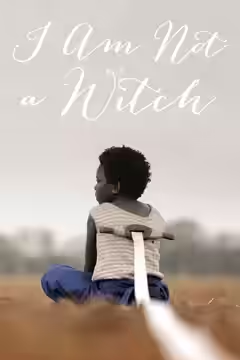
Rungano Nyoni’s first feature is dry, strange and often funny: a small Zambian girl is declared a witch and tethered to a spool of ribbon. The image lasts; the satire around it is broader than it needs to be, and the last third repeats itself.
Rungano Nyoni’s first feature opens on a coach party. Tourists stand at a rail and point their phones at a row of elderly Zambian women sitting in the dust, each with a long white ribbon running from her back to a wooden spool on a lorry behind her. A guide explains the arrangement. Nobody asks the women anything. Then Nyoni cuts to a village, where a woman carrying water on her head trips at the sight of a small girl, Shula (Maggie Mulubwa). That is the whole of the case against her.
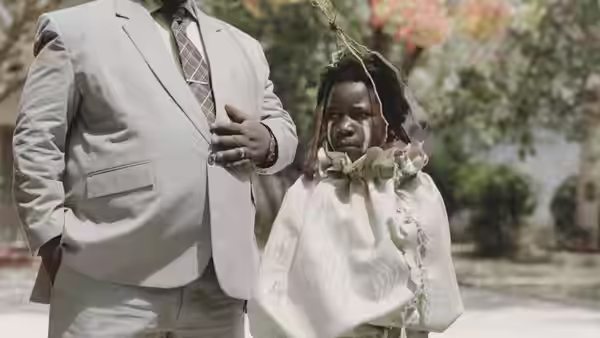
At the police station the neighbours give their statements to an officer (Nellie Munamonga) who writes it all down with a straight face. One man (Chileshe Kalimamukwento) says the girl cut off his arm in a dream; he has both arms. We laughed, and then stopped, because the camera goes back to Shula, sitting against the wall, saying nothing, with nowhere else to be. Nyoni does this again and again and it is the film’s best trick: the joke lands, and then she shows you who is paying for it. Mr Banda (Henry B.J. Phiri), a government official in a suit a size too small, arrives to take charge, and a witch doctor is sent for to settle the question with a chicken.
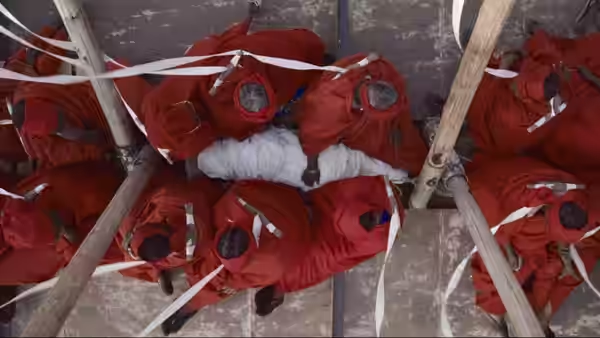
Banda delivers her to the camp. The women there are tied to their spools because a witch set loose will fly away and kill, and a witch who cuts her ribbon turns into a goat; that is the rule, and nobody is interested in discussing it. Shula is given the choice. Mulubwa plays the decision without a line. She looks at the ribbon, at the women, at the ground, and the women wait. We have watched a great many children act and most of it is pitched at the grown-ups watching. This is not. Nyoni appears to have found the right face and then kept the camera on it.
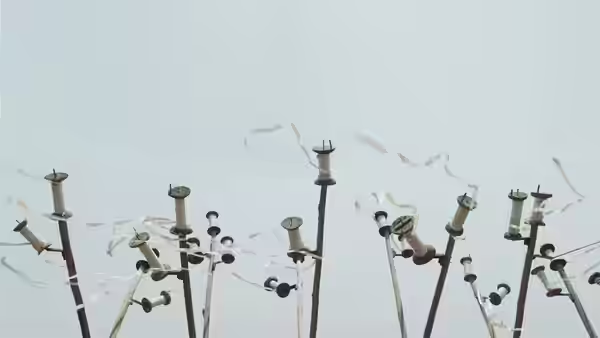
David Gallego shoots the country wide and flat, orange earth running out to a pale horizon, and he keeps the ribbons in frame as thin white lines across all of it, so the women look pinned to the ground they sit on. Nathan Parker’s spools are enormous and wooden and plainly built by someone who took the idea seriously, which is why they work as furniture rather than as a gag. Yann Dedet and George Cragg cut without warning from one place to the next, and the film rarely explains how anyone got there; it is a style, and once or twice it is a muddle. Matthew James Kelly’s music comes in rarely, and when it does it is often concert-hall strings over red dust, which is funny the first time and sadder each time after.
Banda has plans for his witch. He takes her to a line-up of men suspected of theft and asks her to point out the guilty one; she walks slowly along the row while the men sweat. It is the funniest scene in the film, and it is a child being used as a tool in front of frightened adults. Phiri plays Banda as a big, cheerful, perspiring man who talks about Shula as an asset and believes he is being good to her. Some critics have found the performance too broad. We think the broadness is deliberate, but there is a great deal of it, and by the third time Banda is on the phone promising the girl to somebody, the joke has stopped moving. His wife, Charity (Nancy Murilo), who knows the camp from the inside, gets one scene of advice to Shula that explains how this all works better than anything Banda says.
The second half brings the tourists back, and television, and a drought, and we will not describe where it goes. What we can say is that the film has made its point by the hour mark and spends the remaining half hour making it again at a slower pace. The women of the camp, Ritah Mubanga’s Sequinned Witch among them, are more interesting than the plot gives them time for. The scenes where they simply sit and talk, and look after the child in their offhand way, are the ones we wanted more of.
It is 93 minutes and a 12A. Nothing in it would frighten a child; most of it will make an adult uneasy, and the two things are not unrelated. Watch it on the largest screen you have, because the ribbons need the width.