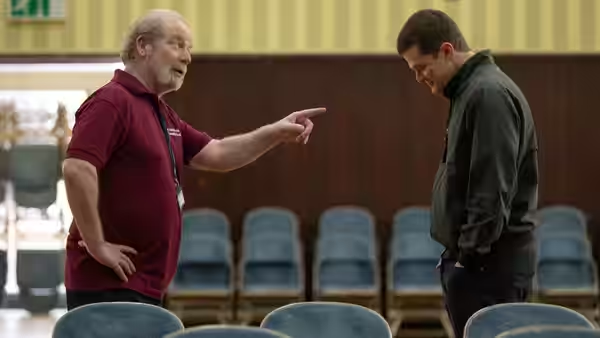
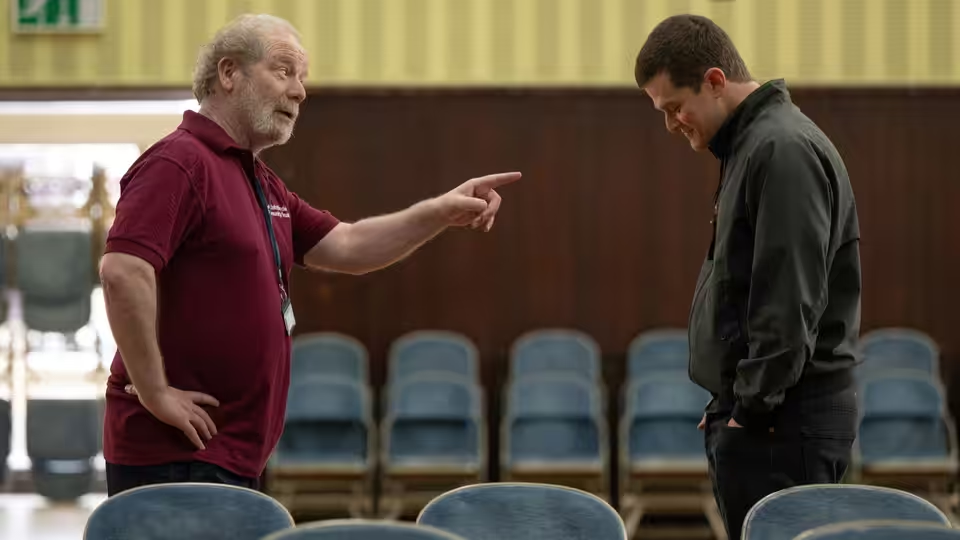
An older man points toward a younger man standing among chairs in a classroom
Film review

I Swear

2025 · Directed by Kirk Jones · 2h 01m

In a sentenceThe swearing is involuntary; the uplift is not

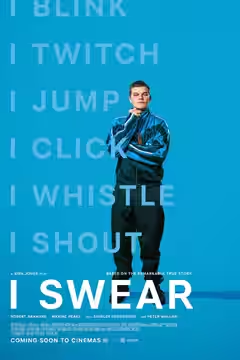
The film opens with the grown John Davidson (Robert Aramayo) on his way to Buckingham Palace, then goes back to his childhood. John (Scott Ellis Watson) plays football and wants to be left alone to do it, and he has started to blink, twitch, click and shout words he does not mean. Nobody can tell his mother Heather (Shirley Henderson) what is wrong, and she is not coping. Dottie (Maxine Peake), a family friend, takes him under her wing, and Tommy (Peter Mullan), a man with no patience for fuss, becomes the nearest thing he has to a father. The diagnosis, Tourette syndrome, names the problem of his life: how to keep a job, a friend or a seat on a bus when your own mouth is against you.

Plays from YouTube when you press play; nothing loads from them until then.

Fi1m review

Kirk Jones’s biopic of the Tourette’s campaigner John Davidson is kind, funny and shaped exactly like every film of its type. Robert Aramayo’s performance is the reason to see it, and it is reason enough.

Kirk Jones wrote, directed and produced I Swear, and it is a film with a job to do. John Davidson, who grew up with Tourette’s and became a campaigner for people who have it, is the sort of subject a producer describes as inspiring, and Jones has made the film that word implies: warm, tidy, built to send you out feeling better about people. It is good, in the way that a well-made chair is good. We would happily give it an evening. We would not tell you it surprised us.

The reason to see it is Robert Aramayo. He takes over from Scott Ellis Watson as John reaches his late teens, and he does the tics, the blinks, the neck jerks, the barked obscenities, without ever letting them become the performance. What he plays instead is the effort around them: the held breath before a room goes quiet, the half-second after a shout when John checks who heard, the tiredness of a man who has been embarrassed so many thousands of times that he has run out of embarrassment and found something drier underneath. He is funny, too, and the film is honest enough to let him be. A man involuntarily shouting the worst possible word at the worst possible moment is a joke, and John knows it before anyone around him does.

Around him Jones has cast well. Maxine Peake plays Dottie as a woman who has decided to be kind and is not going to discuss it, and Peter Mullan gives Tommy the gruffness he has given a dozen men and, underneath it, a patience we did not expect. The performance that got at us, though, was Shirley Henderson’s. Heather is a mother frightened of her own child, and Henderson plays her small and tight, not looking at him, hands busy with something else. We found the kitchen scenes, where she cannot bring herself to touch him, harder to sit through than anything John shouts in public. The film is on John’s side, but it does not make a monster of her, and that restraint is its best decision.

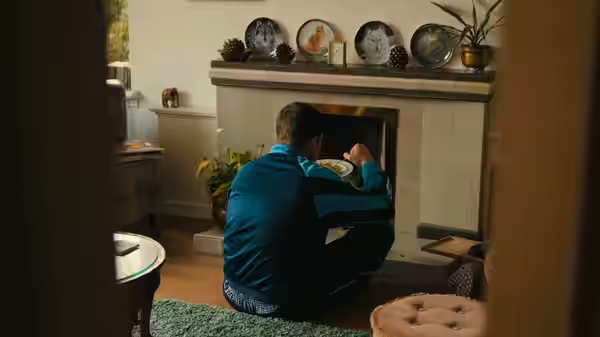
James Blann shoots the town in soft grey daylight and keeps the interiors brown, close and slightly too small for John’s body, so that every twitch seems to knock against a wall. Sabrina Linder’s production design and Denise Coombes’s costumes do the period without winking at it: knitwear, wallpaper, a community hall with a tea urn. Stephen Rennicks’s score is piano and strings and it is used more than we would like; there are scenes where Aramayo is doing the work alone and the music arrives to do it again. Sam Sneade’s cutting is cleanest in the public outbursts, where he holds on the faces of strangers just long enough for us to see them decide what John is.

The trouble is the shape. John tries something, a job, a date, a bus journey, a quiet pint, and the tics wreck it, and we cut to the next attempt. Once this is moving, once it is funny, and by the fifth time we were checking the runtime. The film also tells us what it means; “Education leads to empathy” is said aloud, more than once.

Jones has made gentle films before, Waking Ned among them, and he has not changed his temperament here. He does not do friction. Every awkward stranger softens on schedule, every institution comes round, and a story that in life must have contained a great deal of unresolved unpleasantness is resolved, pleasantly, in 121 minutes. Most critics have been kinder to this than we are, and we understand why: it is hard to hold the manner of the thing against a film this decent about its subject.

It carries a 15 certificate, for the language, which is rather the point. See it for Aramayo, and for Henderson, and go in knowing you will be told how to feel and will feel it anyway.

Critical consensus AI synthesised

74
Positive
13
Mixed
5
Negative
0
Empire
7 September 2025 · John Nugent
85*

Nugent finds the film sweet, funny, and unusually moving despite its familiar feel-good conventions. He especially praises Robert Aramayo’s performance and the film’s compassionate, non-condescending portrayal of Tourette syndrome.

Read the full review →
Los Angeles Times
24 April 2026 · Katie Walsh
85*

Walsh finds the film deeply moving, entertaining and an important extension of Davidson’s advocacy. She singles out Robert Aramayo’s stunning performance and the film’s compassionate portrayal of life with Tourette’s.

Read the full review →
The Guardian
9 October 2025 · Peter Bradshaw
85*

Bradshaw finds the film warm, compassionate and absorbing, with humor that cuts through sentimentality. He especially praises Robert Aramayo’s intelligent, charming performance as John Davidson.

Read the full review →
Screen Daily
8 September 2025 · Nikki Baughan
80*

Baughan finds the biopic stirring and its lead performance exceptional. She particularly praises Robert Aramayo’s portrayal of John Davidson.

Read the full review →
Time Out
6 September 2025 · ★★★★ · Phil de Semlyen
80

The review presents the film as a funny, bittersweet campaigning biopic. It singles out Robert Aramayo’s performance as stellar.

Read the full review →
IndieWire
23 April 2026 · B · Kate Erbland
77

Erbland finds the conventional biopic insightful, though its repetitive setbacks and delayed focus on Davidson’s activism weaken it. She especially praises Robert Aramayo’s sensitive, star-making performance.

Read the full review →

Straight answers AI written, from our review

Is I Swear worth watching?
I Swear is worth watching for anyone who wants a warm, well-acted biopic and can forgive it for following the usual shape, and we scored it 70. Robert Aramayo and Shirley Henderson are the reasons to see it. Go in knowing the film will tell you how to feel, and that you will probably feel it anyway.
How long is I Swear, and what is it rated?
I Swear runs 2h 01m. It is a drama and history film.
Where can I watch I Swear in Slovenia?
I Swear is not on any streaming or rental service in Slovenia at the moment. It is available in 26 other countries; change your country at the top of the page to see where. Availability is checked daily.
How violent or frightening is I Swear, and is it suitable for children?
I Swear is not violent or frightening, but it carries a 15 certificate for language, since John Davidson's Tourette's makes him shout obscenities he does not mean. Younger children should be kept away for the swearing alone; teenagers of 15 and over will be fine. The hardest scenes are quiet ones, in which a mother cannot bring herself to touch her son.
How does I Swear compare to My Left Foot: The Story of Christy Brown?
I Swear is the gentler and tidier of the two films, and My Left Foot: The Story of Christy Brown is the better one. Jim Sheridan's film is rougher and less pious, and Daniel Day-Lewis gives Christy Brown a temper that Kirk Jones never allows John Davidson. Both are worth seeing for their lead performances; Aramayo's is fine work in a film that smooths its edges.
What should I watch after I Swear?
After I Swear, try My Left Foot (1989, Fi1m 85): Daniel Day-Lewis as Christy Brown, with more temper and less tidiness than most biopics allow. Then Ratcatcher (1999, Fi1m 88): Lynne Ramsay’s Glasgow childhood, the Scottish estate film shot as if it were poetry; and The Diving Bell and the Butterfly (2007, Fi1m 87): Schnabel puts you inside a paralysed man’s eye and keeps you there.

Cast

If you liked this, try…

  1. My Left Foot (1989, Fi1m 85)Daniel Day-Lewis as Christy Brown, with more temper and less tidiness than most biopics allow.

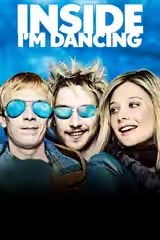
  2. Inside I'm Dancing (2004) · not on Fi1m yetTwo young men in a Dublin care home, funny, rude and refusing to be inspiring.

  3. Ratcatcher (1999, Fi1m 88)Lynne Ramsay’s Glasgow childhood, the Scottish estate film shot as if it were poetry.

  4. The Diving Bell and the Butterfly (2007, Fi1m 87)Schnabel puts you inside a paralysed man’s eye and keeps you there.

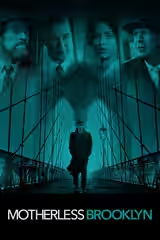
  5. Motherless Brooklyn (2019) · not on Fi1m yetA detective with Tourette’s, and the tics written into the dialogue rather than around it.