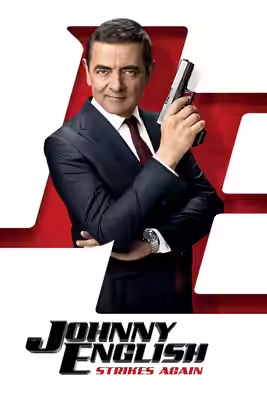
Rowan Atkinson’s physical comedy earns some laughs, but Johnny English Strikes Again has too little else to offer. The spy plot is thin, the technology jokes are tired, and the good routines remain isolated.
Johnny English Strikes Again is intermittently funny, which is a modest return from a comedy lasting 88 minutes. David Kerr has a reliable asset in Rowan Atkinson, whose commitment to English’s foolishness makes even familiar material briefly worth watching. William Davies’s screenplay asks that performance to cover too much thin plotting and too many predictable jokes. The gaps between the good routines are the trouble.
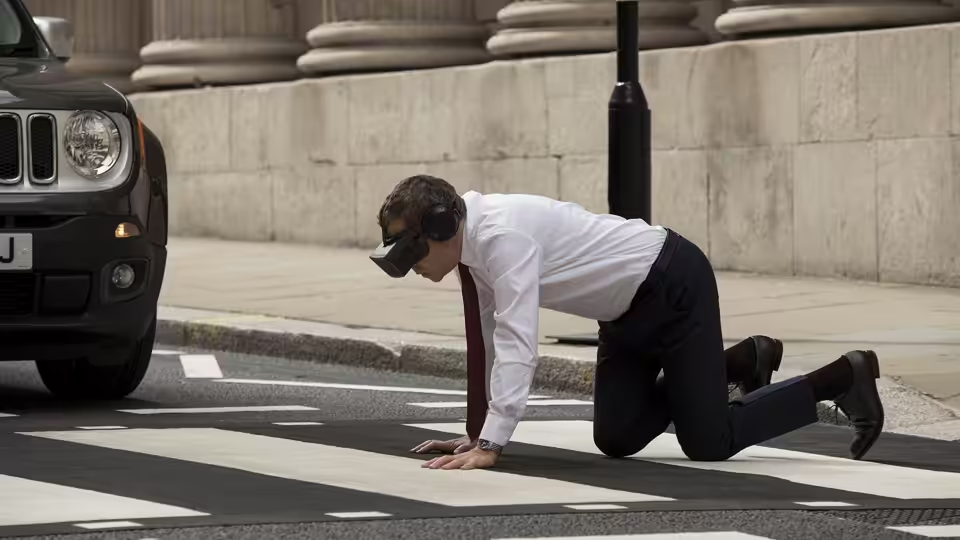
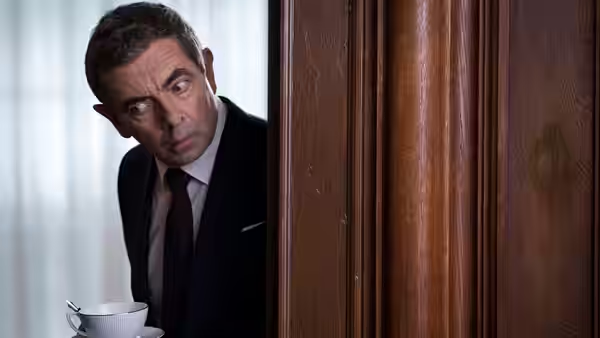
The performance depends on English never discovering how ridiculous he looks. His confidence has to remain intact while everything else goes wrong, and the physical precision makes that unreasonable certainty amusing even when the situation is familiar. We laughed at the virtual-reality routine, because his wholehearted response to imaginary danger gives the stupidity a clear purpose. For that stretch, David Kerr lets the performer do enough to make an obvious misunderstanding funny without needing to explain the joke.
William Davies’s handling of technology is less assured. The hackers’ pranks with traffic lights and an airport suggest other possibilities: modern systems can fail as spectacularly as English does. Yet the film mostly settles for the easier joke that an old-fashioned spy does not understand new equipment. That supplies a workable routine, but repeating it across a feature makes English’s ignorance increasingly tiresome, particularly when his mistakes are so easy to anticipate.
Emma Thompson’s Prime Minister is welcome partly because she gives the comedy a firmer presence than the jokes deserve. With Ben Miller as Bough and Olga Kurylenko as Ophelia Bhulatova, there is no shortage of performers around whom the writer might build a livelier farce. Instead, the supporting characters have too little comic independence from English. The film repeatedly comes back to his inadequacy, even when another character might have supplied a more interesting interruption.
Cinematographer Florian Hoffmeister and production designer Simon Bowles make the spy-film surroundings respectable enough, but there is little comedy in that respectability. The visual interest remains English’s posture and his stubborn certainty about how he ought to behave. David Kerr is better at giving that foolishness room than at making the espionage itself funny. The staging is cautious for a film whose chief attraction is a man making mistakes, and the surroundings seldom contribute another joke.
Mark Everson’s editing gives the individual routines more shape than the story connecting them. The trouble is not simply pace: shortening the pauses would not supply the missing surprises. Howard Goodall’s music provides energy, but it cannot make a familiar situation feel freshly thought through. At 88 minutes, this ought to be a light diversion. Too often, the routines feel separated by a story that offers little pleasure of its own.
We do not need a spy spoof to offer penetrating thoughts on technology, and broad laughs would be enough if they arrived more regularly. Against that modest standard, this remains a mixed proposition. Admirers of Rowan Atkinson’s physical comedy will find passages worth their attention, though even they may lose interest between them. For a comedy this short, it asks for too much patience.