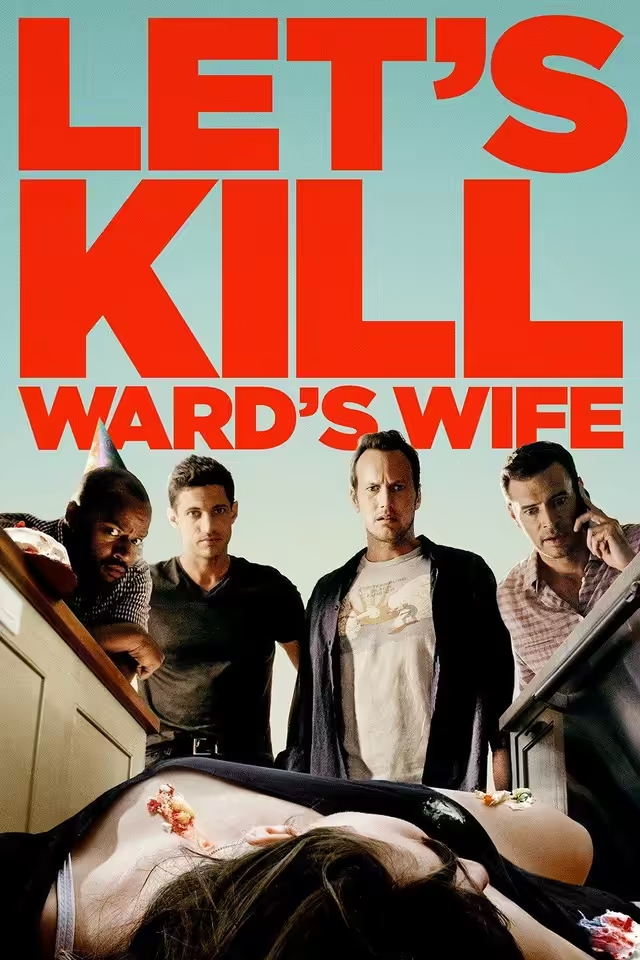
Scott Foley writes, directs and co-stars in a comedy about killing a nagging wife, and he appears to mean it. It is briskly made and Patrick Wilson is funny in it, but the film is not, and its good cheer about the premise curdles fast.
Scott Foley wrote it, directed it, produced it with Patrick Wilson and Joe Hardesty, and gave himself a leading part, so there is nobody else to blame. The idea is in the title. Ward (Donald Faison) is married to Stacy (Dagmara Dominczyk), who shouts at him in front of his friends and rations his time with them, and those friends, Tom (Foley), David (Wilson) and Ronnie (James Carpinello), spend their evenings agreeing that the world would be better without her. Then one of them stops agreeing and acts. It is a dark comedy about husbands, and it is poor: not brave, not funny for long, and far too sure that we are on its side.
Wilson is the reason to keep watching. He plays David as an actor between jobs who cannot walk past a woman without trying, and he says his lines with a lazy, pleased-with-himself half-smile that is funnier than anything written for him. He also produced the film, which may be why he seems the most relaxed person in it. Faison, who has to carry the title, is handed a man so beaten down that he barely speaks in his own scenes, and he plays it honestly; there is a slump in his shoulders in the opening minutes that we believed. Foley gives himself the new father, tired and sensible, and directs himself blandly. Carpinello’s Ronnie is the fourth man and stays the fourth man.
The trouble is Stacy. Foley’s screenplay writes her as a monster from her first scene: she interrupts, insults, forbids, and never once does anything a person might do. Dominczyk plays what she is given with real force, and it is not her fault that what she is given is a target. The film needs us to want her dead so that the men can be forgiven for wanting it, and it goes about this by listing her faults as if they were charges. We laughed twice in the first twenty minutes, at Wilson both times, and then we stopped, because it dawned on us that the film was not joking about the premise. It believes a woman who nags has forfeited something. We were not shocked by that so much as tired by it, and then irritated at how pleased with itself it stayed.
Eduardo Barraza lights everything evenly, kitchens and back gardens and a golf course, in the clean flat daylight of a network sitcom, and the film never once looks as though anything bad could happen in it. That might have been a joke; it is not used as one. Rebecca Weigold cuts quickly and gets the whole thing done in 81 minutes, which we were grateful for. John Spiker’s score is jaunty and keeps telling us we are having fun during scenes where we were not. Lindsey Moran’s houses are big, beige and interchangeable, and Reiko Schoenfeld dresses the men in polo shirts and the women in whatever will read as expensive from across a lawn. None of it is careless. It is simply the look of a great deal of television.
What happens after the first act we will not describe, except to say that it becomes a cover-up comedy and that Greg Grunberg, as a policeman friend named Bruce, keeps wandering in and out of it. Grunberg is likeable and gets the film’s best straight-faced reactions. Amy Acker, as David’s wife Gina, and Marika Domińczyk, as Tom’s wife Amanda, are given one scene each in which they are allowed to be people; the rest of the time they are the reason the men cannot go out. The film seems to think this is what marriage is, and expects us to nod along.
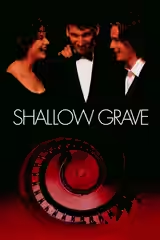
Comedies about killing have a long and honourable history. Kind Hearts and Coronets (1949) murders its way through a whole family and stays charming because it never asks us to agree the victims had it coming; Shallow Grave (1994) watches three friends go wrong over a body and is frightening because it likes them. This film wants the licence of both and does the work of neither. The reviews so far have been poor and we do not dissent.
It opened in Britain on 3 February 2015 with a 15 certificate, it is short, and Patrick Wilson is in it. That is the whole case for the defence.