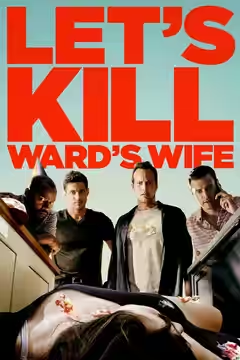
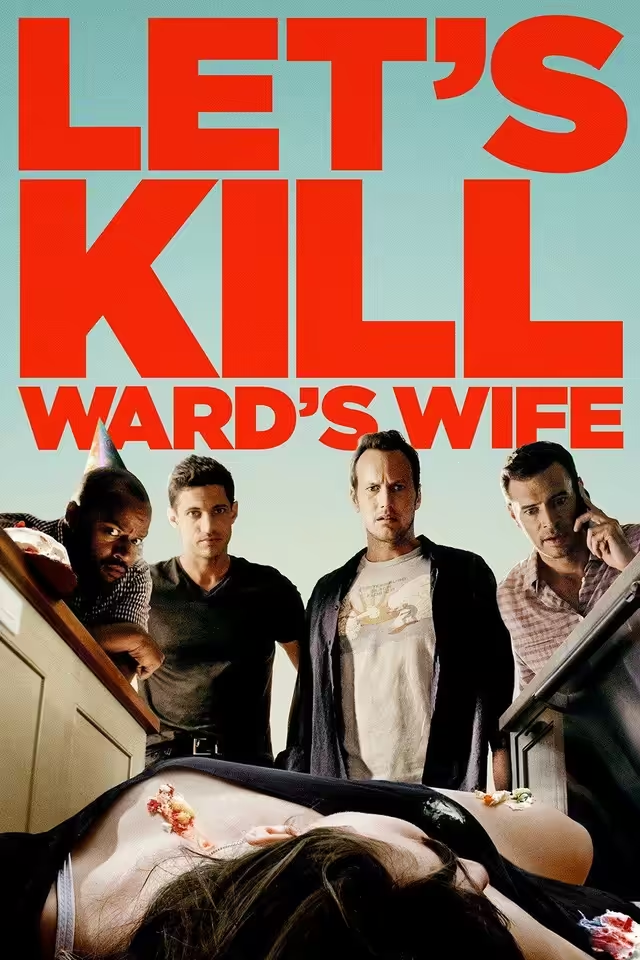
Let's Kill Ward's Wife poster
Film review

Let's Kill Ward's Wife

2014 · Directed by Scott Foley · 1h 21m

In a sentenceFour men agree a woman should die, then look around for the laugh they think they are owed

Ward (Donald Faison) is a husband and father whose wife, Stacy (Dagmara Dominczyk), runs his life: she decides when he may see his friends, which is seldom, and speaks to him in front of them as though he were staff. The friends are Tom (Scott Foley), a new father married to Amanda (Marika Domińczyk); David (Patrick Wilson), an actor married to Gina (Amy Acker) and unfaithful to her; and Ronnie (James Carpinello). Over golf, poker and beers they talk, half joking, about how much better Ward’s life would be if Stacy were dead, and how easy it might be to arrange. Bruce (Greg Grunberg), a policeman, drinks with them. Ward wants a night out and a quiet house; Stacy wants him home. The title says where the talk is heading.

Fi1m review

Scott Foley writes, directs and co-stars in a comedy about killing a nagging wife, and he appears to mean it. It is briskly made and Patrick Wilson is funny in it, but the film is not, and its good cheer about the premise curdles fast.

Scott Foley wrote it, directed it, produced it with Patrick Wilson and Joe Hardesty, and gave himself a leading part, so there is nobody else to blame. The idea is in the title. Ward (Donald Faison) is married to Stacy (Dagmara Dominczyk), who shouts at him in front of his friends and rations his time with them, and those friends, Tom (Foley), David (Wilson) and Ronnie (James Carpinello), spend their evenings agreeing that the world would be better without her. Then one of them stops agreeing and acts. It is a dark comedy about husbands, and it is poor: not brave, not funny for long, and far too sure that we are on its side.

Wilson is the reason to keep watching. He plays David as an actor between jobs who cannot walk past a woman without trying, and he says his lines with a lazy, pleased-with-himself half-smile that is funnier than anything written for him. He also produced the film, which may be why he seems the most relaxed person in it. Faison, who has to carry the title, is handed a man so beaten down that he barely speaks in his own scenes, and he plays it honestly; there is a slump in his shoulders in the opening minutes that we believed. Foley gives himself the new father, tired and sensible, and directs himself blandly. Carpinello’s Ronnie is the fourth man and stays the fourth man.

The trouble is Stacy. Foley’s screenplay writes her as a monster from her first scene: she interrupts, insults, forbids, and never once does anything a person might do. Dominczyk plays what she is given with real force, and it is not her fault that what she is given is a target. The film needs us to want her dead so that the men can be forgiven for wanting it, and it goes about this by listing her faults as if they were charges. We laughed twice in the first twenty minutes, at Wilson both times, and then we stopped, because it dawned on us that the film was not joking about the premise. It believes a woman who nags has forfeited something. We were not shocked by that so much as tired by it, and then irritated at how pleased with itself it stayed.

Eduardo Barraza lights everything evenly, kitchens and back gardens and a golf course, in the clean flat daylight of a network sitcom, and the film never once looks as though anything bad could happen in it. That might have been a joke; it is not used as one. Rebecca Weigold cuts quickly and gets the whole thing done in 81 minutes, which we were grateful for. John Spiker’s score is jaunty and keeps telling us we are having fun during scenes where we were not. Lindsey Moran’s houses are big, beige and interchangeable, and Reiko Schoenfeld dresses the men in polo shirts and the women in whatever will read as expensive from across a lawn. None of it is careless. It is simply the look of a great deal of television.

What happens after the first act we will not describe, except to say that it becomes a cover-up comedy and that Greg Grunberg, as a policeman friend named Bruce, keeps wandering in and out of it. Grunberg is likeable and gets the film’s best straight-faced reactions. Amy Acker, as David’s wife Gina, and Marika Domińczyk, as Tom’s wife Amanda, are given one scene each in which they are allowed to be people; the rest of the time they are the reason the men cannot go out. The film seems to think this is what marriage is, and expects us to nod along.

Comedies about killing have a long and honourable history. Kind Hearts and Coronets (1949) murders its way through a whole family and stays charming because it never asks us to agree the victims had it coming; Shallow Grave (1994) watches three friends go wrong over a body and is frightening because it likes them. This film wants the licence of both and does the work of neither. The reviews so far have been poor and we do not dissent.

It opened in Britain on 3 February 2015 with a 15 certificate, it is short, and Patrick Wilson is in it. That is the whole case for the defence.

Critical consensus AI synthesised

30
Positive
0
Mixed
1
Negative
3
Los Angeles Times
8 January 2015 · Gary Goldstein
60*

Goldstein finds the dark comedy watchable but says its pacing and narrative structure falter after the midpoint. He praises Patrick Wilson’s amusing performance and the film’s bold premise, while faulting the script’s lack of depth and tension.

Read the full review →
Slant Magazine
3 January 2015 · ★½/4 · Chuck Bowen
38

Bowen finds the film’s satire collapses into an unpleasant, sexist celebration of male obliviousness. He notes that Foley’s smooth, professional direction suits the film’s intended contemptuous tone.

Read the full review →
The Guardian
18 April 2015 · Charlie Lyne
10*

Lyne condemns the film as an odious, misogynistic misstep. He singles out its gendered justifications for killing a woman as especially hateful.

Read the full review →
Variety
8 January 2015 · Justin Chang
10*

Chang pans the film as a torturously unfunny, morally rancid comedy. He singles out the film’s shallow characters and failure to make its dark scenario funny, tense, or observant.

Read the full review →

Straight answers AI written, from our review

Is Let's Kill Ward's Wife worth watching?
Let's Kill Ward's Wife is not worth watching, and we scored it 31. It is a dark comedy about husbands who agree a nagging wife should die, and it is far too sure we share the joke; Patrick Wilson is funny in it, the film is not. Watch it only for Wilson, and only because it is over in 81 minutes.
How long is Let's Kill Ward's Wife, and what is it rated?
Let's Kill Ward's Wife runs 1h 21m. It is a comedy film.
Where can I watch Let's Kill Ward's Wife in Iceland?
Let's Kill Ward's Wife is not on any streaming or rental service in Iceland at the moment. It is available in 9 other countries; change your country at the top of the page to see where. Availability is checked daily.
How violent or frightening is Let's Kill Ward's Wife, and is it suitable for children?
Let's Kill Ward's Wife carries a UK 15 certificate and is not suitable for children. It is a comedy about planning to kill a woman that turns into a cover-up comedy, so there is a death and adult talk throughout, though nothing in it looks frightening; it is lit like a network sitcom. The premise, not the violence, is what viewers may find hard to stomach.
How does Let's Kill Ward's Wife compare to Kind Hearts and Coronets?
Let's Kill Ward's Wife wants the licence of Kind Hearts and Coronets and does none of its work. Robert Hamer's film murders its way through a family and stays charming because it never asks us to agree the victims deserved it; Foley's film builds its whole case on a wife having it coming. The earlier film is the better one by a wide margin, and the one to see.
What should I watch after Let's Kill Ward's Wife?
After Let's Kill Ward's Wife, try Kind Hearts and Coronets (1949, Fi1m 91): Eight murders, one Alec Guinness, and not a drop of spite in any of them. Then Shallow Grave (1994, Fi1m 78): Three flatmates, a corpse and a suitcase; the comedy sours exactly when it should; and Delicatessen (1991, Fi1m 83): A butcher, a building full of hungry tenants, and a gentler kind of murder comedy.

Cast

If you liked this, try…

  1. Kind Hearts and Coronets (1949, Fi1m 91)Eight murders, one Alec Guinness, and not a drop of spite in any of them.

  2. Shallow Grave (1994, Fi1m 78)Three flatmates, a corpse and a suitcase; the comedy sours exactly when it should.

  3. Very Bad Things (1998) · not on Fi1m yetA stag weekend goes wrong and keeps going; nasty, but it knows it.

  4. Serial Mom (1994) · not on Fi1m yetKathleen Turner kills over bad manners; John Waters understands suburbia far better than this.

  5. Delicatessen (1991, Fi1m 83)A butcher, a building full of hungry tenants, and a gentler kind of murder comedy.

Let’s Kill Ward’s Wife (2014) review: a nasty comedy with no laughs (Iceland) | Fi1m