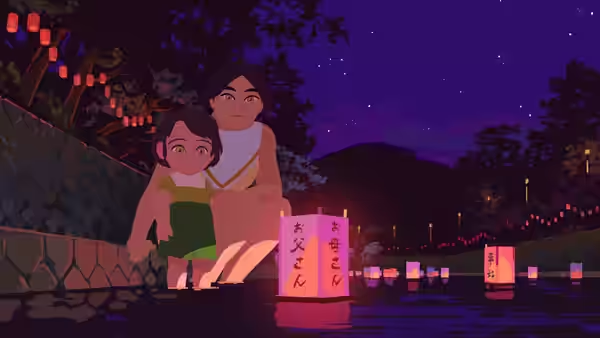
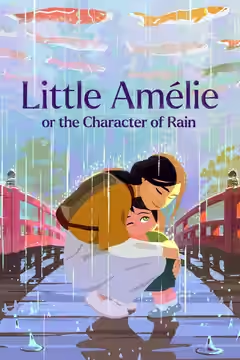
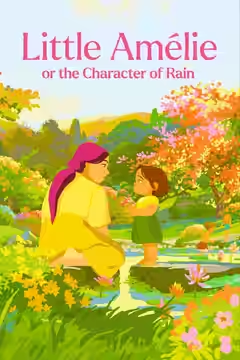
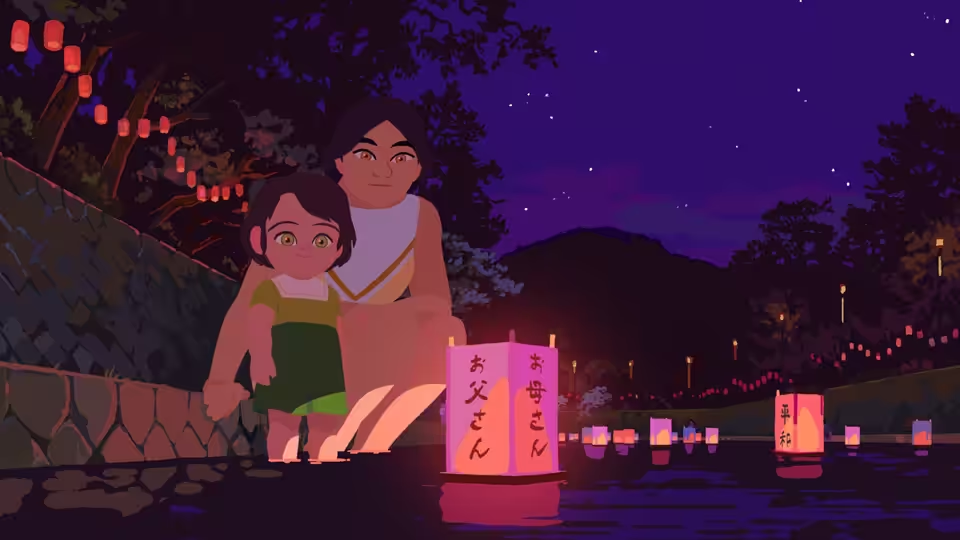
A woman and little girl sit beside a river lined with glowing lanterns at dusk
Film review

Little Amélie or the Character of Rain

2025 · Directed by Maïlys Vallade, Liane-cho Han · 1h 17m

In a sentenceBeing three looks exhausting; at least the colours are good

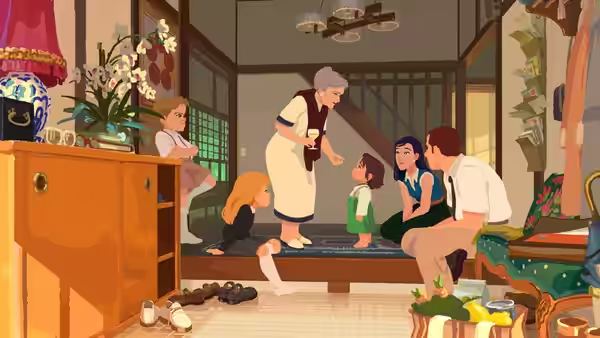
Three-year-old Amélie (voiced by Loïse Charpentier) is learning what to make of the people and sensations around her. Her father Patrick (Marc Arnaud), her mother Daniele (Laëtitia Coryn) and her grandmother Claude (Cathy Cerda) are part of a world whose rules she does not yet understand. She grows close to Nishio-San (Victoria Grobois), and that attachment helps her find her bearings. Everyday discoveries take on proportions she cannot explain. While Amélie tries to understand what she sees, the adults around her carry grief and memories of war.

Plays from YouTube when you press play; nothing loads from them until then.

Fi1m review

Maïlys Vallade and Liane-cho Han make early childhood feel strange, absorbing and worth taking seriously. The animation rewards close attention, though the toddler’s viewpoint can be difficult to follow; we recommend it with that reservation.

Little Amélie or the Character of Rain is a tender, absorbing animation, worth seeing even when its toddler’s thinking becomes difficult to follow. Directors Maïlys Vallade and Liane-cho Han want early childhood to feel unfamiliar again, and they take their small protagonist seriously. Amélie’s discoveries are allowed to matter without being reduced to lessons an adult has prepared for her. We are asked to spend time with someone who has little experience to help explain what she sees.

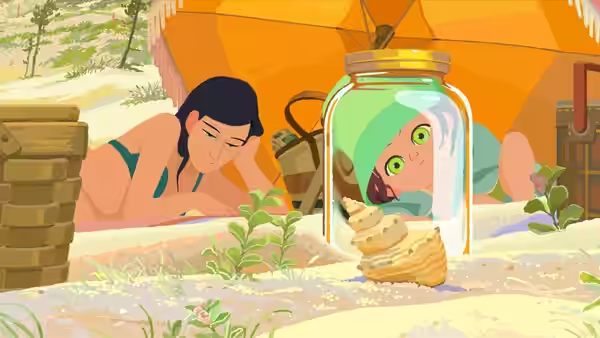
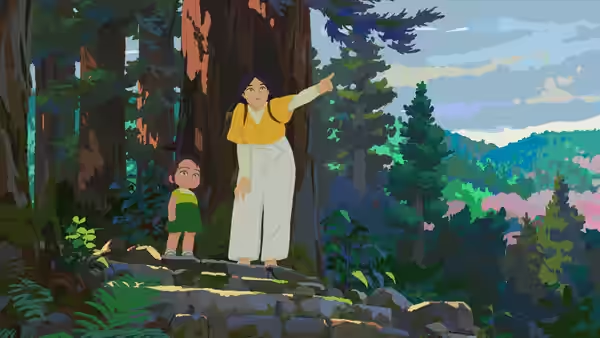
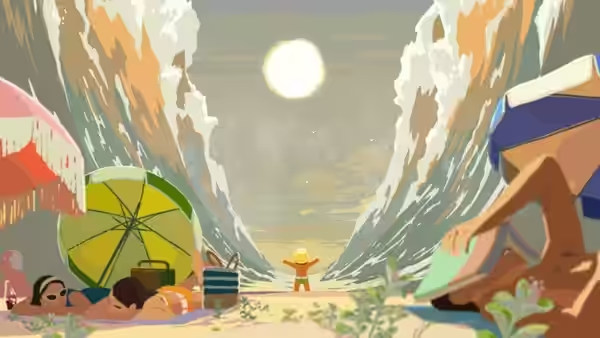
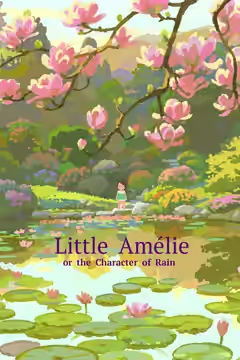
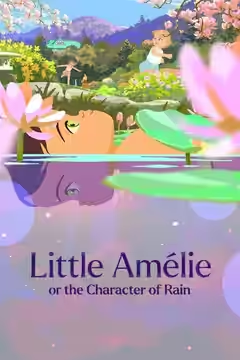
The watercolour-like images make that invitation appealing. Soft colour and relatively spare detail suggest a world still taking shape, while expressive character drawings give us something firmer to read. There is pleasure in simply looking, but the pictures also help us understand why an ordinary experience might occupy all of a small child’s attention. The animation gives those responses enough space to register before we dismiss them as trivial.

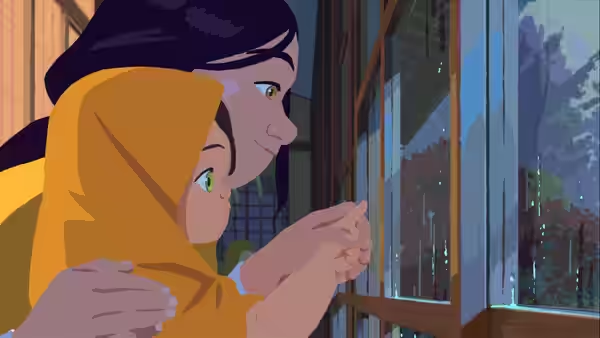
Loïse Charpentier voices Amélie, and Victoria Grobois voices Nishio-San, whose bond with the child gives the film its most engaging relationship. We were moved by their closeness. The expressive faces make their affection clear even when Amélie’s understanding of the world is harder to grasp, so we have something to care about beyond each new discovery. These scenes give the film a warmth that its more puzzling passages need.

Screenwriters Eddine Noel, Aude Py, Maïlys Vallade and Liane-cho Han adapt Amélie Nothomb’s book with room for grief and wartime history alongside the pleasures of discovery. Those subjects could overwhelm a story told from such a young child’s perspective. The film generally handles them with care, allowing us to recognise more than Amélie can understand without treating her feelings as inadequate. Its sadness matters because the affection has been given time to establish itself, particularly in her relationship with Nishio-San.

Ludovic Versace’s editing keeps the 77-minute film compact without making its discoveries feel hurried. That is a useful judgement of scale for a story whose central character cannot yet organise everything into a tidy account. Mari Fukuhara’s music suits the tenderness, although the drawings do much of the emotional work themselves. The most affecting passages give us time to look at a face, and they need little help in telling us what to feel.

The difficulty comes when the writing assumes that sharing Amélie’s uncertainty will be as interesting as sharing her discoveries. We were less persuaded in those stretches, where her unusual thinking becomes difficult to grasp and the story loses its pull. A child’s confusion can be engaging, but we still need enough information to follow what matters to her. Here, some of the connection between one experience and the next remains hazy, and the attractive drawing cannot quite compensate.

As family animation, its willingness to take childhood sadness seriously is welcome. The PG certificate should not be mistaken for a promise that every child will find it comfortable, particularly when grief and wartime history enter the picture. We would choose it for a quiet evening, with adults prepared to talk about more than the drawings. Leave time for questions that may not have quick answers.
Critical consensus AI synthesised

79
Positive
15
Mixed
1
Negative
0

The reviews are strongly positive, with praise clustering around the painterly animation and its ability to make childhood discovery feel immediate. Critics repeatedly pick out the watercolour-like images, expressive colours and a world seen from a toddler’s still-forming perspective. Most also admire the emotional balance: the film’s sweetness leaves space for grief, traumatic history and adult realities. Amélie’s personality and her bond with Nishio draw further praise for giving the visual invention emotional weight.

The spread is fairly narrow, with reservations qualifying the enthusiasm rather than overturning it. Variety finds the toddler’s unusual worldview occasionally difficult to grasp, despite admiring the animation and the central relationship. There is also some disagreement over the likely audience. The Hollywood Reporter questions how child-friendly the serious themes are, while Deadline sees the treatment of history, life and death as suited to sensitive adults and sophisticated children alike.

Empire
13 February 2026 · Jordan King
90*

The critic finds it a rapturous, emotionally balanced celebration of childhood. They single out its soft, painterly animation and especially praise a standout scene explaining wartime bombings through a rice cooker.

Read the full review →
Los Angeles Times
7 November 2025 · Carlos Aguilar
90*

Aguilar calls the film beautiful, life-affirming and emotionally mature. He praises how its animation turns a child’s perspective into imaginative, affecting images.

Read the full review →
The Observer
14 February 2026 · Wendy Ide
90*

Ide gives the film a strongly positive verdict, calling it poetic and strikingly beautiful. She singles out its shimmering watercolour-like animation and sensory portrayal of childhood discovery.

Read the full review →
The AV Club
30 October 2025 · B+ · Jacob Oller
83

Oller praises the film as a vivid, whimsical coming-of-age story with a magic all its own. He singles out its colorful, impressionistic animation and its ability to filter traumatic history through a toddler’s perspective.

Read the full review →
Little White Lies
13 February 2026 · 3/4/4 · David Jenkins
80

Jenkins calls it a dazzling, impressive film that sensitively explores childhood. He praises its vibrant colours, expressive character design and lyrical animation.

Read the full review →
The Guardian
11 February 2026 · Peter Bradshaw
80*

Bradshaw finds the animation tender, sweet and poignant in its portrayal of early childhood. He particularly praises its charming blend of European and Japanese animation styles and its final sequence.

Read the full review →

Straight answers AI written, from our review

Is Little Amélie or the Character of Rain worth watching?
Little Amélie or the Character of Rain is worth watching for its tender view of childhood and expressive animation; we score it 80. We are particularly moved by Amélie’s closeness to Nishio-San, which gives the sometimes puzzling discoveries emotional weight. It suits a quiet family evening, provided adults are prepared for questions about grief and some difficult-to-follow toddler thinking.
How long is Little Amélie or the Character of Rain, and what is it rated?
Little Amélie or the Character of Rain runs 1h 17m. It is an animation and drama film.
Where can I watch Little Amélie or the Character of Rain in Saudi Arabia?
Little Amélie or the Character of Rain is not on any streaming or rental service in Saudi Arabia at the moment. It is available in 18 other countries; change your country at the top of the page to see where. Availability is checked daily.
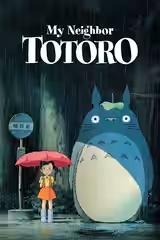
How does Little Amélie or the Character of Rain compare to My Neighbor Totoro?
Little Amélie or the Character of Rain shares My Neighbor Totoro’s attention to childhood discoveries, but we recommend Totoro more readily for its humour and patient storytelling. Both allow fear alongside delight. Little Amélie suits those drawn to watercolour-like animation and a tender relationship between child and adult, though its toddler’s thinking can make the story harder to follow.
Is Little Amélie or the Character of Rain based on a true story or a book?
Little Amélie or the Character of Rain is adapted from a novel by Amélie Nothomb, bringing grief and wartime history into a three-year-old’s discoveries. We find the affection between Amélie and Nishio-San gives newcomers a way into the story without needing the book, although some connections between the child’s experiences remain hazy.
What should I watch after Little Amélie or the Character of Rain?
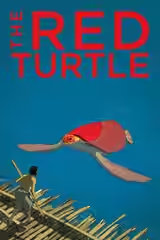
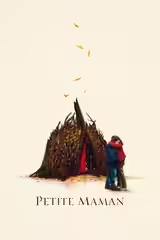
After Little Amélie or the Character of Rain, try My Neighbour Totoro (1988, Fi1m 89): Another child’s view of everyday life, with room for fear alongside delight. Then The Red Turtle (2016, Fi1m 84): Wordless animation that gives nature, companionship and loss the time they need; and Petite Maman (2021, Fi1m 88): Childhood grief approached through a small, patient story that trusts its audience.

Cast

Awards

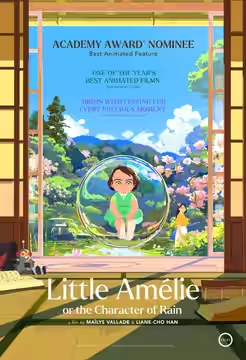
Academy Awards, 2025

Nominated
Best Animated Feature

Annecy Cristal for a Feature Film, 2025

Nominated
Annecy Cristal for a Feature Film

Annie Award for Best Animated Feature, 2025

Nominated
Annie Award for Best Animated Feature

Critics' Choice Awards, 2025

Nominated
Best Animated Feature

Los Angeles Film Critics Association Award for Best Animated Film, 2025

Won
Los Angeles Film Critics Association Award for Best Animated Film

If you liked this, try…

  1. My Neighbour Totoro (1988, Fi1m 89)Another child’s view of everyday life, with room for fear alongside delight.

  2. The Red Turtle (2016, Fi1m 84)Wordless animation that gives nature, companionship and loss the time they need.

  3. Petite Maman (2021, Fi1m 88)Childhood grief approached through a small, patient story that trusts its audience.

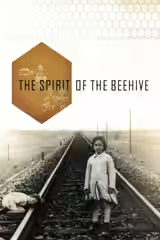
  4. The Spirit of the Beehive (1973, Fi1m 87)For adults: a child’s private discoveries unfold amid the aftermath of war.

  5. Ernest & Celestine (2012, Fi1m 84)Softly drawn animation with a stubborn friendship and a welcome distrust of rules.