Osgood Perkins’ FBI horror is as frightening as its reputation for most of its length, thanks to Andres Arochi’s boxed-in frames and a Nicolas Cage kept wisely scarce. Then it stops to explain itself, and the fear goes out of it.
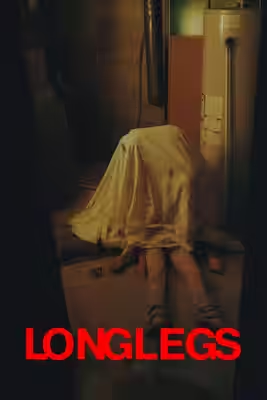
Osgood Perkins has made a serial killer film in the shape of the early 1990s ones, with a young FBI agent, a cipher, a snowbound town and a boss who does not believe her, and filled the shape with something older and stranger. For about an hour it is the most frightening thing we have sat through in some while. Then it stops and explains what has been going on, and the fear goes out of it and does not come back. See it, and expect the last half hour to be weaker than the first.
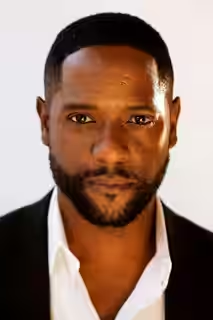
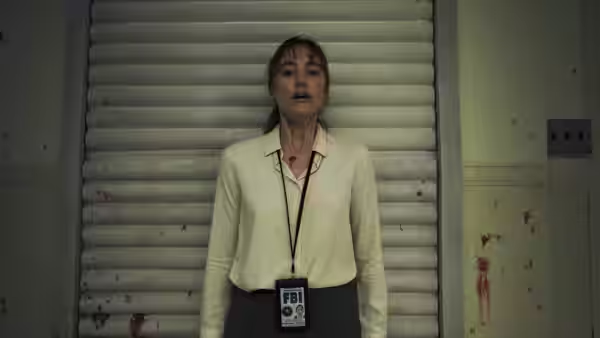
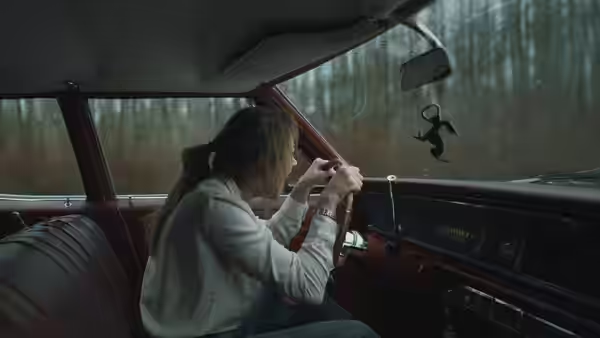
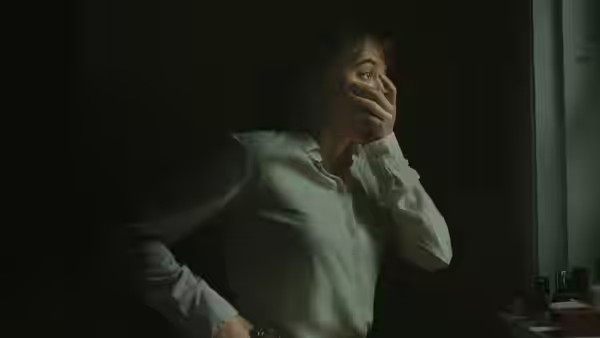
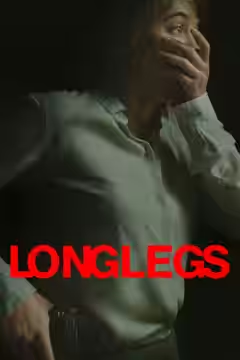
Lee Harker (Maika Monroe) is new to the Bureau and knows which door to knock on before anyone has told her. Agent Carter (Blair Underwood) hands her a case decades old: families dead in their own homes, the fathers seemingly responsible, and at each house a coded letter signed Longlegs. Monroe plays Harker with her arms held in and her voice barely above a murmur, a woman who has learned to take up as little space as possible. Underwood gives Carter more warmth than the role needs, and it helps. Alicia Witt, as Harker’s mother Ruth, lives among crucifixes and speaks as if the phone might be tapped.
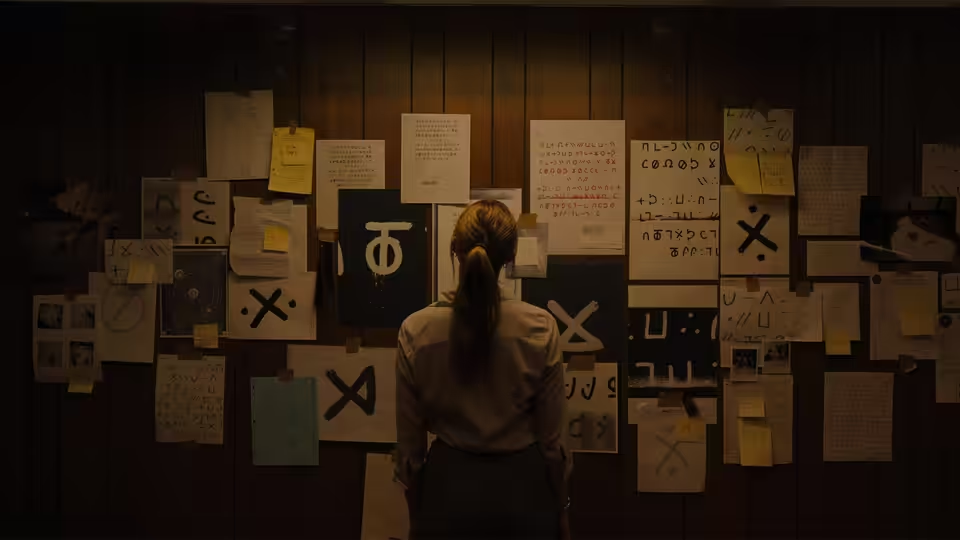
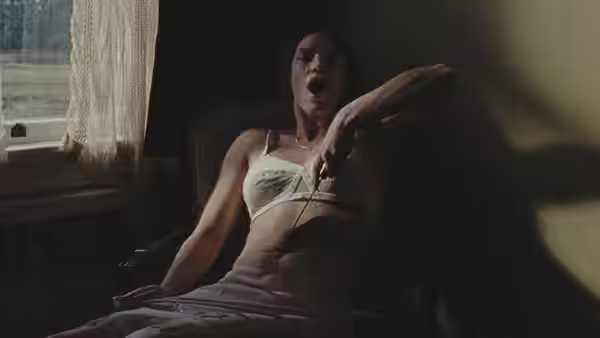
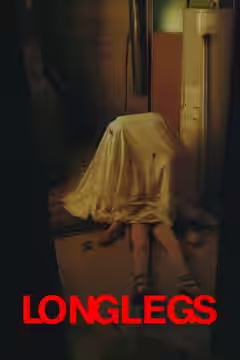
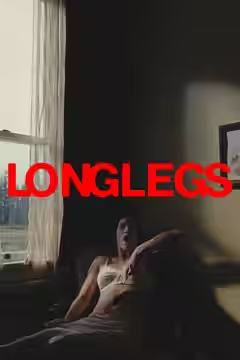
Andres Arochi shoots the 1970s prologue in a narrowed, boxed-in frame, and when Longlegs first appears the top of the picture cuts him off at the mouth, so we get a chin, a smile and a voice. It is a cheap trick and it worked on us completely; we spent the next forty minutes with our shoulders up around our ears. Later, Arochi leaves Harker small and dead centre with a great deal of empty ceiling above her, and the dread comes from that space. Danny Vermette’s production design keeps every interior beige and under-lit, and Mica Kayde dresses Harker in a suit a size too large.
Graham Fortin and Greg Ng cut late. Shots are held past the point of comfort, then the film jumps to black with a line of the killer’s letter in white, and that rhythm, slow, slow, then the snap, is where most of the fright is. The music, by Perkins and Elvis Perkins, is a low churn that hardly ever settles into a tune. The one time it does is when Cage sings, and we would rather he had not, which is presumably the point.
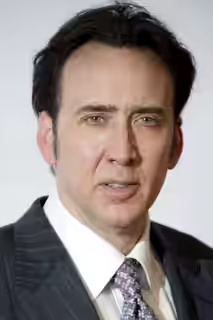
Nicolas Cage is on screen far less than the marketing suggests, which is the film’s best decision. His face has been powdered white and padded out until it looks like a doll left too long by a radiator. He speaks in a high sing-song and lurches into a shriek, and we found him properly horrible for a scene and a half. After that he is a man in make-up doing a voice, and the film knows it, so it keeps him in short doses. Kiernan Shipka has one scene and does more with a fixed stare than Cage does with all his hardware.
The trouble is the ending, and most critics, warm as they are, cool at about the point we did. Perkins the director trusts a frame with too much ceiling in it to frighten us. Perkins the writer does not trust us to be frightened by what we do not understand, and in the last half hour a character lays out how everything has worked, as if reading the instructions off the back of the box.
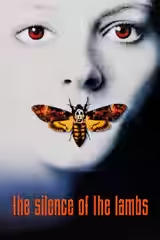
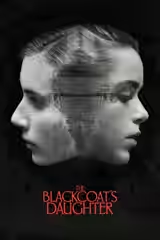
Perkins’ earlier films, The Blackcoat’s Daughter and I Am the Pretty Thing That Lives in the House, had the same patience and the same problem. The comparison everyone reaches for is The Silence of the Lambs, and it holds for the first act. After that the film is nearer to a folk tale, and it would have been braver to leave it one.
See it in a cinema where possible, or at home with the lights off; the fear is in the sound and the empty space, and both shrink on a laptop. It is 101 minutes, which is right. The 15 certificate is honest: there is little blood on screen, and most of the damage is done by what we do not see.