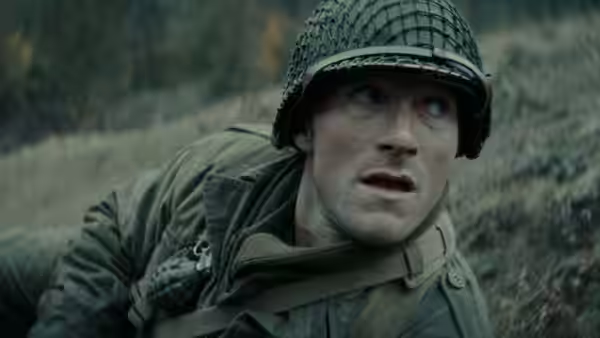
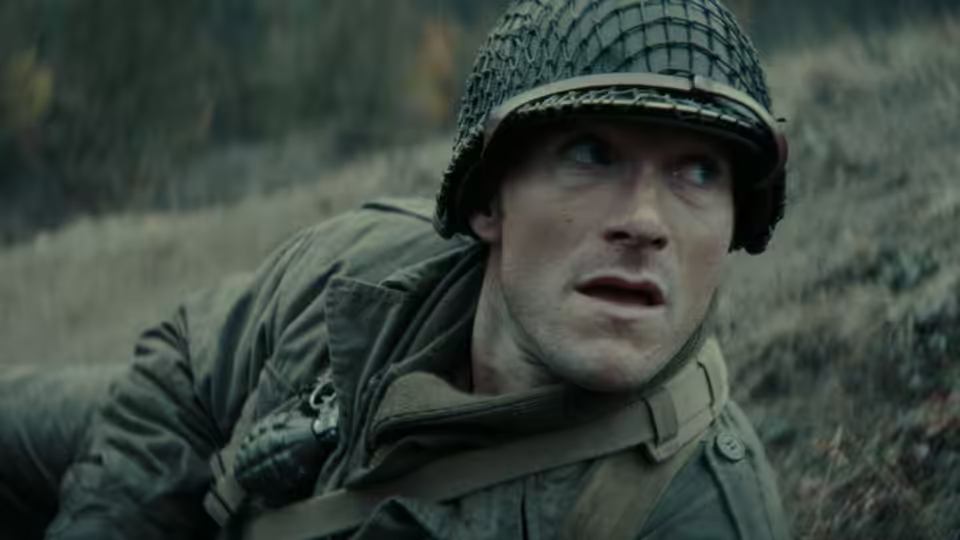
A helmeted soldier in a netted steel helmet looks upward against a concrete wall
Film review

Lucky Strike

2026 · Directed by Rod Lurie · 1h 42m

In a sentenceThe soldiers are better company than the script allows them to be

Lucky Strike follows Castle (Scott Eastwood) through a fight for survival. The story moves from the company of soldiers to an ordeal he faces alone. Colin Hanks plays Colonel Neale, Aunjanue Ellis-Taylor plays Mrs. Caldwell, and Taylor John Smith plays Bellingham. The ensemble also includes Lorne MacFadyen as Major Barrett, Atanas Srebrev as General Lauer and Alfie Stewart as Burt Miller. Rod Lurie directs this 102-minute action and war film from a screenplay he writes with Marc Frydman.

Plays from YouTube when you press play; nothing loads from them until then.

Fi1m review

Rod Lurie’s Lucky Strike stages combat with assurance, but its solitary struggle gives us too little reason to care. Scott Eastwood is a credible action lead, hampered by clumsy dialogue and familiar writing.

Rod Lurie can stage a battle, and Lucky Strike gives us reasons to wish he had found a stronger story to put around one. This is a capable but unpersuasive war thriller, confident in combat and much less convincing when it asks us to care about Castle. At 102 minutes, it still has stretches that feel laboured. More incidents would hardly help when the existing danger has so little lasting effect on our interest.

Lorenzo Senatore’s cinematography does its strongest work in the long battlefield takes. Allowing the action to continue without an immediate cut gives the fighting a continuity that helps the suspense build. We felt tense during these passages because the sustained camera movement kept us caught up in the combat. There is a welcome assurance here: the sequences have enough interest within them to hold our attention without constantly hurrying us towards the next one.

The difficulty comes with Castle’s isolation. The soldiers’ camaraderie gives the film a human interest that the solitary material struggles to replace, and the change puts considerable pressure on Scott Eastwood. He is credible as the centre of the action, but his performance does not make Castle particularly compelling when there is less happening around him. His restraint suits the physical ordeal; the script gives him too little else to work with, and restraint eventually becomes difficult to distinguish from limited characterisation.

Marc Frydman and Rod Lurie’s screenplay is the chief problem. Familiar situations need not be fatal to a survival thriller, provided the dialogue makes the people facing them worth following. Here, clumsy exchanges repeatedly interrupt the involvement that the combat has earned, and the stakes never feel sufficiently strong to sustain the solitary struggle. The writing asks for concern more readily than it supplies reasons for it, leaving Scott Eastwood to carry scenes that need more than a credible physical presence.

Christal Khatib’s editing is more effective within the set pieces than across the film as a whole, where the uneven tension becomes wearing. A suspenseful passage can only do so much when our interest has to be rebuilt afterwards. Larry Groupé’s music and P. Erik Carlson’s production design contribute to an assured production, though neither makes the thinly written ordeal more involving. The technical competence is clear enough that the weaknesses in the dialogue become particularly hard to overlook.

A solitary survival film has an exacting task: it must make the company of one person sufficient. Removing the other soldiers should sharpen our interest in Castle, but here it costs the film relationships that were helping to hold it together. That is a substantial weakness for this kind of thriller, however well the immediate danger is staged. The combat demonstrates the control needed to make the premise work, which makes the less engaging stretches frustrating.

There is enough skill here to keep the film from becoming a chore throughout. The strongest sequences deserve their share of the running time, and Scott Eastwood is not the liability the weakest dialogue might suggest. Even so, we would hesitate to recommend it beyond viewers with a particular appetite for wartime action. Choose it for the combat only if familiar plotting is a price you are prepared to pay.

Critical consensus AI synthesised

52
Positive
1
Mixed
2
Negative
2
The Guardian
4 August 2026 · Leslie Felperin
65*

Felperin finds it an effective but uneven wartime thriller, held back by clunky passages. She singles out the tense, well-staged set pieces as its strongest moments.

Read the full review →
The Hollywood Reporter
24 June 2026 · Frank Scheck
35*

Scheck finds the film derivative and unable to sustain its intended tension, despite assured filmmaking. He praises the immersive long takes and suspenseful set pieces, while criticizing the clichés, ham-fisted dialogue, and Scott Eastwood’s lack of charisma.

Read the full review →
Variety
24 June 2026 · Owen Gleiberman
35*

Gleiberman finds the film skillfully staged but not especially enthralling, with its stakes feeling weak. He praises the combat sequences while lamenting the loss of soldiers’ camaraderie once the protagonist is alone.

Read the full review →
Deadline
25 June 2026 · Pete Hammond
85*

Hammond calls the film a riveting, quietly powerful war story well worth telling. He praises Scott Eastwood’s performance and the tense, expertly shot battlefield sequences.

Read the full review →
The Wrap
25 June 2026
50*

The critic finds the film a capable but flawed World War II thriller, with its late-arriving message and narrative inconsistencies undermining the story. They praise Scott Eastwood’s commanding lead performance and the film’s visual presentation.

Read the full review →

Straight answers AI written, from our review

Is Lucky Strike worth watching?
Lucky Strike is worth considering for committed war-action viewers, but we score it 52 out of 100: its assured combat cannot make up for a weak survival story. Scott Eastwood is credible in the action, yet clumsy dialogue and thin characterisation make his solitary ordeal much less engaging than the soldiers’ camaraderie.
How long is Lucky Strike, and what is it rated?
Lucky Strike runs 1h 42m. It is an action and war film.
Where can I watch Lucky Strike in Hong Kong?
Lucky Strike is not on any streaming or rental service in Hong Kong at the moment. It is available in 5 other countries; change your country at the top of the page to see where. Availability is checked daily.
How violent or frightening is Lucky Strike, and is it suitable for children?
Lucky Strike has a UK 15 certificate and is unsuitable for children under 15; its battlefield combat and survival ordeal include tense passages. We find the sustained battlefield takes suspenseful because they keep us caught up in the fighting, though the review gives no basis for specifying how graphic the violence is.
How does Lucky Strike compare to Come and See?
Lucky Strike offers capable wartime action, but we recommend Come and See more strongly for its harsher account of war through a Belarusian boy’s experience. Where Lucky Strike struggles to make its isolated soldier compelling, Aleksei Kravchenko’s performance and the punishing sound in Come and See make the boy’s terror almost unbearable; it suits viewers prepared for that intensity.

Cast

If you liked this, try…

  1. Hell Is for Heroes (1962) · not on Fi1m yetA small infantry unit faces pressure that leaves little room for heroics.

  2. The Train (1964) · not on Fi1m yetWartime action with clear physical stakes and difficult questions about its human cost.

  3. The Captain (2017) · not on Fi1m yetA German deserter finds a uniform and discovers how readily people obey.

  4. The Outpost (2020) · not on Fi1m yetRod Lurie stages combat around the exposed position of an isolated military base.

  5. Come and See (1985, Fi1m 92)For a harsher account of war, grounded in a Belarusian boy’s experience.

Lucky Strike (2026) review: good combat, weak story and dialogue (Hong Kong) | Fi1m