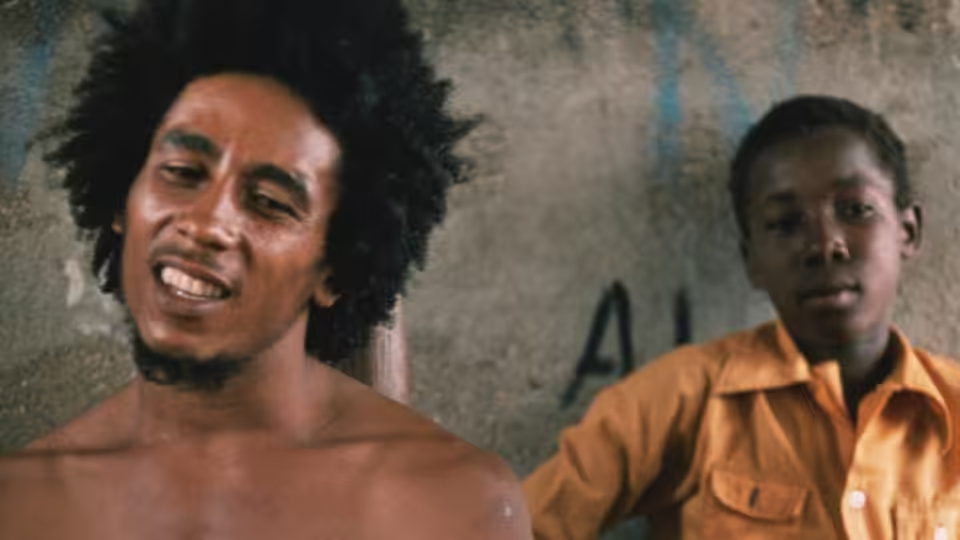
Bob Marley beside a young boy in an orange shirt against a graffiti-marked wall
Film review

Marley

2012 · Directed by Kevin Macdonald · 2h 24m

In a sentenceThe performances make a convincing case for giving Bob Marley more time and everyone else a little less

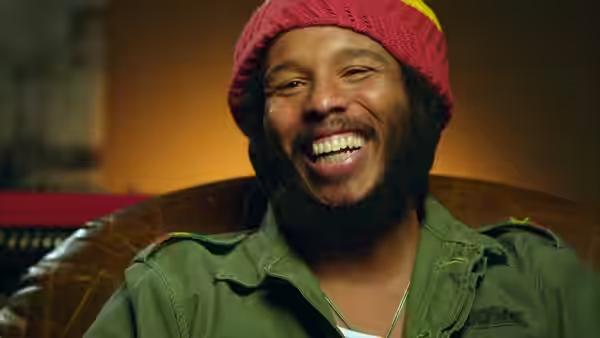
Bob Marley appears through archive footage in Kevin Macdonald’s documentary, while Rita Marley, Ziggy Marley and Bunny Wailer appear as themselves. Jimmy Cliff, Cedella Marley and Chris Blackwell also contribute to an account built around one musician and the people who can speak about him. Recorded performances sit alongside their recollections as the film asks what can be understood about Marley beyond the songs. His own image and voice remain at the centre, but the account also depends on what these other participants remember, and on how their perspectives fit together.

Plays from YouTube when you press play; nothing loads from them until then.

Fi1m review

Kevin Macdonald’s Marley is a rewarding music documentary with performances worth waiting for. Its 144 minutes leave room for a wealth of testimony, though the admiration can become tiring and the music deserves longer stretches.

Kevin Macdonald’s Marley is a good music documentary that could have been a shorter, better one. At 144 minutes, it gives considerable space to the people around Bob Marley and to the archive footage in which he appears. The patience often pays off: a speaker has time to become a person rather than a quick endorsement between songs. There are also stretches when Macdonald seems unwilling to let a contribution go simply because it adds little to what we already understand.

Rita Marley is the most valuable presence because her account makes room for things that do not fit comfortably into a tribute. Her contribution complicates the affection without requiring us to dismiss it, and Macdonald is wise to include it. Ziggy Marley, Bunny Wailer, Jimmy Cliff, Cedella Marley and Chris Blackwell add further perspectives. Hearing from so many people is rewarding, although their accumulated presence can make the case for Marley’s importance feel settled before it has been properly examined.

The archive performances provide a more immediate reason to care. We were moved by the urgency of Bob Marley’s singing, which makes the admiration expressed elsewhere feel earned. Those passages also remind us how much a performance can tell us without somebody explaining its significance. Macdonald gives us enough to feel that force, then too often returns to the business of telling the life when we would happily listen for longer.

Mike Eley and Alwin H. Küchler’s cinematography is unobtrusive, and that suits a film asking us to attend to people rather than admire its own technique. The photography gives the testimony its due without trying to compete with the performances for attention. Faces hold our interest even when the accounts begin to cover familiar ground. This is patient visual work, though it cannot by itself make every recollection equally useful.

Dan Glendenning’s editing has the harder task of keeping all that material moving. Individual passages have energy, especially when the archival images take over, but the film as a whole becomes wearing through accumulation. The repeated return to testimony also gives the music less uninterrupted space than it needs. A firmer cut could have preserved the range of voices without giving quite so much room to accounts that leave much the same impression.

Macdonald is less satisfying on the work of making the music. The testimony supplies plenty of reasons for valuing Marley, but we wanted a clearer sense of how particular musical choices produced that effect. For a documentary with this much time available, that seems a fair request. The familiar music-biography format encourages the problem, using songs to illustrate whatever the testimony has just told us, then moving along before we have heard enough.

Our recommendation is for anyone prepared to spend time listening to these people, rather than anyone chiefly hoping for a concert film. The performances justify the attention, and the less comfortable testimony gives the portrait some needed weight. Allow for the length, and do not expect every question about the man to be answered. We would still have preferred Macdonald to let a few more songs finish.
Critical consensus AI synthesised

74
Positive
8
Mixed
3
Negative
0

Most critics welcome Marley as a detailed, moving portrait, with praise clustering around the interviews and archival performances. Access to friends, family and bandmates gives the account intimacy, while the concert footage conveys the pleasure and conviction in his music. The reviews also value the attention to his early career, religious beliefs and political commitments. For the more enthusiastic critics, the breadth helps explain both the musician and his cultural reach.

Length is the recurring reservation, including among admirers: several reviews find that the detail becomes exhausting or slows the film down. There is also concern that the music needs more uninterrupted space. The spread runs from enthusiastic praise to mixed responses, with no outright negative verdicts. Slant Magazine finds the portrait overly romanticised, though it values Rita Marley’s more complicated perspective; HeyUGuys argues that the reverence leaves Marley himself insufficiently understood.

Empire
10 April 2012 · Eve Barlow
90*

The critic calls the documentary an epic, uplifting and definitive portrait of Bob Marley. They praise its breadth, from interviews with people in Marley’s life to its account of his musical and cultural legacy.

Read the full review →
Los Angeles Times
20 April 2012 · Kenneth Turan
85*

Turan finds the documentary moving, authoritative and a fitting tribute to Marley. He especially praises its extensive archival performance footage and the joy it conveys in Marley’s music.

Read the full review →
The Hollywood Reporter
12 February 2012 · festival review · Jordan Mintzer
85*

Mintzer calls it a stirring, potentially definitive portrait of Bob Marley, though its lengthy running time and abundance of detail can bog it down. He praises the concert footage and the film’s closing performances for showing Marley’s commitment to unifying Jamaica.

Read the full review →
Time Out
17 April 2012 · ★★★★ · Tom Huddleston
80

Huddleston gives the documentary a positive four-out-of-five rating. The available standfirst highlights its opening credit identifying Marley’s record label, but does not reveal a specific praise or complaint.

Read the full review →
The Guardian
13 February 2012 · festival review · Andrew Pulver
75*

Pulver finds the documentary a richly detailed and worthwhile portrait of Marley. He praises its account of Marley’s early musical career and its engagement with his religious and political convictions.

Read the full review →
The New Yorker
15 April 2012 · Anthony Lane
70*

Lane finds the documentary inspiring and effective at restoring the longing and indignation behind Marley’s music. He praises its account of Marley’s life but wishes it gave more time to let the music play uninterrupted.

Read the full review →

Straight answers AI written, from our review

Is Marley worth watching?
Marley is worth watching for its archive performances and revealing testimony, and we score it 77 out of 100. We recommend it to anyone interested in the people around Bob Marley as well as his music, though its 144 minutes become wearing and the songs deserve more uninterrupted space.
How long is Marley, and what is it rated?
Marley runs 2h 24m. It is a music and documentary film.
Where can I watch Marley in Hungary?
Marley is available to buy from Apple TV from Ft 1,990. Availability is checked daily; the links above go straight to each service.
How violent or frightening is Marley, and is it suitable for children?
Marley carries a UK 15 certificate, so it is not suitable for children under 15 under that classification. The certificate indicates material intended for older teenagers and adults, but we cannot give a specific account of violence or frightening content from the material described in our review.
How does Marley compare to Buena Vista Social Club?
Marley gives more space to biographical testimony than Buena Vista Social Club, which we recommend more readily if hearing musicians play is the main attraction. Both reward patient attention to their contributors, but Marley lets recollections crowd out the songs, while Buena Vista Social Club sometimes distracts from its performances with restless cutting and a circling camera.
What should I watch after Marley?
After Marley, try Buena Vista Social Club (1999, Fi1m 76): Patient attention to musicians whose personalities are as engaging as their performances. Then Senna (2010, Fi1m 84): Archive footage brings a public figure close without making his life feel small.

Cast

If you liked this, try…

  1. The Last Waltz (1978) · not on Fi1m yetA concert film that gives its musicians room to finish the song.

  2. Buena Vista Social Club (1999, Fi1m 76)Patient attention to musicians whose personalities are as engaging as their performances.

  3. The Punk Singer (2013) · not on Fi1m yetA musician’s convictions receive the same close attention as the songs.

  4. Senna (2010, Fi1m 84)Archive footage brings a public figure close without making his life feel small.

  5. Ornette: Made in America (1985) · not on Fi1m yetA musician’s life told with formal curiosity and considerably less biographical tidiness.