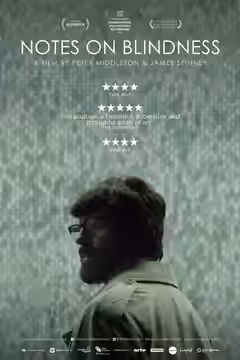
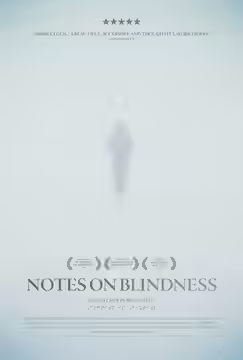
Pete Middleton and James Spinney set John Hull’s cassette diaries of going blind to actors who mouth every word, and the result is tender, strange and precise. It is cushioned a little too comfortably by its music, but the rain alone is worth the evening.
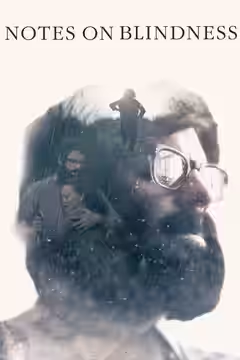
John Hull was a theologian at the University of Birmingham who went completely blind in 1983 and, because he could no longer write, started talking into a cassette recorder. He kept it up for three years. Pete Middleton and James Spinney have taken those tapes, with Hull’s own voice and his wife Marilyn’s, and built a 90-minute film in which actors mouth the words exactly as they were spoken. It sounds like a stunt. It is the best decision in the film, and the film is one we recommend, with a caveat about how softly it has been upholstered.
Daniel Renton Skinner plays Hull, and the job is harder than it looks. He has to match a dead man’s breathing, his pauses, the small laugh Hull gives when he catches himself being pompous, and he has to do it while his eyes stay still. He manages it so well that within ten minutes we had stopped checking his lips. Simone Kirby’s Marilyn is tired, patient and sharper than her husband expects, and in the few recorded conversations between them you can hear a marriage being renegotiated in real time. Eileen Davies and David Hobbs, as Hull’s parents in Australia, have less to do and do it carefully.
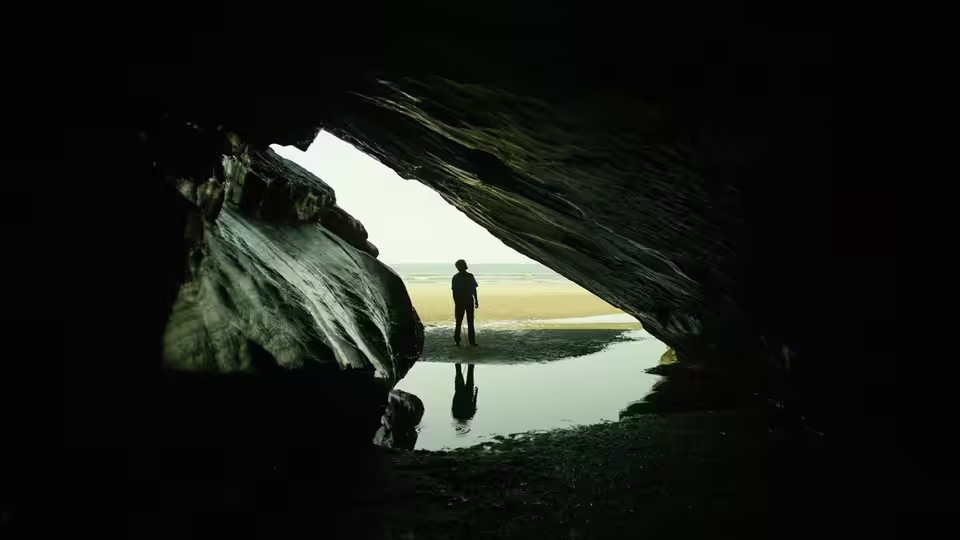
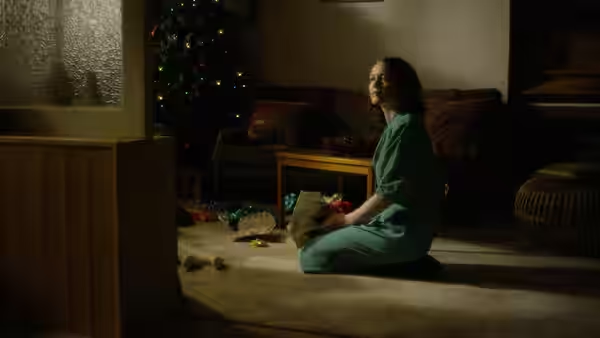
Gerry Floyd shoots the whole thing in a shallow focus that leaves most of the frame unreadable. A lamp, a hand, the edge of a desk; the rest is brown dark. Damien Creagh’s house is full of the right 1983 things, the hulking recorder, the boxed cassettes labelled in Marilyn’s hand, the study that fills up with sound equipment as the books stop being any use. Saffron Cook and Julia Drummond-Haig put Hull in the corduroy and cardigans of a man who has stopped being able to check his own clothes. Julian Quantrill cuts slowly and is not afraid of a black screen with tape hiss running under it, which is where some of the best moments live.
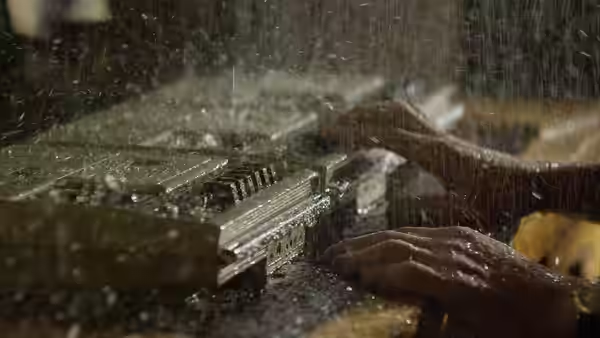
Then there is the rain. Hull describes standing at a door while a shower falls on the garden, and how the sound of it on the path, the lawn, the fence and the roof gives him back the shape of a world he had lost. Middleton and Spinney let the rain do it on screen, moving the camera across each surface as his voice names it. It moved us more than we were prepared for, and we have thought about it every wet afternoon since. There is a quieter passage, earlier, in which Hull admits he can no longer picture his daughter’s face, and Skinner plays it without moving at all. That one we found hard to watch.
The caveat is the music. James Ewers, Spinney and Noah Wood have written a score of soft piano and strings, and it is nearly always there, lying under passages that would have been stronger with nothing but the hiss of the tape. Hull is describing deprivation, and the film keeps handing us a blanket. A handful of dream sequences, and a visit to a faith healer (Jamie Bradley), are also illustrated more fully than they need to be, when the voice had already done the work. Most critics have waved this through; one or two have called it a betrayal of the subject. We would not go that far, but we noticed it, and we noticed it most in the moments the film most wanted us to feel something.
The method has a precedent. Clio Barnard’s The Arbor (2010) had actors lip-synching to interviews about the playwright Andrea Dunbar, and used the gap between voice and body to unsettle. Middleton and Spinney use the same device to comfort, which is a legitimate choice and a less interesting one. Derek Jarman’s Blue (1993) gave a film about losing sight a single blue frame for 79 minutes and trusted the audience with it. Notes on Blindness trusts us about two-thirds as far.
Hull died in 2015, before the film came out. What he left is a record of a clever man thinking his way through a catastrophe without self-pity, and the film serves it well. Watch it at home with the lights off and the sound turned up, and resist the urge to look at your phone, which is a smaller version of exactly the test Hull was set.