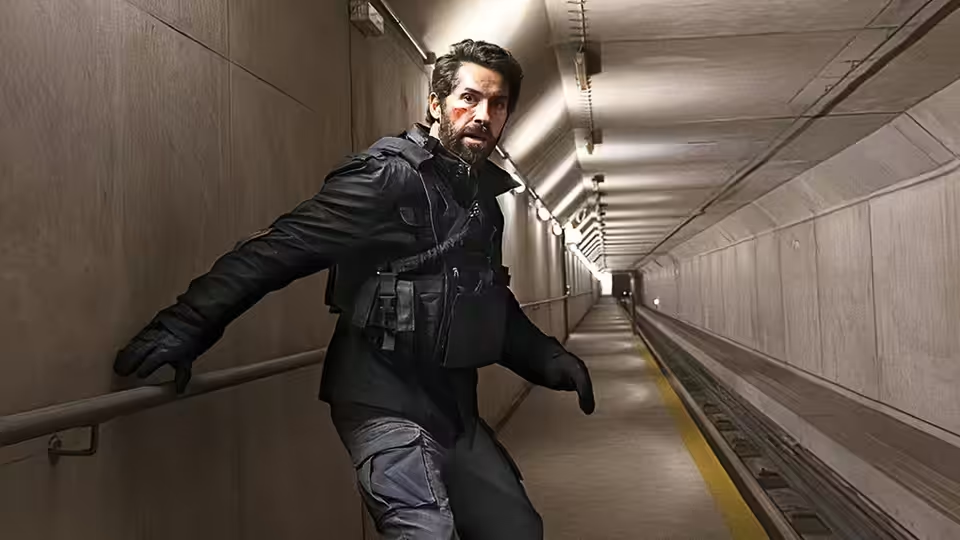
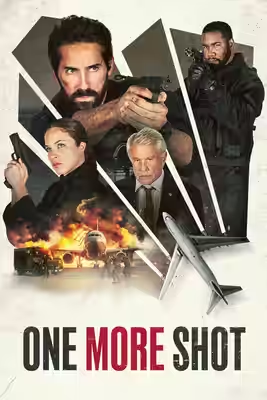
Scott Adkins makes the fighting worth watching, but the continuous-take approach leaves too much waiting between encounters. The stunt work deserves attention; the sluggish storytelling makes it difficult to recommend the whole film.
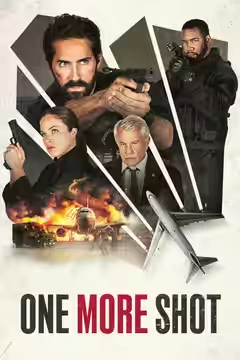
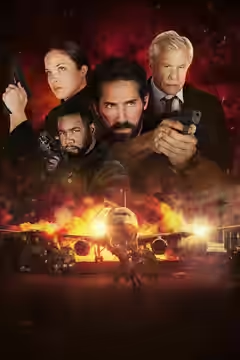
The fighting in One More Shot is good enough to make its sluggishness irritating. James Nunn directs an action thriller built around the appearance of one continuous take, a choice that promises to keep us close to the effort of staying alive. Scott Adkins supplies the physical skill that such a choice demands. At 102 minutes, though, the film spends too much time making us wait for another reason to pay attention.
As Jake Harris, Scott Adkins is the main reason to persist. We were excited by the sight of him taking on the mercenaries, because the sustained filming lets us appreciate the physical work involved in each encounter. There is pleasure in watching a performer carry an action sequence without continually needing an edit to get him out of trouble. For those stretches, the decision to keep the action apparently unbroken earns its place in the film.
Job Reineke’s cinematography and Liviu Jipescu’s editing sustain that appearance of uninterrupted action. It is a demanding way to organise a thriller, because a pause that might otherwise be cut becomes something the audience has to sit through. Between fights, we become conscious of the time needed to reach the next encounter. The camera keeps going, but there is too little happening to justify our following it.
Jamie Russell’s screenplay also asks us to accept one Navy SEAL taking on a coach-load of mercenaries. That is hardly disqualifying in this sort of film; we do not demand a sensible staffing ratio before enjoying an action sequence. But repeated demonstrations that the hero can keep going need some variation to remain interesting. After a while, each fresh opponent seems to offer much the same problem, and we become less curious about how it will be solved.
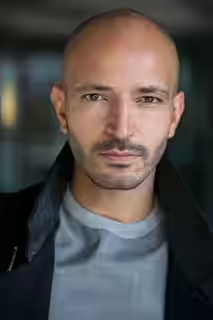
William El-Gardi, playing Amin Mansur, provides some welcome human interest alongside the physical exertion. His presence helps, although a capable performance cannot make every interval between action scenes feel necessary. James Nunn seems reluctant to sacrifice the continuous-take effect even when a brisker route through the material would serve the actors better. The pauses become especially frustrating because the stunt work has already demonstrated how absorbing this approach can be.
Austin Wintory’s music cannot make those stretches feel urgent, and Natalie O’Connor’s production design gives us too little distraction from them. An action thriller does not need elaborate surroundings or a score announcing every threat. It does need something worth watching when nobody is fighting. Here, too much of that responsibility falls back on Scott Adkins, whose physical assurance remains more persuasive than the story carrying him between encounters.
Against the straightforward requirements of an action thriller, the film succeeds intermittently: the fighting holds our attention, while getting to it often does not. Maintaining the appearance of a single take adds a difficulty that the film never consistently turns to its advantage. There is enough skill here to reward a particular interest in Scott Adkins, but we cannot recommend it simply as a good evening’s entertainment. Admirers of his work should bring more patience than his opponents get.