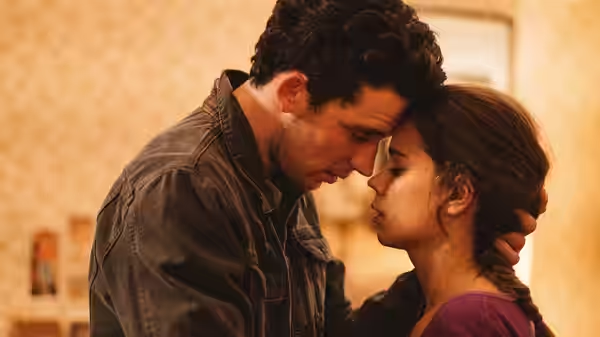
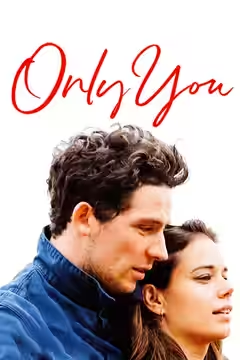
Laia Costa and Josh O’Connor make Only You a romance worth the discomfort. Its account of infertility is attentive to both partners, though a repetitive middle stretch tests the patience it otherwise earns.
Only You is an absorbing romance whose strongest asset is the time it gives to two people under pressure. Harry Wootliff takes infertility seriously, without letting it erase the attraction that makes the relationship worth caring about. We recommend it for its leads and its attention to an experience that romance can too easily tidy away. The middle stretch is repetitive, and some of the storytelling is less convincing than the performances.
Laia Costa and Josh O’Connor give the romance the necessary attraction before the strain becomes its main business. Their ease with each other matters: without it, there would be little reason to care when being together becomes harder. They allow humour to survive alongside the hurt, so the relationship never feels wholly defined by its problems. We believe these people enjoy each other’s company, which romantic dramas sometimes neglect in their hurry to make everybody miserable.
The screenplay, credited to Harry Wootliff and Matthieu de Braconier, is strongest in its treatment of infertility as a strain shared by two distinct people. There is room here for affection and frustration to exist together, and for neither person to respond neatly. We were upset by the repeated rounds of IVF, because the performances make the effort to remain close through them so painful. The film gives that effort considerable time, without requiring either partner to become an example of how to cope.
Shabier Kirchner’s cinematography contributes to the closeness without competing with the actors for attention. Its subtlety is useful in a film where emotional shifts matter more than large events. The music by Emilie Levienaise-Farrouch and production design by Andy Drummond are supporting contributions here; we would not single either out above what the leads achieve together. The film is most persuasive when the couple’s feelings are complicated enough that we cannot immediately decide what either should do.
Tim Fulford’s editing is less successful at keeping the middle section moving. Repetition may suit the subject, but it still leaves stretches in which the relationship seems to be under the same pressure for too long. We understand the difficulty before the film finishes impressing it upon us. At 119 minutes, it could lose some of that insistence without making the experience seem easy or the couple’s distress less credible.
The later storytelling also becomes more conventional, which is a disappointment after such careful attention to the couple. We will not describe its turns, but the writing begins to settle for familiar ways of moving a romance along. The actors remain persuasive even when the story stops surprising us. That matters, though it does not make the choices themselves more interesting.
We stay interested because the lovers are allowed to be imperfect. They can be funny, attractive and difficult without the film losing sympathy for either of them. This is worth an evening for anyone who wants a romance with room for uncomfortable feelings. If fertility treatment is a painful subject close to home, approach it with care.