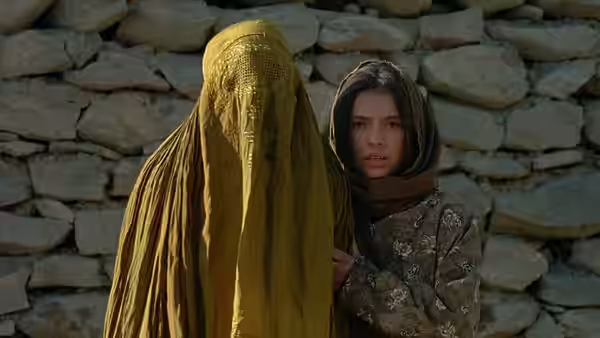
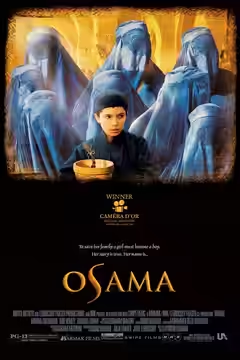
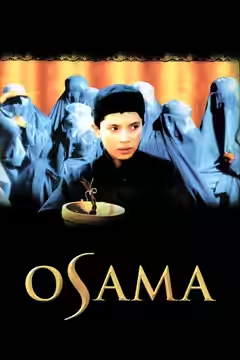
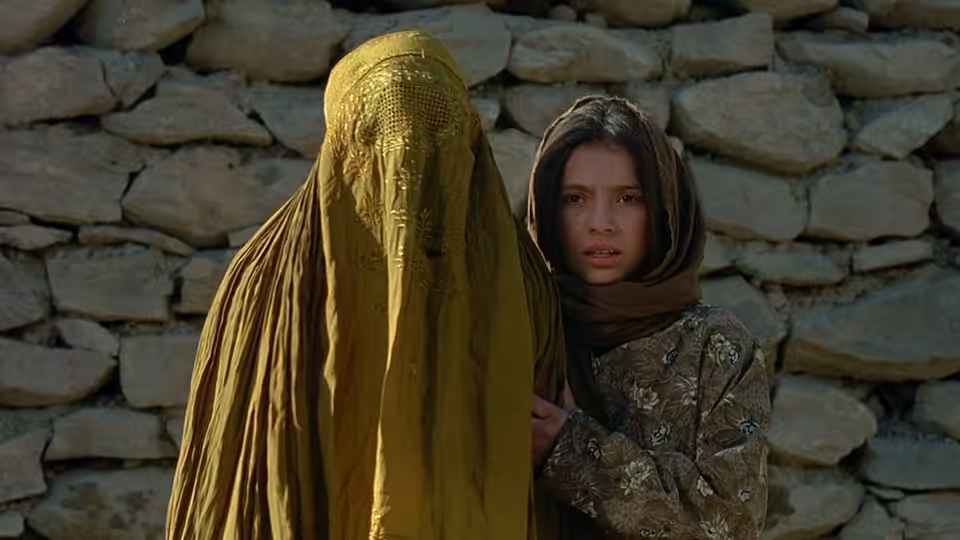
Osama (Marina Golbahari) stands beside a woman in a golden burqa against a stone wall
Film review

Osama

2004 · Directed by Siddiq Barmak · 1h 23m

In a sentenceA girl must pass as a boy, and we kept wishing the film would let her be a child

Osama (Marina Golbahari) is a girl who must become a boy to save her family. Mother (Zubaida Sahar) and Grandmother (Hamida Refar) are among the people bound up in that decision, while Aspnadi (Arif Herati) also figures in her story. For the girl, protecting her family means concealing that she is a girl and persuading others to accept her as a boy. The task makes her responsible for helping her family while keeping her own identity hidden from the people around her.

Fi1m review

Siddiq Barmak’s drama makes a child’s forced disguise troubling, and Marina Golbahari gives us reason to care. The writing leaves too little room for the girl beyond her family’s need of her.

Osama is a distressing drama with a forceful premise and a rather narrow sense of its central character. To save her family, a girl must become a boy: writer-director Siddiq Barmak puts a child’s identity under pressure before she has much chance to establish it for herself. The situation commands attention, and the film has enough feeling to warrant an evening for those drawn to the subject. Our reservation is how thoroughly the girl’s predicament comes to define her.

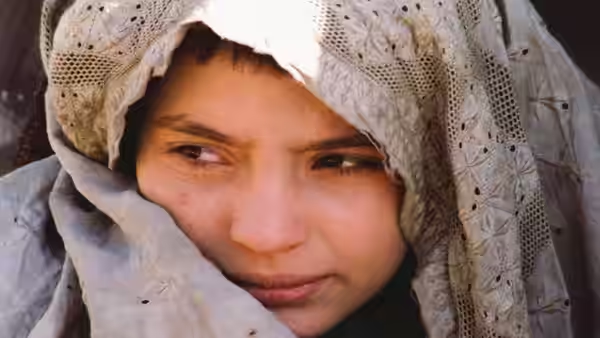
Marina Golbahari carries the title role, and much of the film’s value lies in our concern for her. We found the obligation placed on this girl upsetting: she is being asked to protect her family by concealing who she is. That is a cruel reversal of what a child should be able to expect from adults. Golbahari makes the responsibility feel too large for the person carrying it, without requiring us to mistake endurance for maturity.

Zubaida Sahar’s Mother and Hamida Refar’s Grandmother make the family more than an excuse for the disguise. Their presence gives the girl’s task a human purpose, and prevents us from treating her change of identity simply as an exercise in suspense. Yet Barmak’s writing gives need so much importance that other qualities struggle to register. We understand the family’s dependence on the girl, but have too little opportunity to consider what she might want for herself.

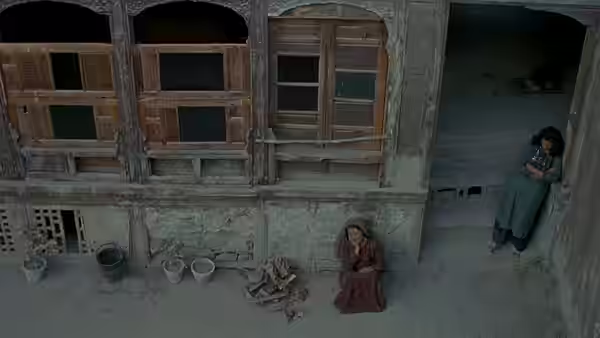
Ebrahim Ghafori’s cinematography and Akbar Meshkini’s production design give the drama a convincing physical presence. The girl’s need to be accepted as a boy gives her appearance enough importance already, and their work does not distract us from that. We are chiefly occupied with how others might see her. That is useful for suspense, but it leaves us wanting more of what she thinks and notices for herself, beyond the practical business of maintaining a disguise.

Siddiq Barmak also edits, and the 83-minute running time is welcome. There is discipline in keeping such a severe premise this compact, though the emotional pressure becomes wearing. Mohammad Reza Darvishi’s music contributes less to our unease than the obligation imposed on the girl, which is troubling enough without assistance. The chief difficulty could not be solved by a cut or a musical cue: the writing needs to give her qualities that have nothing to do with her family’s requirements.

Films about children under pressure need to leave some room for childhood, even when the circumstances offer little of it. Osama earns sympathy readily, but its tight concentration on the family’s need makes our acquaintance with the girl feel incomplete. Golbahari holds our concern even as the writing keeps her within these narrow limits. If the premise speaks to you, her performance is reason enough to consider it; expect a constricted, demanding evening.

Critical consensus AI synthesised

1 of 6
Positive
0
Mixed
1
Negative
0
Screen Daily
22 October 2003 · Lee Marshall
64*

The accessible page does not reveal the critic’s verdict or any specific praise or criticism. The review text is behind the publication’s access wall.

Read the full review →

Straight answers AI written, from our review

Is Osama worth watching?
Osama is worth considering for Marina Golbahari’s performance and its troubling premise, though we score it 64 for writing that gives its central girl too little room beyond her family’s needs. We find the responsibility placed on her upsetting; this suits viewers drawn to demanding drama who can accept a narrow account of the child herself.
How long is Osama, and what is it rated?
Osama runs 1h 23m. It is a drama film.
Where can I watch Osama in Chile?
Osama is not on any streaming or rental service in Chile at the moment. It is available in 2 other countries; change your country at the top of the page to see where. Availability is checked daily.
How does Osama compare to Wadjda?
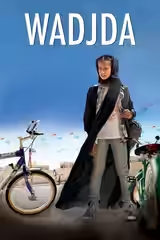
Osama is the more severe drama; we recommend Wadjda more readily for its humour and fuller sense of a girl’s own wishes. Both concern children facing adult restrictions, but Wadjda centres on wanting a bicycle, while Osama makes its girl responsible for protecting her family through disguise, leaving less room for her personality.
What should I watch after Osama?
After Osama, try Wadjda (2012, Fi1m 80): A girl’s wish for a bicycle meets restrictions imposed by adults. Then The Breadwinner (2017, Fi1m 84): An animated treatment of a girl supporting her family under Taliban rule; and The White Balloon (1995, Fi1m 87): A child’s small errand receives patient attention and carries unexpected anxiety.

Cast

Awards

International Submission to the Academy Awards, 2004

Nominated
International Submission to the Academy Awards

If you liked this, try…

  1. Wadjda (2012, Fi1m 80)A girl’s wish for a bicycle meets restrictions imposed by adults.

  2. The Breadwinner (2017, Fi1m 84)An animated treatment of a girl supporting her family under Taliban rule.

  3. The Circle (2000) · not on Fi1m yetWomen navigate restrictions that turn ordinary journeys into dangerous undertakings.

  4. The White Balloon (1995, Fi1m 87)A child’s small errand receives patient attention and carries unexpected anxiety.

  5. Moolaadé (2004) · not on Fi1m yetA woman’s protection of girls brings her into conflict with village authority.